MAIDEN VOYAGE
Book and lyrics by Mindi Dickstein
Music by Carmel Dean
directed by Tara Overfield Wilkinson
Southwark Playhouse Elephant, London – until 23 August 2025
running time: 95 minutes no interval
https://southwarkplayhouse.co.uk/productions/maiden-voyage/
Shows and films, let alone musicals, about women excelling in activities usually associated with men are hardly common, especially when mounted by predominantly female creative teams. Therefore, it was dismaying, ahead of seeing it, to note the muted critical response to this heartfelt, imperfect but mostly seaworthy new tuner premiering at Southwark Playhouse.
I’m not suggesting for a moment that shows should be praised when they’re undeserving, but, watching this, it felt that the often unfavourable response was surprising given, when considered as a whole, how much there is here to enjoy. The musical revisits the true story of yachtswoman Tracy Edwards (a superb Chelsea Halfpenny) who in 1989 skippered the first all-female crew, on a refurbished vessel christened ‘Maiden’, in the Whitbread Round The World Yacht Race, finishing second. It’s an inspirational story about overcoming the odds and confounding other people’s expectations, not typical fodder for a musical treatment, but Tara Overfield Wilkinson’s muscular, dramatic production works wonders to theatricalise it.
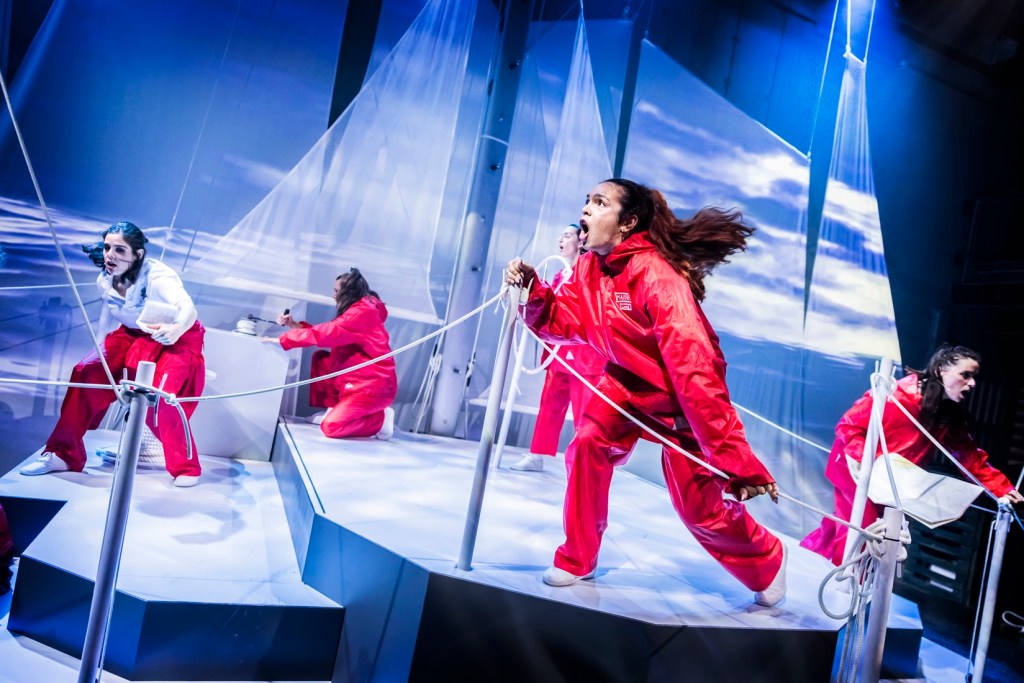
Visually, it’s rather splendid. The set is a series of platforms, ropes and screens that gradually, excitingly takes the shape of a boat as the performance progresses. Jack Baxter’s video design conjures up serene waters then a roiling, turbulent sea beneath dark cloud-scudded sky in a thrilling, terrifying storm sequence (further enhanced by Dominic Bilkey’s sound and Adam King’s lighting design, both contributions vivid and ingenious). Overfield Wilkinson choreographs as well as directs, and has her cast sliding, staggering and pitching to simulate being at sea in extreme conditions. This is boldly effective, imaginative theatrical storytelling of the highest order and, in all honesty, it’s more effective than the actual material.
Mindi Dickstein’s book has a tendency to hurl information at us without much nuance or flair, but moves swiftly and captures the excitement of the race, and the determination of the racers. Characters ranging from King Hussein of Jordan, an early mentor for Tracy, to our heroine’s concerned mum, to chauvinistic pundits and journalists, pop up to hasten the story along but neither they nor the dozen women crew are presented as little more than sketches. It gets a little repetitive, but that isn’t inappropriate given how much of the show features the day-to-day seafaring lives of these women.
The structure feels a little off as the piece really takes its time with establishing the personal and professional challenges Edwards and colleagues endure in pursuit of their dreams but then ends abruptly, as though the authors suddenly remembered that the show is only supposed to last ninety minutes. A dialect coach might have been advisable too, as a couple of the accents from the international sailing team are alarmingly non specific. If all this ultimately matters surprisingly little, that’s thanks to the commitment of a talented cast, Carmel Dean’s frequently rousing songs, and the bravura low-tech ingenuity of Overfield Wilkinson’s staging.
Dean’s music fares better than the book: it’s a surging, intermittently soaring tapestry of sound that invokes sea shanties, folk and pop, elevated by gorgeous, strings-heavy orchestrations by long term Sondheim collaborator Michael Starobin. All the singing is strong and the complex vocal harmonies are stunning (Dean also did the vocal arrangements).
Halfpenny is wonderful, making Tracy simultaneously unassuming, hard-edged yet appealing. There’s real affection in the relationship portrayed between her and best mate Jo (a winning Naomi Alade). The team of international women who join them on their epic journey aren’t particularly fleshed out in the writing but the ensemble do a lovely, spirited job of bringing them all to life. Juliette Artigala, last seen as Cosette on the stunning non-replica Les Mis at Paris’s Theatre du Châtelet, makes a particularly strong impression as a French sailor learning English from a phrasebook to connect with her fellow crew, and Sam DeFeo, despite an inconsistent accent, makes a creditable professional debut as a brash, humorous New Zealander determined to find fun amongst all the travails.
The writing for the men is even less robust but the performances are potent and effective. Daniel Robinson offers a delightful study in benign neurosis as one of the team’s biggest supporters. There are shades of Jason Robert Brown’s Parade in the sequences where male pub drinkers and newspaper personnel make acidic snipes and misogynistic observations from the sidelines.
Ideally, Maiden Voyage needs another workshop to be fully satisfying but, even in this iteration where the production and performances seem stronger than the actual work itself, it’s refreshing to see an ambitious new tuner willing to tackle subjects and situations outside the typical remit of musical theatre. It’s not a world beater yet but this is an admirable initial cast off.


 ajhlovestheatre