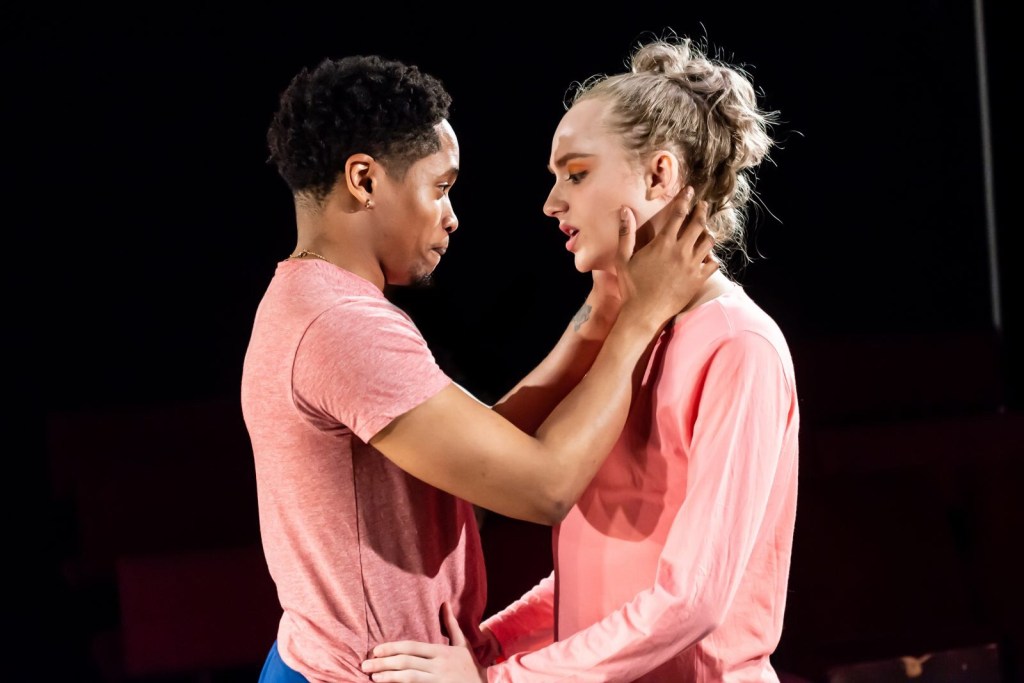
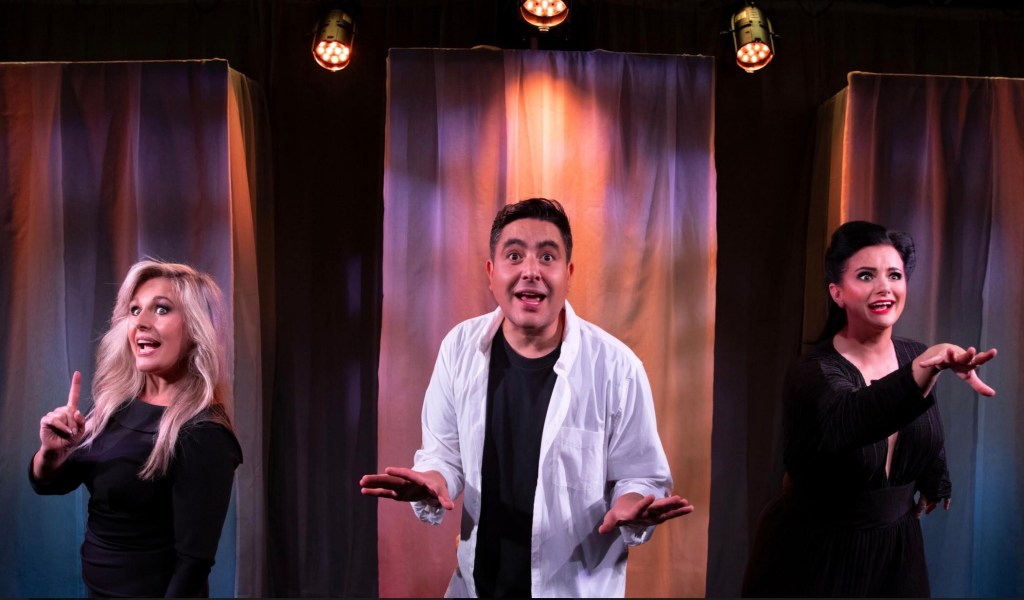
The gay attitude to monogamy isn’t particularly original dramatic fodder, but Shaun Kitchener’s engaging comedy of bad manners feels truly fresh in at least one way: he has created a life-loving, fragile but fun gender fluid character called Parker (winningly played by Matt Greenwood) and not made them the sidekick, the “you go, gurrrl” best friend, but instead placed them right at the epicentre of some pretty sticky sexual/social shenanigans. It’s never clear whether or not Parker is a master manipulator which in turn imparts a potent dose of extra interest into what is an eminently watchable, if not otherwise particularly original, script, the centrepiece of the Kings Head 2021 Queer Festival.
Parker and their sexy, sullen-at-first boyfriend Jamie (Imran Adams) are moving into a house share with uptight Taylor and friendly Riley (Jordan Laviniere and Chris Jenkins convincingly conveying the dynamics of a couple who have been together a decade), and things take a turn for the comic when Parker excitedly recognises Riley, now a successful insurance broker, as a former boy band member. If the plot that follows doesn’t exactly surprise, the relationship breakdowns sort-of do, to the point of slightly straining credulity. The characters are contemporary and crisply drawn.
James Callàs Ball’s production mines Kitchener’s text for all it’s comedy, pathos and slight shock value, and it is very well acted. Jenkins in particular does superb work as the fundamentally decent Riley, and impressively, affectingly charts his descent into disillusionment and fury. Adams’s Jamie stays strangely unknowable but entirely plausible, and amusingly contrasts with the judgemental but fascinated-despite-himself Taylor of Laviniere who, at least at first, has a lot of trouble getting his head around the sexually open nature of his new lodgers’ relationship. Greenwood gives Parker a brittle, vital edge that hints at untold reserves of hurt but also strength, and a slight tang of danger.
All That may not be a modern gay classic, but it’s an enjoyable, thought-provoking slice of Queer life with a whiff of authenticity and a spiky wit that make it well worth ninety minutes of your time.
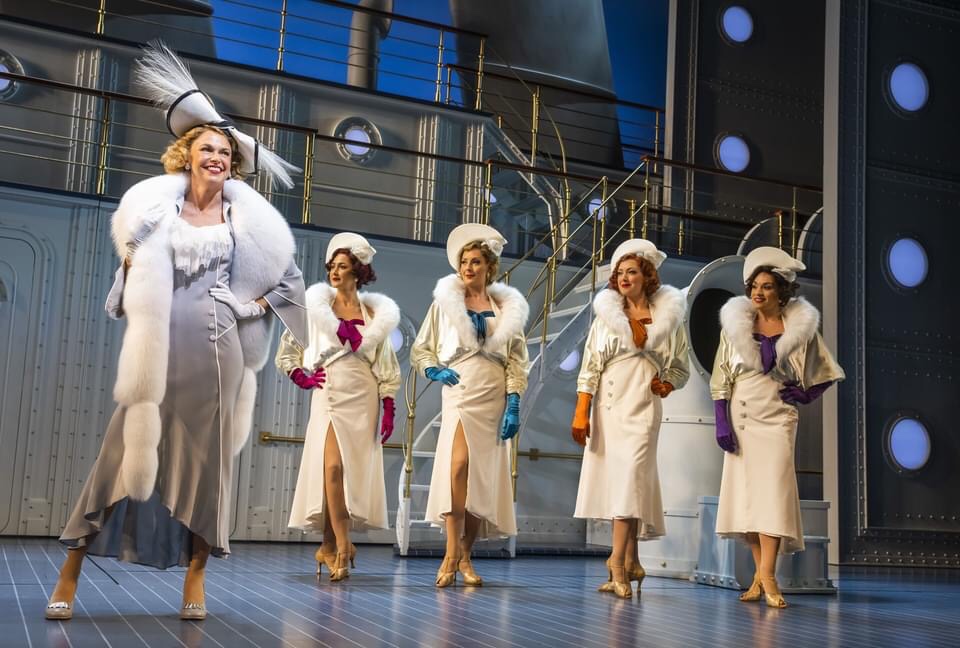
“Musical comedy, the most glorious words in the English language!” bellows big shot Broadway producer Julian Marsh at a climactic moment in that quintessential backstage musical 42nd Street. It’s a preposterous claim of course but after encountering this delightful, transporting revival of Cole Porter’s Anything Goes, now ensconced at the Barbican, it’s hard not to agree with him. This is the kind of show, and production values, that helped create Broadway’s reputation as the ultimate musical theatre wonder factory. A madcap farce set on a luxurious Transatlantic cruise ship, it’s as slick as oil, camp as Christmas and as joyous as a rabble of Labrador puppies.
Anything Goes is hardly an unknown property: although it dates from 1934 when Ethel Merman first blasted “I Get A Kick Out Of You” , “You’re The Top” and the title number across Manhattan, there have been at least three London revivals, the most recent being the terrific 2002 National Theatre staging by Trevor Nunn with an on-fire Sally Ann Triplett as brassy cabaret singer/unlikely evangelist Reno Sweeney. This Barbican staging was first seen to great acclaim in New York in 2011, but it couldn’t have come at a more welcome time for a pandemic-exhausted London. As with Hairspray and Joseph, both also enjoying never-better remountings in the West End, what stuns most right now about this happiest of shows is just how damn moving it is when the joy really kicks in. It’s like medicine for the spirit.
Well, that’s the second most stunning thing actually….. the predominant one is Sutton Foster as Reno, giving the kind of performance musical theatre students should go and watch as part of their curriculum.
Adorably goofy one moment and implacably elegant the next, she is the living embodiment of the idea of somebody having “funny bones”: her performance is a rare combination of inspired clowning, exhilarating belting and sheer old fashioned razzmatazz stage presence, all the stuff of which theatregoers memories are made. It’s also heartwarming to note her onstage generosity to her co-performers, owning the spotlight but joyfully willing to share it. She repeatedly finds that elusive musical theatre ‘sweet spot’ where a character expresses themselves through dance and song because that is the only way they can express themselves. It’s both heightened yet rooted in a euphoric reality, and it’s a rare pleasure to behold. She won a Tony for this role on Broadway a decade ago, she’s even better in it now.
There’s always a danger, when the headlining turn is as captivating and magnetic as this one, that the star is missed whenever they’re off stage, and it says much for the quality and talent of the rest of this magnificent company that this doesn’t even prove to be the case here. Robert Lindsay brings a gorgeous, James Cagney-like swagger to gangster Moonface Martin and comes pretty close to stealing every scene he’s in, or at least he would if his co-stars weren’t such dazzling pros as Gary Wilmot as a permanently drunk Ivy League money man and Felicity Kendal as a clueless socialite, hell bent on betrothing her daughter (a luminous Nicole-Lily Baisden) to the wealthiest possible match.
Samuel Edwards skilfully negotiates the thin line between cocky and confident and makes an attractive triple threat male lead. Carly Mercedes Dyer and Haydn Oakley are flat out sensational as, respectively, a hilarious, man-eating gangster’s moll and an adorably buffoonish English aristocrat, bringing the house down with their individual numbers.
There has been some grumbling about the high seat prices but from Derek McLane’s gleaming ship setting to some of the most opulent costumes (by Jon Morrell after the late Martin Pakdeniz) to grace a London stage in many a year, you can really see where your money has gone. Broadway veteran Kathleen Marshall directs and choreographs with such showmanship and panache that you’ll have trouble wiping the grin off your face. When the whole company rips into the title song led by the thrilling Ms Foster, it’s like tap dance heaven. The second act showstopper “Blow Gabriel Blow” even out-tops that, it’s utterly glorious.
Just cannot recommend this highly enough, it’s a life enhancing triumph and you should do whatever it takes to get a ticket…I can’t wait to go back.
If you go and see this -and if you’re interested in musical theatre as an art form then you really really should- then you may want to take tissues…. a whole bunch of them actually, as there are likely to be tears. Many tears in fact. Although it couldn’t be more different in scale and ambition, this engrossing chamber musical scored by one of America’s most interesting but underrated composers, Andrew Lippa (best known here for The Addams Family, touring again shortly) packs an equal emotional punch to any of the traditionally ‘weepy’ shows such as Les Mis or Rent. Or at least it will to anybody who’s had a sibling, borne a child, fallen out with a family member, or suffered a loss.
Beyond raving about the note-perfect cast (Rachel Tucker and Lewis Cornay, and it’s hard to imagine anybody else inhabiting these roles) or Guy Retallack’s terrific, truthful staging which strikes an exquisite balance between showy, naturalistic and inventive, or Lippa and Greenwald’s surging score -only intermittently melodic perhaps but never less than expressive- finely played by Chris Ma’s superb, string-heavy quartet, it’s difficult to recommend this too overtly without spoiling the story. Set across decades, it begins as a touching tale of smalltown American Jen and her fractious but loving relationship with her much younger brother John in the face of a troubling family background.
So far, so simple, but what unfolds becomes a quietly fascinating look at the timeline of US history from the 1980s to the present day (the original New York production set the show between the 1950s to the 1990s, but the update here is seamless) taking in the ‘endless war’ in the Middle East, 9-11, even the pandemic, all charted against a deeply intimate story of the effect two contrasting siblings have on each other. It’s also about the deep bond between a mother and child, and the dangers of bringing the expectation of past familial tensions to bear on younger generations. It’s ingenious and involving, but never feels heavy handed, even in a bizarre second act Game Show send-up where two of the lead characters air their grievances to a baying crowd. Here the sheer aplomb and accuracy with which Cornay and Tucker nail the TV genre deflects attention from the fact that it’s quite a radical departure from the main, rich meat of the piece.
Given her impressive musical theatre track record on both sides of the Atlantic, it’s hardly a surprise that Tucker sings this rangy, challenging score with fearlessness and an exhilarating soprano-edged belt, but it’s her acting that proves the real knockout here. She moves so convincingly from wide-eyed youngster to impassioned radicalism to early middle aged American Mom, that you almost forget it’s the same actress, although it is very much a consistent portrayal of a flawed but lovable young woman. Her innate warmth and relatability have seldom, if ever, been shown off to such powerful effect as they are here. Try and forget the look on her face when she realises that her beloved younger brother is on the brink of going off to fight in a war she is so passionately opposed to, or watch her physicality break open in her cathartic, healing 11 o’clock number, the stirring “The Road Ends Here”. She’s utterly brilliant.
Lewis Cornay matches her every step of the way. He spends more of the show playing a child but does so endearingly, with absolute wit and economy, never once tipping over into the panto-like excesses some grown-up actors are prone to when playing a pre-teen. A superb comedian, Cornay also makes chillingly convincing the sequences when he turns on his idealistic sister. It’s a very accomplished performance.
It’s highly likely that Rachel Tucker will return to the New York production of Come From Away to resume ripping the roof off the Schoenfeld Theatre when Broadway reopens this autumn, and Lewis Cornay deserves to be heading for great things: don’t miss the chance to see them up close and together in this extraordinary little-but-mighty musical, their chemistry is magical. But don’t forget those tissues.
Originally released as an album in 2013, Drew Gasparini’s collection of songs charting aspects of youth and young adulthood from crushing hard to unwanted pregnancy with lots in between, has acquired cult status, exacerbated further during the last year by a much loved online presentation. On the basis of last night’s raucously well received concert version, it’s not hard to understand all the love.
Gasparini’s house style is like the love child of Jonathan Larson and Jason Robert Brown, with invigorating slugs of funk and soul thrown in for good measure. It’s rocky, mostly upbeat and pleasingly melodic. It’s also unmistakably American. There’s even an attractive, if slightly ponderous, meander into Country & Western with a lugubrious all male trio examining the motivations behind mass high school killings, not something one would necessarily expect to hear on a musical stage outside of the next Carrie revival.
For this one-off concert, producers Liam Gartland and Alex Conder (who, due to a last minute indisposition, actually performed, and did so rather superbly) assembled a formidable, diverse team of young singer-actors, representing the cream of young performing talent, some fresh out of college and a couple of rising stars who are already developing fan bases on a par with Gasparini’s. Flynn Sturgeon’s versatile, instrument-hopping six piece band are also hugely impressive.
All of the voices here are good, but a couple of them are astonishing. Billy Nevers sounds like a bona fide soul star and brings real warmth and vulnerability alongside the fiery vocals. Luke Bayer’s gorgeous ringing tenor and charm to spare continue to cement his reputation as one of UK musical theatre’s most likeable young leading men, and Maiya Quansah-Breed’s sass and charisma light up the stage. Olivia Lallo and Ahmed Hamad bring real depth of feeling as well as terrific voices to one of the only sections of the show to have a through-narrative: an engaging young couple falling in love before an unwanted pregnancy brings on the angst and doubt.
Roxanne Couch and Caroline Kay display vocal power and versatility, and both sound like potential future Elphabas, for when Wicked is next recasting, and Callum Henderson brings some much needed comedy to the proceedings, again fielding a fine singing voice.
Richly enjoyable though most of the ICUAD songs are, the concert format does unfortunately render them a bit relentlessly samey by the end of almost two hours, as each one heads towards the same ear-splitting, full-throated conclusion, however magnificently managed by cast and band. This is a real belters paradise, but the overall effect becomes a little numbing, like watching endless rounds of very good audition pieces for a particularly overwrought new musical. The muddy sound design didn’t help, with well over half the lyrics rendered unintelligible when more than one person sang. The lyrics that I could make out though seemed heartfelt and incisive, if not particularly original.
There is so much talent here though, and it would be fascinating to see what a strong director, say a Luke Sheppard or a Jonathan O’Boyle or a Paul Foster, could do to hammer the material into a coherent theatrical shape. As it is, I went straight home and sought out Drew Gasparini on Spotify.
Here it is then: the last offering in this truly excellent season of new writing, and I for one will be extremely sorry to see it end. Far and away the worst thing about producer Sonia Friedman’s inspired initiative to give new/new-ish writing an auspicious West End start is how short the runs are…. just three weeks for each production. I guess the plays were unknown quantities so maybe the thinking was that if one or all of them had been unmitigated disasters then at least the casts wouldn’t be staring out at empty houses for too dispiritingly long a period of time. Of course, that did not happen though – I mean, Sonia does have form: Leopoldstadt, Harry Potter & The Cursed Child, Our Ladies of Perpetual Succour – and we’ve been treated to a diverse trio of sparkling, exciting new pieces any of which would have looked like an oasis of theatrical achievement even in an artistic landscape considerably less barren than the one we’re currently facing post-pandemic.
Inspired by the real life case of ‘fake heiress’ con-woman Anna Sorokin who was convicted of grand larceny after running financial and social amok in mid 2010s Manhattan, Joseph Charlton’s Anna X is an ultra-modern morality tale. It’s a breathless but steely meditation on the fragility of the ‘virtual world’ and the ease with which it facilitates dishonesty and disengagement. The two actors – The Crown’s Emma Corrin and Nabhaan Rizwan, both excellent – portray not just icy Anna and her eager-to-please but cocky “new millionaire” quarry Ariel, his wealth deriving from the creation of a high end, eye-watering lot elitist dating app, but also everybody else who enters their orbit.
Anna passes herself off as an art curator, so it feels appropriate that Daniel Raggett’s flashy, punch staging (Mikaela Liakata and Tal Yarden’s set and projection designs are genuinely dazzling) feels as much like an art Installation as it does a conventional theatrical production. Like the acting performances, it is effortlessly cool and technically flawless, and, in all honesty, probably more remarkable than Charlton’s gripping but occasionally pedestrian script, though it takes a certain amount of chutzpah to create a play where both of the protagonists are essentially so unlikeable.
Few will care, I suspect, preferring to luxuriate in the shimmering, transformative visuals, the pumping soundtrack (sound design by Mike Winship), and the bursts of biting wit. It may be my least favourite of the Re:Emerge Season but it’s still a scintillating way to spend eighty minutes, skilfully evoking the excitement yet increasing dehumanising of global cities as electronic online living threatens to supersede actual lived existence. I’m keeping everything crossed that in the not-too-distant future, this, Walden and J’Ouvert each get extended return engagements. They all deserve it.
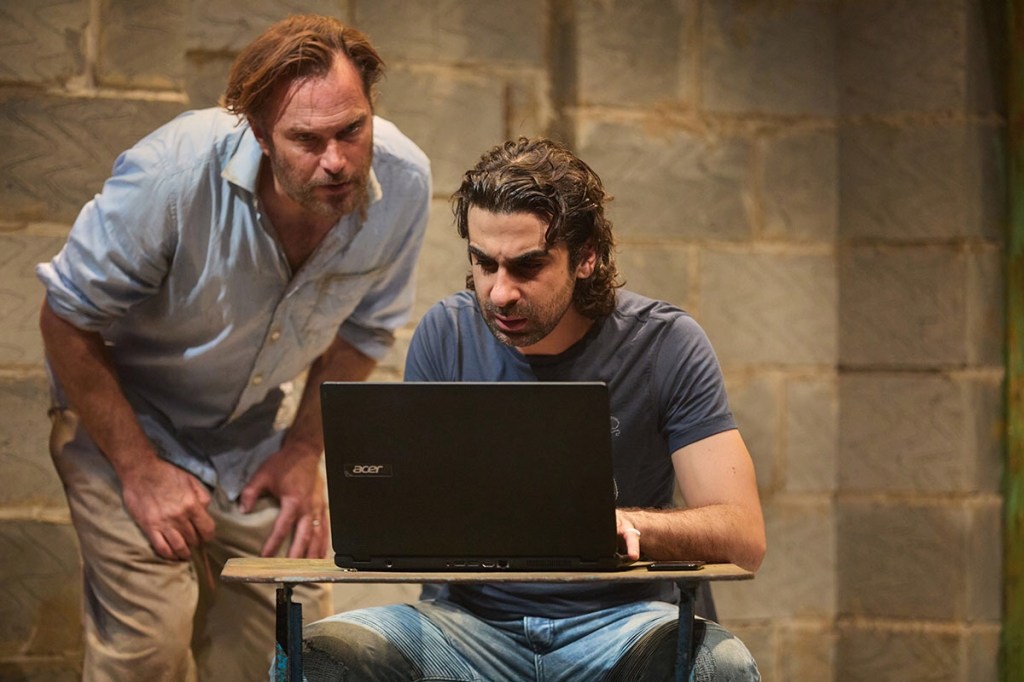
It may only have four actors on a single set, but Ayad Akhtar’s engrossing, explosive piece feels very much A Big Play. A New York-based Pulitzer Prize winner with Pakistani heritage, Akhtar would seem better qualified than most writers to explore simultaneously the corrosive effect of American influence on less affluent countries, the dangers of extremism, and the damage corporate greed can inflict. That he has done so in a fiery, gripping script peppered with nuggets of jet black humour and some moments of genuine shock, is cause for real celebration. It’s not hard to see why this was one of the hottest tickets in town during its first run at the Kiln’s previous incarnation, the Tricycle, back in 2016.
Set entirely in a dingy, bunker-like cell in Pakistan where affluent Citibank trader Nick is held captive by a forceful but disorganised bunch of militants (they thought they were kidnapping his boss) who force him to work out his incarceration by stock market trading for them to the tune of the $10 million they are asking for his ransom. It soon becomes clear that nobody’s motives are entirely pure -within the militia group, personal financial gain locks metaphorical horns with the desire to better the lot of the community, while Nick isn’t without his flaws- and Indhu Rubasingham’s terrific production plays out as a sort of cross between an unusually engaging think piece and a balls-to-the-wall political thriller.
The acting is magnificent ….and occasionally surprising. When Scott Karim initially swaggered on as mouthy, London escapee, and Nick’s most violent captor Bashir, I admired his energy but thought we were about to be treated to a somewhat one-note performance. Not so: Karim finds the pain and a number of tics and inadequacies beneath the bravado, and ends up turning in a compelling portrait of toxic masculinity at odds with a genuine desire to do good. He is also very very funny.
Similarly, Sid Sagar as the most initially sympathetic captor, also the one at the lower end of the food chain, brilliantly suggests a spark of resistance and independent thinking, that is progressively extinguished as the story progresses. Always a powerful stage presence, Tony Jayawardena utterly convinces as an urbane, impeccably mannered Imam capable of sudden moments of molten fury and unsettling cruelty. Daniel Lapaine’s visual and spiritual disintegration as the increasingly desperate Nick is so superbly done it becomes painful to watch.
The technical elements in the production, but especially Oliver Fenwick’s toxic, jaundiced lighting and Alex Caplen’s unsettling sound design of drones thrumming overhead just before another horrifying explosion, help immeasurably in ratcheting up the tension. Rubasingham’s slick but spiky, beautifully modulated staging ends on a note that is at once terrifying and ambiguous, also potentially slightly different from that of the published script, and I would love to discuss it further but that would involve spoilers. So, you should just go and see it for yourself.
Akhtar actually won his Pulitzer for his 2014 piece Disgraced, which was one of the Bush’s first plays in their forever home, but The Invisible Hand is every bit as good: fascinating and fiercely intelligent. It stays with you long after the final firecracker moments, and you’ll be discussing it all the way home.
Although this show and it’s sister revue Closer Than Ever are beloved of musical theatre aficionados, the classy song-writing team of Maltby & Shire has never created a true blockbuster. True, Richard Maltby Jr co-wrote the lyrics to Miss Saigon, but the duo’s joint forays into Broadway musicals have been modestly successful at best (Baby, Big The Musical). Watching this engaging song cycle in the intimate confines of Waterloo East makes one wonder if the reason massive main stream success has eluded them is that their work is too delicate and conversational for such a bombastic art form as the big Broadway musical.
There are moments of razzmatazz and exuberance for sure, but the main impression left by these often enchanting, attractively melodic numbers is of snapshots – some humorous, some heartfelt, mostly romantic – of urban lives in varying states of regretful flux or joy; even at it’s darkest the tone is more of gentle melancholy than heart-on-the-sleeve despair. There’s a wonderful number about a literary know-it-all coming to terms with the fact that her competitiveness while doing, of all things, the New York Times crossword is the root of her perennial loneliness. Or another, the rollicking samba-esque ‘I Don’t Remember Christmas’ where a litany of memory-evoking objects signals that a cast-off lover is some way from being over his ex, despite all his protests to the contrary. There’s a wit and a lightness of touch about the work that makes it perfect for the often underrated art form of revue, especially when performed as it is here by a likeable, golden voiced trio, accompanied by a superb musical director (Inga Davis-Rutter).
The neurotic fizz of the material is pure New York and it’s slightly diluted by the decision to have the cast perform some of the show in their native accents but other bits of it in the American accents that feel more suitable. The musical staging and ‘bits of business’ could be sharper and more focussed, Gerald Armin’s production really coming into it’s own when the cast are front and centre, finding the quiet intensity or rueful comedy in the songs.
Gina Murray is glorious: a magnetic comedienne with a lot of heart, and a silky, gorgeous voice that occasionally opens out into a thrilling belt. Nikki Bentley finds an effervescent joy in her lighter moments but also an affecting depth in a couple of the ballads, delivered in a supple, versatile vocal that combines sweetness and power. Noel Sullivan is a lot of fun, and also in possession of a fine voice, although he wasn’t fully on top of his lyrics the night I saw it, resulting in some unfortunate corpsing.
First seen in 1977, the peppy, fundamentally optimistic ‘Today Is The First Day Of The Rest Of My Life’ (yes that’s an actual lyric) outlook of the show feels very much like something from a bygone, less cynical era. Other aspects however, such as an intelligent attitude to bruised human feelings or some moments of authentic joyfulness, are timeless.
These are immaculately crafted theatre songs, each one almost a mini-play all by itself, and this is a welcome opportunity to experience them while basking up close (with full Covid safety measures in place, of course) in some terrific world-class talent. The show won’t rock anybody’s world but it’s a very nice time.
Thanks to Broadway master showman Bob Fosse who directed and choreographed the legendary original production, Pippin was perceived for decades as a deathly commedia dell’arte carnival: a troupe of sinister but sexy players bring to anachronistic life the mythical story of Pépin, the wayward, questioning son of medieval emperor Charlemagne amidst flamboyant production numbers, lyrical ballads, clever patter songs and culminating in a bittersweet, unsettling finale.
Although there have been other takes on it, none of them really stuck until Diane (Waitress, Jagged Little Pill) Paulus’s rapturous 2013 New York revisal which turned the whole thing into a spectacular, slightly alarming circus. For this version, based on a smaller scale outdoor mid-pandemic mounting from last year, director Steven Dexter has gone right back to the show’s 1967 hippie roots (before Fosse got his splayed, angular hands on it) and the result is a couple of hours of whimsy and delight, albeit still with a certain amount of kick, that may surprise people who think they have a handle on Stephen Schwartz and Roger O. Hirson’s endlessly malleable show.
Wandering into Charing Cross Theatre’s traverse auditorium one could be forgiven for thinking we were about to be treated to an immersive revival of Hair when confronted with David Shields’s attractively chaotic set, and it’s fug of incense, rainbow tie-dyed sheets, hanging dream-catchers and abundance of dangling fairy lights. It’s like being at an outdoor festival during the Summer Of Love, yet ironically feels way more airy and atmospheric than when the earlier incarnation of this staging actually WAS outdoors, admittedly having to compete against the roaring traffic and street sounds of Vauxhall. There’s also real magic derived from Aaron J Dootson’s transformative lighting design.
Stephen Schwartz is the composer and lyricist of Wicked but Pippin is a more exciting and consistently melodic score. From the sparkle of the enchanting opening number ‘Magic To Do’ which introduces the players and the principal themes (“illusion, fantasy to study / battles, barbarous and bloody / romance, sex presented pastorally”) through an appetising, lilting mix of numbers esoteric and poppy (Pippin’s melodic cri de cœur ‘Corner Of The Sky’ was even a Jackson 5 hit in the 70s), this score is a gem. The lyrics have wit and, at times, surprising depth.
If Hirson’s book is less clear -who are these players that alternately cajole, torment or seduce the emotionally and spiritually lost hero? does Pippin really assassinate his warmongering father or is that just in his unsound mind?- it has heart and genuinely works as a sort of portentous but affable Flower Power romp.
Ryan Anderson makes a wondrously athletic Pippin, and is likeable enough that the characters’s self-absorption isn’t a turn-off, and he negotiates the rangy demands of Schwartz’s wonderful but technically tricky songs with considerable panache. The Leading Player is the killer role though (in more ways than one) and has been performed by men and women. Here Ian Carlyle brings a breezy charm that curdles into something more troubling as the evening progresses. He moves like compressed liquid and sings up a storm, although the darker elements of the role could do with being amped up several notches: this Leading Player ends up feeling like a bully, but to really drive the piece he should be truly terrifying.
The three women in the company are flat-out stunning: Natalie McQueen brings a quirky manic energy but innate goodness to Catherine, the young widow Pippin takes up with, and makes something genuinely moving out of her exquisitely sung closing solo. Gabrielle Lewis-Dodson is a knockout as the hero’s ambitious, morally bankrupt step-mother, all flash, sass but dead-eyed stare. Genevieve Nicole, a thrilling, peerless Leading Player in Jonathan O’Boyle’s acclaimed Hope Mill and Southwark Playhouse version a few years back, comes close to stopping this show as Pippin’s rapacious-for-life grandmother, with the joyous but regret-tinged singalong number ‘No Time At All’. This role, like most of the others in the show, is open to a number of interpretations, but here Nicole conceives her as a sort of Park Avenue Grande Dame transplanted to rural hippiedom and living her best life, and the result is breathtakingly funny.
As Pippin’s father, step-brother and step-son respectively, Dan Krikler, Alex James-Hatton and Jaydon Vijn may have less to work with but prove terrific triple threats. Nick Winston’s choreography, unusually for a production of Pippin, feels more reminiscent of the long-limbed elegance of Gillian Lynne’s jazz-ballet fusions than Fosse’s more jagged work, but it’s consistently exhilarating.
The juxtaposition of showbiz razzle dazzle with existential despair that makes Pippin such a unique and compelling addition to the musical theatre canon is given shorter shrift than in other version I’ve seen but maybe after the sixteen months we’ve all had, this sunnier, sweeter interpretation is all we can cope with right now. It’s a shame also that the transformation at the end (no spoilers, go see it) isn’t more extreme. Still, even if it’s not as emotionally satisfying as it could be, this Pippin is still cracking entertainment.
Young Adult fiction is a beloved and lucrative literary genre. If there were an acknowledged theatrical equivalent – and if such a thing existed, it would have to include such crowd pleasers as Heathers, Loserville, Bare: A Rock Opera even possibly Six– then surely Be More Chill would be It’s apotheosis. Inspired by the late Ned Vizzini’s cleverly wrought maelstrom of teen angst and sci-fi, this cultish musical was something of a phenomenon during it’s initial off-Broadway runs where tickets were rarer than hens teeth, but then saw it’s reputation stall somewhat when it transferred unsuccessfully to the main stem, possibly as a result of the core late teen audience being unwilling, or unable, to pay Broadway prices.
The London production is a replica of the NYC original and had it’s season at The Other Palace cut short by the pandemic. Now it’s back for a summer run at the Shaftesbury where it fits snugly, striking exactly the right balance between anarchy and sincerity. More staid audience members may initially find themselves a bit bewildered by the neon-etched, hyper-kinetic blast of colour and snark that characterises this quirky slice of Americana, but look closer and Be More Chill is a surprisingly well made musical.
Joe Iconis’s tuneful, eclectic score, witty and bombastic, kicks off with a genuinely accomplished opening number, introducing hero, teen misfit Jeremy (played with charm but commendable lack of cuteness by Scott Folan), his equally off-beat best mate (Blake Patrick Anderson, delightfully nerdy), his widowed Dad, in too much despair to ever get fully dressed (lovely work by Christopher Fry), plus the whole milieu of small town American High School, and the various eccentrics who inhabit it. The music may be pop, but the storytelling is classic Broadway musical comedy. Setting the tone so vividly makes it easier to swallow the tall tale that follows in Joe Tracz’s peppy book: Jeremy discovers a tiny pill-sized computer called the Squip that, when ingested, makes it’s owner invincible. However, like Little Shop of Horror’s Audrey Two but without the viridity and indeed the eating of people, the Squip turns out to be hell bent on world domination.
Along the way, Iconis’s songs throw up some real gems, including a rollicking anthem ‘The Pitiful Children’ for the Squip reminiscent of the sinister joy of Glam Rock, a roof raising cellphone gossip number that is a modern homage to Bye Bye Birdie’s classic ‘Telephone Hour’ number, and a bona fide showstopper in ‘Michael In The Bathroom’, a glorious lament for socially anxious teens everywhere, delivered flawlessly by Anderson. Perhaps most surprising is the lyrical, haunting, almost Country & Western inflected finale ‘Voices In My Head’ which acquires authentic poignancy when one realises it is partly inspired by the fate of the original novel’s author Joe Vizzini, who took his own life in 2013.
The casting is terrific: Stewart Clarke makes a magnificent Squip, both magnetic and chilling, with a stunning voice and an irresistible malevolent energy, never more so than when leading the company in Chase Brock’s dynamic, angular choreography, the detached smirk permanently etched across his handsome face. Melody Chance hilariously imbues school drama queen Christine with an almost alarming intensity tempered with real sweetness and Millie O’Connell is deliciously funny as a top Mean Girl type. As her sidekicks, Renée Lamb and Eloise Davies even impressively find some vulnerability and depth under all the belting and attitude.
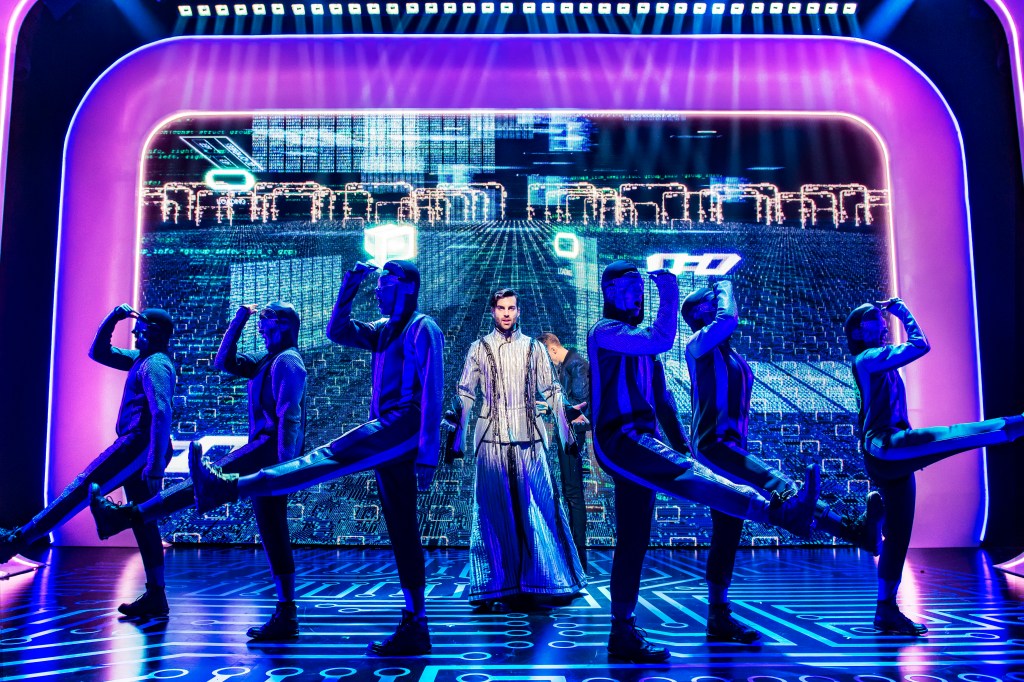
Performed entirely in Beowulf Borritt’s giant computer set, Stephen Brackett’s production is deceptively clever: for all the preposterousness and chaos, it is swift and clear, making intelligent use of Alex Basco Koch’s exhilarating old-school computerised images and Bobby Frederick Tilley’s agreeably outlandish costumes, while Brock’s dances feel fresh and original. Audibility can sometimes be an issue in rock and pop musicals but here Ryan Rumery’s sound design hits the theatrical sweet spot whereby the music is sufficiently loud as to to be truly rousing, but we catch every lyric.
Despite being very enjoyable, the frequently derivative script isn’t really top drawer – at it’s funniest it’s a bit like watching Avenue Q without the puppets – but the treatment of it most certainly is. Plus the second act, which contains the lions share of good songs, is rather stronger than the first, perhaps because this is where the show deviates most significantly from it’s source material and allows the musical to become it’s own beast. Ultimately though, it feels like a summer hit.
If you haven’t done your research, you might think that “gay plays” generally fall into two camps (no pun intended): either heartwarming, spiky but ultimately feel-good tales like Harvey Fierstein’s Torch Song, Jonathan Harvey’s Beautiful Thing and Robert Madge’s glorious, current My Son’s A Queer But What Can You Do, or hard-hitting recent-history AIDS dramas like the epics Angels In America and The Inheritance, and Larry Kramer’s searing The Normal Heart, soon to be revived at the National. All the more reason then to applaud this revival of Charles Dyer’s mid-‘60s piece first seen at the RSC, which presents something quite different.
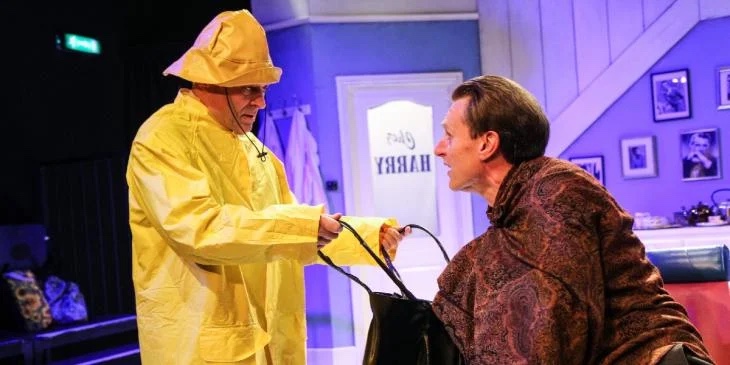
Part tragicomedy, part oddball thriller, and with a touch of melodrama, Staircase feels like something a Queer Harold Pinter might have come up with. Written and set before the decriminalisation of homosexuality in the UK, it’s about a gay couple who run a barber shop and one of whom is awaiting criminal proceedings having been caught in drag sitting on another man’s knee. Or is it? With tantalising ambiguity, Dyer suggests that all may not be as it seems with these two men, which would therefore mean that one of them -the playwright’s namesake, and played with preening panache by John Sackville- is even more of a troubled narcissist than we already imagine. It’s probably not fair to say any more than that for fear of spoilers for potential ticket buyers.
And buy a ticket you should as this is a genuine rediscovery. While the attitude that gay men are fundamentally compromised loners is (mercifully) an antiquated one, it is part of gay history, and Dyer expresses it with cracking, expressive, sometimes brutal dialogue, shot through with flashes of campy humour used as armour rather than real mirth. The sense of “otherness” and being a constant outsider that these men talk about rings very true, even as it unwittingly points up how far we’ve come. There’s also an eerie prescience when they talk about gay people having children of their own.
Tricia Thorns’s meticulous production also features a poignant, funny, strangely haunting performance from the always-superb Paul Rider as Harry, the gentle but acerbic proprietor of the tonsorial parlour (exquisitely realised in Alex Marker’s detailed, authentic set, complete with checkerboard floor, black and white headshots of bygone film stars, and hair-cuttings underfoot).
If not quite a lost classic, Staircase emerges, more than 55 years after it’s premiere, as a genuinely engaging, troubling period piece. Not sure when we’ll see it again, or indeed done as well as this, so therefore I would say hasten along.



 ajhlovestheatre