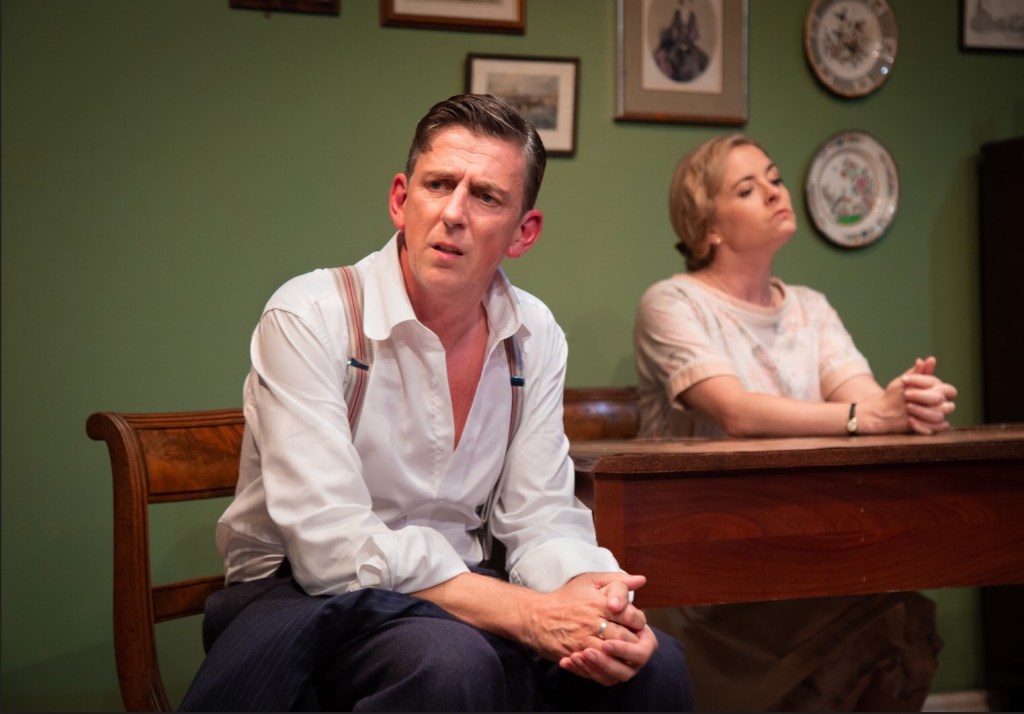
The Finborough has a rich and noble history of rediscovering lost dramatic gems, alongside their programme of new work (this year’s Bacon and Pennyroyal remain two of my favourite new plays since theatres re-opened post-pandemic), and Kate O’Brien’s family tragicomedy, seldom seen since it’s 1926 premiere, continues that line of programming. In all honesty, Distinguished Villa is a little clunky and unlikely to be turning up in the West End or at the National any time soon, but it offers a stimulating, emotionally engaging couple of hours in the theatre that has a surprisingly contemporary spin on subjects such as mental health and the limits imposed on women’s lives, which is remarkable considering that it is nearly a century old.
O’Brien’s play is set in the living room of the Hemworth family’s Brixton home (dubbed “Distinguished Villa” by approving neighbours) and is populated by a dramatis personae of satisfyingly vivid figures. Matriarch Mabel, in Mia Austen’s witty performance, is a socially mobile monster in a pinny, obsessed with keeping up appearances, endlessly bemoaning her fragile health -although she’s probably the most robust character on stage- and blithely unaware of the anguish of husband Natty (Matthew Ashforde, impressive in a complex role) who is clearly suffering from some sort of advanced but undiagnosed form of depression. Then there’s Gwendolyn, Mabel’s not-as-innocent-as-she-looks sister, a tantalisingly mysterious female lodger and a pair of contrasting gentlemen callers.
The somewhat meandering first half takes it’s time setting all this up: it’s perfectly watchable, thanks in no small part to the generally superb performances, but feels a little static, something which Hugh Fraser’s otherwise accomplished direction can’t do much about. The second act is more plot-driven and considerably more dynamic. An illicit affair, an unwanted pregnancy, a shocking tragedy and men behaving (very) badly: all these crop up, and if the transitions between themes and tones are sometimes ponderous, that’s a flaw in a play feels like a precursor to Noel Coward’s rather more disciplined This Happy Breed: O’Brien gives us beautifully crafted dialogue and especially compelling female characters, but can’t seem to make up it’s her mind if she wants Distinguished Villa to be a domestic comedy or an old fashioned melodrama.
Holly Sumpton is magnetic but unknowable as the elusive Frances, and Tessa Bonham Jones finds real emotional heft in younger sister Gwendolyn’s conflict and terror. Brian Martin is winningly ardent and skilfully negotiates some pretty clumsy writing as the young man torn between them. Simon Haines is hugely impressive as the urbane upper class gent who turns out to be a lot less charming and honourable when the mask slips. Ashforde handles Natty’s existential crisis with real compassion, and Austen is a spiky, nervy joy as his unloving Mrs. Mim Houghton’s gorgeously detailed set and Carla Evans’s costumes help root these figures in an entirely convincing historical period.
Ultimately, Distinguished Villa is no world beater but still has a certain resonance; whatever it’s flaws, it never prompts the thought, as some disinterred scripts tend to do, that there is a myriad of obvious reasons why it hasn’t been produced in decades. It’s certainly hard to imagine a better production of it than this one.
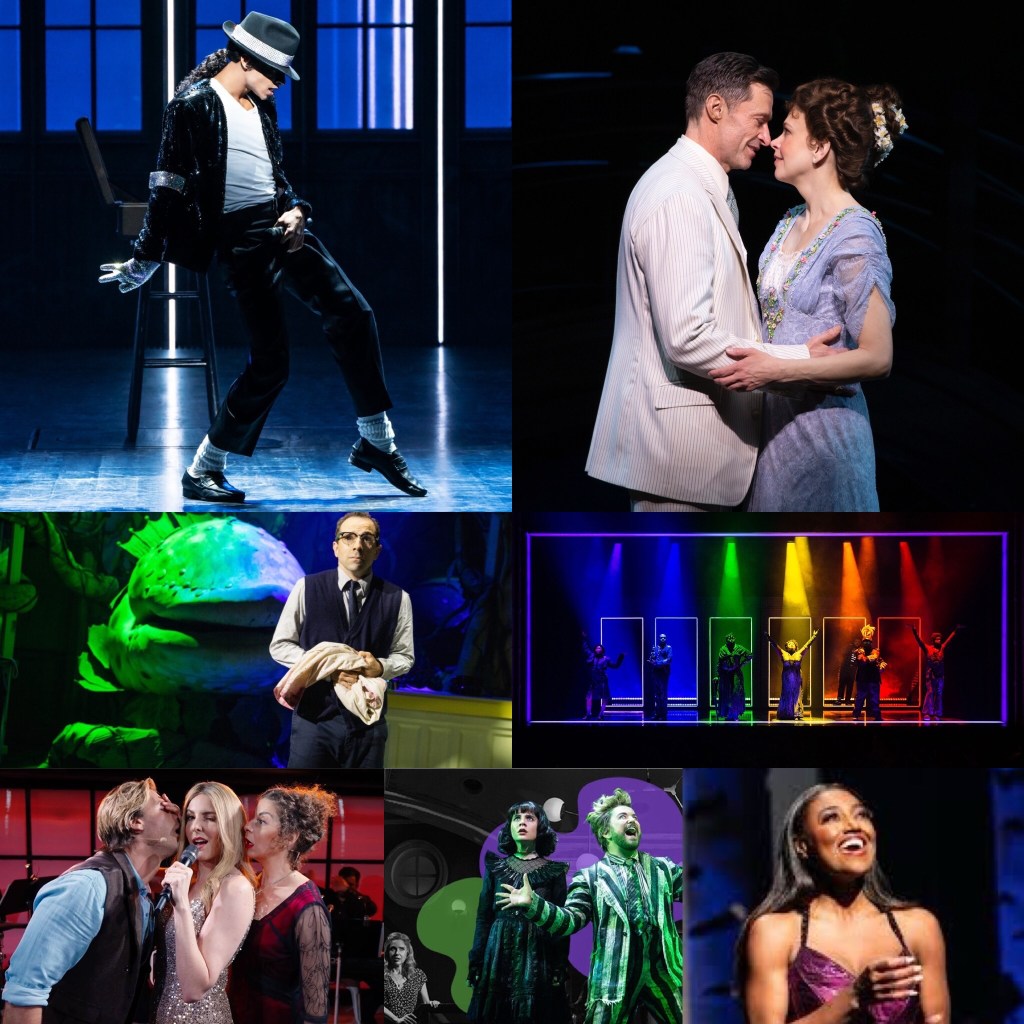
Photo credits: Myles Frost in MJ by Matthew Murphy; Hugh Jackman and Sutton Foster in The Music Man by Julieta Cervantes; Audrey Two and Rob McClure in Little Shop of Horrors by Evan Zimmerman; company of A Strange Loop by Marc J Franklin; Constantine Rousouli, Marla Mindelle and Alex Ellis in Titanique by Emilio Madrid; Kerry Butler, Elizabeth Teeter and Alex Brightman in Beetlejuice by Matthew Murphy; Patina Miller in Into The Woods by Matthew Murphy and Ethan Zimmerman
This being the first full summer post-shutdown when theatre on both sides of the Atlantic is back to something approaching normality, it’s interesting to look, from a UK perspective, at a couple of the New York musicals that we can hope to be hitting the London stage before too long. A small caveat to begin with though: while the West End is doing reasonably well (every theatre is occupied and with future tenants lined up, even though disappointingly few productions are regularly selling out), it should be noted that, at the height of the tourist season of 2022, Broadway has only twenty one shows playing. There are exciting things announced for the autumn/fall for sure, but it’s still remarkable to consider that, at time of writing, exactly half of the houses that constitute Broadway are sitting dark, and that, of those with shows, only two of them are hosting straight plays (both of which are London imports: The Kite Runner and the blockbuster Harry Potter & The Cursed Child, here streamlined into a briefer but equally magical single epic play, as opposed to the expensive two parter still on offer at the Palace).
Everything else on Broadway is a musical, ranging from the long running usual suspects (Wicked, Phantom, The Lion King) through classic revivals to a soaringly original new work that genuinely prescribes hope for the future of the genre. The biggest hit, but only likely to cross the Atlantic if it’s above-the-title star elects to come with it, is Hugh Jackman in The Music Man, a Jerry Zaks-directed revival of Meredith Wilson’s Broadway classic. Critics have been divided on the merits of both the production (attempts to water down the more unreconstructed aspects of this 1957 musical have met with some derision) and Jackman’s athletic central turn as confidence trickster Harold Hill, although generally everyone adored the leading lady (Sutton Foster, seen here to great acclaim in last summer’s Anything Goes at the Barbican). With star power like this, The Music Man will likely prove similarly critic-proof should it hit London: the piece itself may not be held in the same affection here as it is in the US, but, concerts aside, Jackman hasn’t appeared on the London stage since he starred in the National’s Oklahoma! back in 1998-9, and he has a massive fan base.
With Terry Gilliam and Leah Hausman’s opulently imaginative Into The Woods from Theatre Royal Bath allegedly eyeing a West End transfer, I guess the chances are little to zero of London audiences getting to see the other high profile revival this season, a semi-staged version of Sondheim and Lapine’s masterpiece featuring a full onstage orchestra and lightning-in-a-bottle casting, mixing Broadway veterans and debutants, all delivering career-highlight work. Some of the leads have just changed but Philippa Soo (Cinderella), Brian D’Arcy James and Sara Bareilles (Baker and Wife), Julia Lester (Little Red Riding Hood) and Patina Miller’s Witch, amongst others, found colours and nuances in the lyrics and characters that I had never encountered before in the half dozen other productions I’ve seen. The absence of decor and elaborate costuming in Lear deBessonet’s production only serves to highlight the sheer brilliance of the material. The Bath production is great fun, but this one is perfection.
Plans are already underway for a London transfer for MJ, the bona fide blockbuster that attempts to simultaneously eulogise, mythologise and humanise Michael Jackson, and ends up being a flashy Vegas-style spectacle with jawdropping production values and, of course, banging tunes. Double Pulitzer Prize winner Lynn Nottage (Sweat, Ruined) has provided a serviceable script, centring on a documentary team filming Jackson in rehearsal for his 1992 World Tour amid unsavoury rumours. It’s her blandest work to date (one suspects that the fact that the whole extravaganza is presented “by arrangement with the Estate of Michael Jackson” means that her hands were tied when it comes to exploring the more controversial aspects of the MJ legend) but never plumbs the depths of Katori Hall’s clunky book for Tina The Tina Turner Musical.
On the plus side, and why London theatregoers will flock to MJ in the same way their NYC cousins are doing, there are THOSE songs (‘Beat It’, ‘Billie Jean’, a thrilling first act finale mash-up of ‘Earth Song’ and ‘They Don’t Care About Us’, and ‘Thriller’ have seldom sounded so exciting or vital) and the most dynamic theatre choreography since Cats. Choreographer-director Christopher Wheeldon (An American In Paris) has ingeniously added just enough ‘Jackson-isms’ to satisfy the fans, to the rigour and craft of his classical background: the result is both an homage and, at times, an improvement on the original work. The exhilarating ensemble of dancer/athletes/human dynamos fair take the breath away, as does Natasha Katz’s endlessly inventive and transformative lighting design.
Wheeldon’s work is as eclectic as it is electric, as evidenced by a spinetingling second act exploration of Jackson’s dance influences, from jazz age hoofers the Nicholas Brothers to Astaire to Fosse, before culminating in a roof-raising version of ‘Smooth Criminal’. Tony winner Myles Frost, in an authentically sensational Broadway debut leads from the front but the performance of the night for me, apart from the dance ensemble, is that of Quentin Earl Darrington who doubles Jackson’s Tour Manager and his tyrannical father with a dazzling sleight of hand. MJ is about as far removed from the UK’s long-running Thriller Live as Les Mis is from a school play and will be a massive West End hit when it’s time comes.
It lost out on winning the Tony for Best Musical, as did our beloved Six, to A Strange Loop, a show that will be a much harder sell to UK audiences but is such an epoch-making leap forward in terms of form, content, structure and representation in musical theatre, that it is required viewing for anybody who cares about the art form. Not since Sondheim and Lapine unleashed the poisoned romanticism of Passion in 1994 has such an unconventional and daring piece taken home the big prize (also winning the 2020 Drama Pulitzer, one of only ten musicals to achieve that in over 100 years of the award being given). The fact that Michael R Jackson’s “big, Black and queer ass American” -to quote the rollicking opening number- musical, a massive critical success off-Broadway pre-pandemic, is even on the Great White (!) Way is cause for rejoicing.
A triumphant, sometimes painful, breathtakingly inventive interrogation of racial and sexual identity, filtered through a stunning score that shimmers, soars and screams, taking in influences from jazz and gospel to pop and showtunes, and the authentic life experiences of a young Black gay creative trying to write a musical masterpiece while also negotiating the toxic NYC dating scene, straitened finances and regular guilt trips from his stridently God-fearing mother, it’s a mould-breaking beauty. One of the many fascinating things about this power-packed show, equal parts fun and anguish, and never less than riveting, is how something so specific and current, can also feel so timeless and so universal, if you’re only willing to open your heart and mind.
Brilliance doesn’t automatically convert to ticket sales of course and this would be a tricky proposition were it to open cold in the West End without a massive star (in an ideal world, UK and American Equity would strike a deal whereby we get this terrific original Broadway cast for a limited London season, before passing the baton to British talent). It would be a great fit for somewhere like the Young Vic, Stratford East or the Lyric Hammersmith, and although the National generally produces it’s own work, it does have form with bringing over Broadway successes that are not obviously commercial to UK audiences (Fela! and the original Caroline, Or Change spring to mind). This would play well in the Dorfman, although it’s also sufficiently vivid to ignite the larger Lyttelton.
I’m fervently hoping that A Strange Loop does make that Transatlantic crossing. The precedents are strong: in the last twenty one years only three Tony Best Musical winners weren’t later seen in London, and of those, Hadestown (2019) had already played at the National Theatre prior to conquering Broadway and The Bands Visit (2018) gets it’s belated UK premiere at the Donmar this autumn. That leaves only 2014’s A Gentleman’s Guide to Love and Murder, which was very much an American view of English Victoriana, something that never seems to go down very well over here (The Mystery of Edwin Drood anyone?). A Strange Loop’s unique mix of rage, sweetness, insight and freshness will be a shot of pure adrenaline to the London theatre scene.
Another unusual NYC treat that I really hope we get over here -although it’s not a Broadway show, or at least not yet- is the fantastically bonkers Titanique, the über-camp Celine Dion jukebox disaster musical we didn’t know we needed. Performed in a basement comedy club in Chelsea but stuffed to the gills with Broadway level talent (co-creators and stars Marla Mindelle and Constantine Rousouli have umpteen Main Stem credits between them, as do several of the fabulous supporting cast), it’s premise is that Dion didn’t just sing My Heart Will Go On for the epic movie, but that she is also a survivor of the sunken ship, and is here hell bent on inserting herself, however inappropriately, into every single scene of a re-enactment of the film. Mindelle’s Celine is a thing of wonder, capturing precisely Dion’s bizarre and specific mix of diva and innate niceness. And blimey can she sing. The voices and musicianship throughout are astonishingly good, and raise the chaotic but frequently hilarious proceedings into something truly special.
You haven’t lived until you’ve seen the iceberg that sunk the Titanic reimagined as a bitchy drag version of Tina Turner (wrecking the ship to River Deep Mountain High) or characters lip syncing for their lives (literally) à la Drag Race to get places on the lifeboats or an entire cast berating a cardboard cut-out of Patti LuPone for not wearing a mask. Not every joke lands but you’ll be having far too good a time to care, and there’s real magic in the way Mindelle can put over a genuinely moving A New Day Has Come, complete with breathtakingly gorgeous backing vocals from the rest of the cast, in amongst all the screaming laughter, pulling the audience up short. This irresistible smash-up of Saturday Night Live, karaoke (if you can imagine a singalong where the singers and band are world class) and James Cameron’s bloated film has just extended until the end of the year and could, in the right venue, totally repeat it’s success over here.
Another gem is the long-running revival of Little Shop of Horrors, which takes Alan Menken and Howard Ashman’s musical comedy masterpiece back to it’s modest off-Broadway roots, a far cry from the excesses of the movie and the richly imaginative apocalyptic vision at Regents Park in 2018. Having already featured a succession of high profile performers as good hearted, nebbish horticulturist Seymour (Jonathan Groff, Jeremy Jordan, Skylar Astin…and the role’s current incumbent, Rob McClure, is utterly, heartcatchingly wonderful), Michael Mayer’s production, modest of scale but mighty of heart, humour and impact, displays an admirable trust in the material without treating it like a museum piece (Audrey is conceived quite differently from the Judy Holliday-inspired breathless blonde immortalised by the original’s Ellen Greene.) It may be too soon after the Open Air Theatre’s mind blowing version for London to welcome this glorious piece back, but a show this fine is always worth seeing.
A surer bet is Beetlejuice, which has the unique distinction of being a musical that announced it’s intended closure for summer 2020 (although the pandemic interfered with all that anyway) then saw such an upswing in business, as well as the vociferous support of online fans, that it roared back to life (ironically, for “a show about death”, as the giddily sick opening number has it) at a new venue when Broadway reopened. A gaudy, rambunctious distillation of the Tim Burton comedy horror, it features outlandish design and puppetry, a bouncy score by Australian Eddie Perfect, and a barnstorming central turn -equal parts cute, camp and utter revulsion- from Alex Brightman as everybody’s favourite undead bio-exorcist.
The musical positions grieving Goth teenager Lydia (Winona Ryder in the film, Elizabeth Teeter on stage) at the centre of the story to satisfying emotional effect. The whole thing is about as subtle as a sledgehammer, and a tumultuously good first half gives way to a sloppier second that loses momentum, but it’s undeniably a hell of a lot of fun and, as with Moulin Rouge, which opened on Broadway in the same season, you can see wherever every cent of your high ticket price has gone. When the inevitable London transfer is announced, expect a considerable degree of hysteria.
Traffic going in the opposite direction, from the UK to the US, has been comparatively sparse. Although Stoppard’s exquisite Leopoldstadt and the Wendell Pierce-Sharon D Clarke Death of a Salesman are soon to start Broadway previews, and Jodie Comer in Prima Facie is slated for later in the season, the only musical confirmed to transfer is the glorious & Juliet arriving at the end of next month following a phenomenally successful Toronto run. One would imagine that it’s “only a matter of time” (and yes that is a quote from the show’s lyrics!) before Back To The Future announces a Broadway bow (the West End show has predominantly American creatives anyway), but no concrete news of the Andrew Lloyd Webber Cinderella getting to NYC as yet, and Everybody’s Talking About Jamie so far hasn’t progressed beyond it’s limited run LA premiere at the beginning of the year. However, the state of American musicals on Broadway this coming season has seldom looked healthier with Some Like It Hot, Kimberley Akimbo, Almost Famous, the Neil Diamond A Beautiful Noise, K-Pop (technically Korean, I guess), plus sumptuous revivals of Camelot and Sondheim’s Sweeney Todd, and a boldly reimagined 1776, all confirmed, plus Sing Street and Lin-Manuel Miranda’s New York New York all in the pipeline.
Meanwhile, on THIS side of the Atlantic, we’ve also got a lot to look forward to. Fingers crossed.
Following the death last year of inarguably the greatest musical theatre artist of his generation, Stephen Sondheim, Into The Woods seems to be cropping up with the most regularity in terms of revivals. Not surprising really: it’s more immediately accessible than Sunday or Pacific Overtures, more fun than Passion, less terrifying than Sweeney, less precious than Night Music and more family friendly than Company, Merrily or Follies. With it’s depiction of a bunch of beloved fairy tale characters (albeit given a decidedly Manhattanite slant) such as Cinderella, Little Red Riding Hood and Jack heading off “into the woods” to sort out their respective stories, it has, on the surface at least, a cosy familiarity coupled with the tart ingenuity that characterises much of Sondheim’s work, and this is the only one of his oeuvre in decades to receive a big screen adaptation, unless you count the recent Spielberg West Side Story.
Into The Woods is a cracking piece of entertainment, emotionally and comedically satisfying, wildly clever but not intimidatingly so, full of vivid, relatable characters and with a sprinkling of unique magic that is equal parts Broadway and the Brothers Grimm (Jonathan Tunick’s peerless orchestrations – beautifully pared down for this production – undoubtedly help with this). It’s also subversive and unsettling: killing off probably the most relatable character half way through act two remains one of the most audacious things I’ve ever seen in a musical.
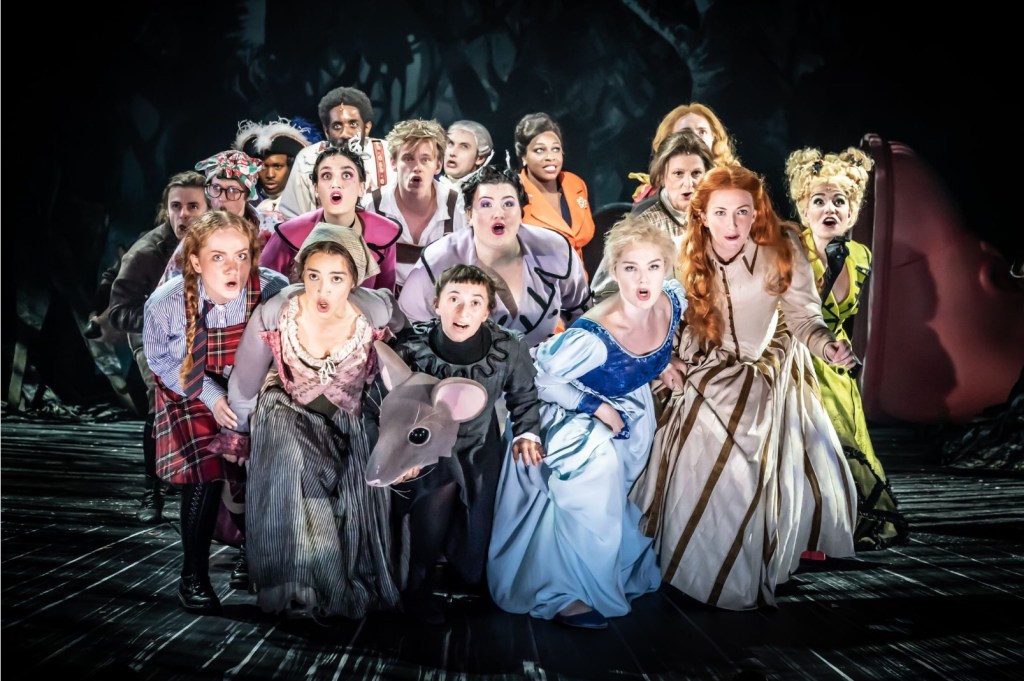
Terry Gilliam and Leah Hausman’s production at Theatre Royal Bath certainly embraces those aspects of the piece, despite being pretty as a picture. That this staging is one of two high profile productions currently on either side of the Atlantic is testament to the durability and timelessness of Sondheim and book writer James Lapine’s creation.
The two versions could not be more different, and the British one is by far the most opulent and visually imaginative. Lear deBessonet’s Broadway show is essentially a transfer of the City Center concert that got the kind of reviews artists and publicists can usually only dream about, featuring a cast of Broadway veterans and debutants, all utter perfection, and a career-redefining performance by Sara Bareilles as the Baker’s Wife. The magnificent orchestra in NYC is onstage, the set is stripped right back, the costumes are basic and there are barely any wigs used…and yet the relationships are explored on such detail, the characterisations are so rich and the acting is so damn good that there is no way this life-enhancing, transporting experience can be described as “just” concert, proving that with material and casting this good you don’t really need all the bells and whistles.
By contrast, Gilliam and Housman and their team (set by Jon Bausor, costumes by Antony McDonald, lighting by Mark Henderson) hurl everything at the wall. It hasn’t quite found it’s footing yet (it’s a beast of a show at the best of times, before one even starts putting special effects, puppetry and huge set pieces into it, and some of the book scenes lack focus) but when it does iron out the creases, this will be an Into The Woods for the ages. It’s already wildly exciting visually and contains moments of rare delight. The invention, sheer theatrical verve and sometimes sick humour are something to savour.
The framing device of having a child playing with her Pollock’s Toy Theatre is an inspired one: Jon Bausor’s eye-popping set turns the entire proscenium arch and stage into the toy theatre. The black and white nursery aesthetic punctuated with riots of stunning colour topped off with a giant cuckoo clock marking each midnight, looks at times like an homage to Richard Jones’s original 1990 London production. Other USPs include the reinstatement of ‘Our Little World’, the cosy/creepy duet for the Witch and Rapunzel (soaring voiced Maria Conneely) added to the score for the first London staging, but seldom heard since (neither the current Broadway revival nor the Northern Ireland Opera production earlier this year in Belfast included it), and a shockingly funny collapsing house moment that recalls Buster Keaton silent movies at their most precise and dangerous.
There are issues however: some of the delicious comedy that is right there in the script goes for surprisingly little; Julian Bleach, giving basically the same performance as he delivered in The Grinning Man and Shockheaded Peter, seems so much a part of the fairy tale milieu that his protestations that he is commenting on the story not part of it, make little sense; by contrast, when the gloriously disagreeable Witch of Nicola Hughes (who’s first entrance is a total coup de theatre, and who sings like a dream) transforms, it’s into a modern power suit with handbag, thereby making her look like she’s in a completely different world from the other characters, with their elaborate wigs and gorgeously fanciful costumes. It’s confusing and does little to help this fine singing actress, or us, to find the beautiful version of the Witch, and she could also afford to punch up the bleak humour and the sadness once transformed.
No reservations at all about the terrific pairing of Rhashan Stone and Alex Young as the Baker and his wife, he a lovely everyman with a sweet innocence that makes him ill-prepared for what the stories throw at him, she a clear-eyed pragmatist with zero sentimentality and oodles of warmth. Young’s phrasing and ability to find new colours in the lyrics and character demonstrate why she is fast becoming one of the foremost British Sondheim interpreters of her generation.
Another Sondheim expert is Gillian Bevan, here tremendously affecting as a more melancholy than usual Jack’s mother, and Audrey Brisson is a lovable, athletic Cinderella even if her voice isn’t quite the lush soprano ideal for this role. Equally athletic and lovable is Barney Wilkinson’s Jack, who delivers his signature ‘Giants In The Sky’ number perched atop a gigantic clock face suspended in mid air. It’s one of a series of stunning stage pictures, all watched over by a Greek chorus of woodland creatures that look like something out of Beatrix Potter.
Nathanael Campbell and Henry Jenkinson are great fun as a pair of campy, self-absorbed Princes, forever pursuing maidens that are just out of reach. Lauren Conroy’s grave Glaswegian Little Red Riding Hood looks fragile but has a cool detachment that shades into considerable ferocity. I also loved Alexandra Waite Roberts’s venomous Stepmother. In both the New York and UK productions, Jack’s cow Milky White (here, Faith Prendergast) comes perilously close to stealing the show.
You know you’re watching a Sondheim musical when the curtain rises on act two to reveal a bunch of disgruntled characters singing about how they never thought they could be this happy, and all through gritted teeth. Melodically lovely though much of the music is, it’s the brilliance of Sondheim’s lyrics that really distinguishes this score. The rather hackneyed notion that Sondheim’s work, however ingenious, is somehow chilly and lacking emotion is blown out of the water by the heartcatching simplicity of the bereaved Baker’s duet with his estranged father, ‘No More’, which is surely as moving an expression of loss, despair and ultimately acceptance as was ever written.
If the ending, including the standard ‘No One Is Alone’, veers towards sentimentality (certainly not an accusation one could make of Sondheim’s earlier works) that cosy acceptance is still hard won. Even if you’re familiar with James Lapine’s superb book, the aforementioned act two death of a lovable character and the shock waves and melancholy shadows that generates remains shocking in both current production. At the Broadway performance I attended, this moment provoked audible howls of outrage and horror, in Bath there was an appalled silence.
In the words of Cinderella, “opportunity is not a lengthy visitor” and this run ends on 10th September but given the talent, imagination and budget lavished on it, it’s unlikely that this is the end of the road for this captivating crowd pleaser: surely a transfer announcement is imminent. All it needs is a few tweaks, a bit more polish and humour, and a West End theatre.
If you’re in New York City and have any real interest in musical theatre as an art form, you cannot miss A Strange Loop. Winner of the 2022 Tony Award for Best Musical (beating monster hits Six and the Michael Jackson bio-musical MJ), also the Pulitzer Prize for Drama (one of a very select band of musicals to achieve this), Michael R Jackson’s “big, Black and queer ass American Broadway show”- to quote the rollicking opening number – is as boldly innovative as Showboat, Oklahoma! or West Side Story were in their day. It’s also as hip as Hamilton, as hilarious and provocative as The Book of Mormon, as soul-stirring as Rent, and as unapologetically it’s own beast as anything Stephen Sondheim created.
To quote a lyric from another of the haunting songs, A Strange Loop is “entertainment that’s undercover art”, and succeeds triumphantly as both; it interrogates racial and sexual identity, as well as what a musical even is, pushing boundaries and the envelope. There are moments that unquestionably make uncomfortable viewing, but there’s a fierceness and intellect at work here that make most other musicals seem tame in comparison. There is also a playfulness and lightness of touch that prove irresistible: something this innovative and soul-searing has no business being this much fun as well. But oh it is.
The lead character, named Usher as that’s what he does as a survival job at Disney’s The Lion King when not trying to create his own musical masterpiece, is based at least in part on creator Jackson which explains the tang of authenticity and raw emotionalism of much of the material. This is unmistakably lived life experience, as Usher struggles to reconcile his artistic integrity with the snarky demands of his agent, all the while negotiating the tricky NYC gay dating scene amid unwelcome interjections and judgement from his deeply religious mother and alcohol dependent father. It’s filtered through an unconventional structure (there is no linear storytelling but instead a succession of scenes, experiences, attitudes and even genres that collectively make up a picture of a fractured, troubled yet hopeful life) matched by a stunning score that shimmers and screams and soars.
Musically, Jackson’s achievement here somewhat recalls Jeanine Tesori’s outstanding work on Fun Home (another queer masterpiece that took home the Best Musical Tony) and Caroline (Or Change) in that snippets of gorgeous melody explode or drop in briefly without always expanding into a full number. Some of it has a melancholy beauty (the minor-keyed, threatening yet yearning pieces for Usher’s drunken, uncomprehending Dad) or poppy but ironic joy, that one imagines Sondheim would have relished. There are influences from jazz to gospel to traditional show-tunes, yet what Jackson has crafted remains elliptically unique, and very very impressive.
His text examines the conflation of gay sex and mortal sin within certain strongly Christian quarters of the Black community, and also the fetishisation and stereotyping of Black men in the gay world, some of it self-perpetuated. Being reminded that there are still some people, in this day and age, who think that AIDS is God’s punishment is never going to be easy, and A Strange Loop looks at them through a clear but ironic lens, in a robustly funny parody of a Gospel play (“because that’s what the people want”) that goes from playful to sinister in the blink of a beaded eye.
There’s sweetness here too though, notably in a scene where Usher, at work, encounters a rich older lady up from Florida (“I come here every year to see my shows…I like Wicked”), played by the luminous L Morgan Lee, a history maker this year as the first trans woman to be Tony-nominated, who warns him of the perils of not following one’s dreams and not putting oneself at the centre of one’s own life. It’s a heart-catching little scene and number that unsurprisingly brings the house down.
Usher is played with a winning combination of open-hearted charisma and cute camp by newcomer Jaquel Spivey, adorable but with a satisfyingly hard edge, a hero to root for, reckon with, and care about. It’s an epic role, vocally demanding and emotionally tough, and Spivey inhabits it completely: he’s extraordinary.
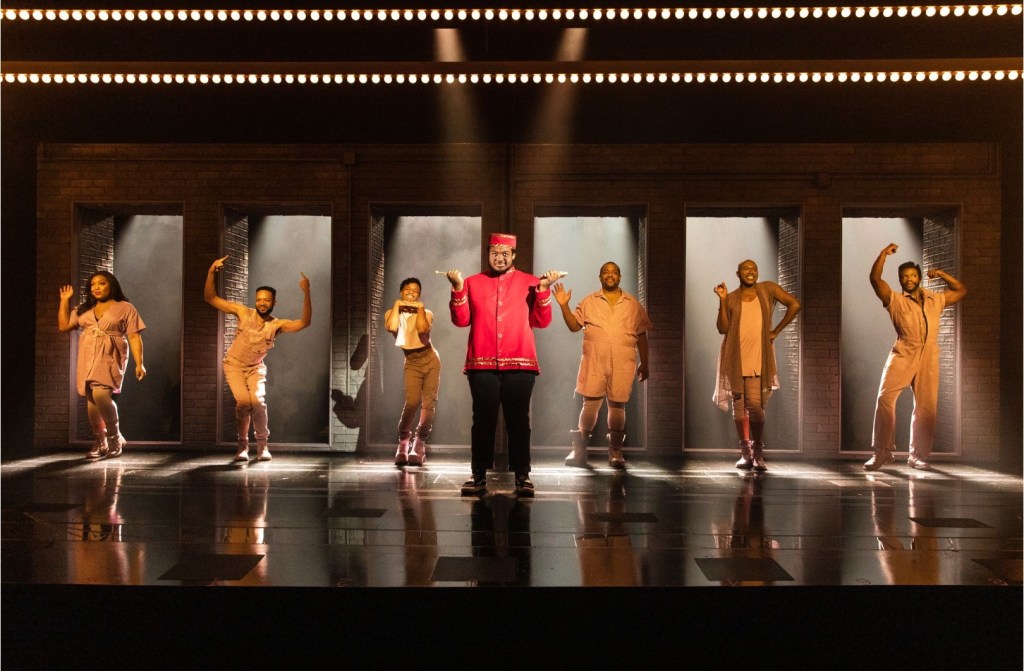
The other characters are Usher’s “thoughts” (“Surprise! this is your daily loathing”, “your numbers are in the toilet with the Black Excellence crowd and you’re getting real close to cancellation”) who also embody every other figure (Usher’s parents, his agent, a brutal married hook-up, an idealised boyfriend in a scenario that turns horribly sour…) in a story where, in terms of action, nothing happens…yet everything happens. These Thoughts are played by a sextet of beautiful, shape-shifting Black performers so in tune with Jackson and director Stephen Brackett’s vision that it’s hard to imagine anybody else playing these roles: each one of them is a wonder, equally adept at OTT comedy and nailing moments of searing truth. They are each gloriously specific and individual, but, when required, form an immaculately drilled team.
Magnetic Jason Veasey draws a startling contrast between our hero’s Dad and a random person met on public transport that appears – on paper – to be the man of Usher’s dreams. The aforementioned Lee radiates authentic star quality, as does Antwayn Hopper, breathtakingly sexy and with a voice like molasses infused with honey, who finds unexpected vulnerabilities in a unflinchingly explicit sequence that explodes numerous taboos around sexuality and race.
James Jackson Jr. and John-Michael Lyles are vivid, exciting stage presences who both get moments of utter brilliance in the course of the show. John-Andrew Morrison does something really remarkable as Usher’s God-fearing mother, in that he presents her initially as something of a comedy grotesque, all homely blessings and hand-clasping piety, then slowly but surely reveals her anguish and humanity, despite some of the unacceptable things coming out of her mouth. It’s an ingenuously even-handed portrayal.
Brackett’s staging is oil-smooth but infused with just enough jagged edges to trouble and ignite. Raja Feather Kelly’s terrific choreography and Arnulfo Maldonado’s ingenious set (which includes a jaw-dropping transformation) are exquisitely, colourfully lit by Jen Schriever. If there are times when the lyrics could be clearer, the exhilarating vocal harmonies emerge strong and enthralling in Drew Levy’s sound design.
“If you can’t please the Caucasians then you’ll never get the dough” goes one of Jackson’s particularly coruscating lyrics and one can only hope that this show finds the audience to consolidate it into the Broadway smash it deserves to be. It’s a true original and a cause for celebration. In the present theatrical climate, where jukebox musicals, movie spin-offs, star-driven revivals and shows just out to give audiences a mindless good time, are raking in the audience big bucks, A Strange Loop is unlikely to achieve the run of something like, say, Six or MJ or Hamilton, even though it fully deserves to. It’s a thing of outrageous, unconventional beauty. I can’t wait to see it again.
It’s amazing what difference a year makes. Actually, it’s fifteen months since Jack Holden’s almost-monologue exploded into the West End to ecstatic reviews and equally enthusiastic audiences. It rode the wave of the zeitgeist, following hot on the heels of TV’s magnificent It’s A Sin, with which it shares themes and a historical time period (the brutal decimation of the London gay community by AIDS in the 1980s), it was at the vanguard of live theatre reopening post-pandemic, and there was a particular potency to presenting a story about a plague in the midst of another plague.
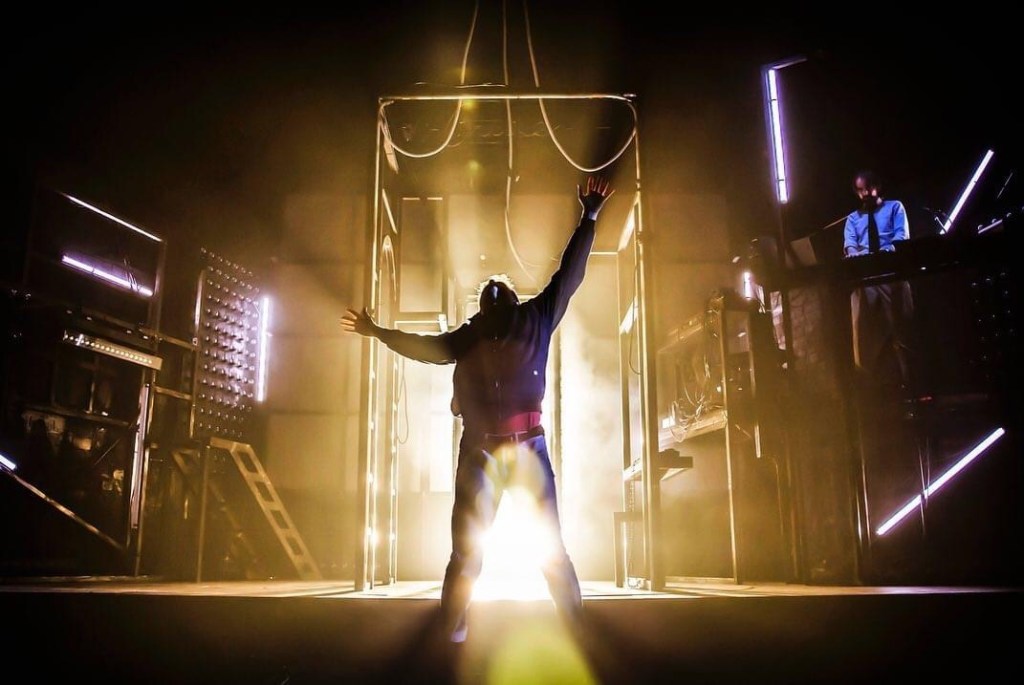
Now it’s back, in a larger venue and a slightly more bombastic physical production. Director Bronagh Lagan’s deceptively sophisticated direction remains, as does Stufish and Nik Corrall’s revolving set, part climbing frame, part cage, part safe space. Prema Mehta’s neon-etched, clubby lighting feels more overwhelming than the original. Already boldly inventive, the physical production now feels like a complete sensory journey, thanks in no small part to the exciting sound design of John Patrick Elliot (who also performs as a musician/extra character and proves at once unobtrusive yet indispensable) and Max Pappenheim.
I’m not sure however if it’s the less intimate venue (the Apollo is hardly cavernous but it’s probably a tougher space than the 470 seat Duchess where this show originated) or that theatrical expectations have altered, but neither the script nor Holden’s central performance dazzle quite as much as they did when they first appeared. The gear changes between the fabulously comic and harrowingly sad, and the transitions from prose to poetry and rap, feel clunkier this time around. Despite that, Cruise remains an impressive achievement, at once a Valentine to a lost Soho and a eulogy for some of the lost souls that were early AIDS victims.
Another USP that Cruise had, and still has, is that outside of the late Kevin Elyot’s superb canon, there are few British plays that deal with the devastating effects of HIV and AIDS upon the gay community. The USA has the NYC-centric The Normal Heart, As Is, and Angels In America, and of course Mathew Lopez’s extraordinary epic The Inheritance, which premiered at The Young Vic but always had its spiritual home on the other side of the pond. Over here though, not so much. and Holden’s dynamic, accomplished piece of storytelling goes some way to redressing that balance.
Holden switches capably from unassuming present-day good guy to outrageous Soho denizens of yesteryear, to edgy, but not unsympathetic, gay movers-and-shakers, with an astonishing fluidity. At the top of the show he might seem likeable if nondescript, but by the end of it you marvel at his energy and sheer chutzpah, even if a couple of the accents he assumes are a bit iffy.
His writing is spicy and inventive, conjuring up a colourful milieu that marries sleaze with the sense of a gleeful community that may be living in the shadow of death, but fairly bursts with vitality. The Soho he evokes in this confessional-cum-scream of defiance is simultaneously full of joy, kindness, eccentricity and danger.
I wasn’t perhaps as bowled over by Cruise on a second viewing, but it unquestionably delivers on it’s triple promise of fusing theatre with club culture, a history lesson, and a rambunctious piece of entertainment. If you couldn’t get to see it first time around, don’t miss your chance now…it’s quite a thrill ride.
As the UK lurches into chaos and chronic heat, the ongoing unrest in Ukraine has disappeared from our headlines somewhat, so it feels fitting that the ever enterprising Finborough is hosting this duo of contemporary short plays from the region. They serve as a sharp reminder that, however bad we think we have it, there are more difficult places in the world to live in. The first play, Vorozhbit’s Take The Rubbish Out, Sasha is set partially during the current war while Nezhdana’s monologue, Pussycat In Memory Of Darkness, the second, takes place during the 2014 Donbas conflict that foreshadowed it. While the plays are presented in reverse chronological order, their placement makes perfect sense from a theatrical point-of-view, in that the second piece is immeasurably stronger.
Anyway, Vorozhbit’s play, in a naturalistic English language version by Sasha Dugdale, centres on the widow and pregnant daughter of the titular Sasha, a former officer in the Ukrainian army who died unexpectedly, not in combat but at home. Sasha, or rather his ghost, is also a character in this three hander and it’s clear that he enjoyed, or at least endured, a combative relationship with his spirited, demanding wife.
At first, the way the women address each other and the deceased but very present Sasha (Alan Cox) seems an intriguing way of acknowledging that, to the grief-stricken, it is profoundly difficult to admit that a loved one is no longer alive. Svetlana Dimcovic’s direction has Cox and Amanda Ryan almost touch at certain points, but never quite making contact. These domestic scenes work, in the main because the actors are so good (Izzy Knowles plays the daughter), but also because the combination of kitchen sink tragicomedy and the supernatural feels fresh and original.
Unfortunately, both the script and Dimcovic’s direction soon get bogged down with the trivial minutiae of these people’s lives, and become ploddingly literal: for instance, at one point the women have a ritualistic feast at Sasha’s grave to mark his one year anniversary which requires Ryan to unpack a load of prop food and a picnic blanket for a five minute scene, to zero theatrical effect. Worse still, Dimcovic and choreographer Jones make the actors perform a misconceived series of buttock-clenchingly awkward interpretive dance sections for no very intelligible reason beyond daring the audience not to giggle inappropriately.
If the aim of the play and production is to convey that “normal” life continues in the face of tumultuous world and personal events, I’m not sure that straddling the twin lame horses of absurdity and boredom is the best way to get the point across. It’s disheartening seeing such fine actors floundering through this.
One can only hope that disgruntled patrons don’t cut their losses and leave at the interval though, as the following play, Neda Nezhdana’s bizarrely named Pussycat In Memory Of Darkness, translated with edgy flair by John Farndon, is utterly riveting. Inspired by true incidents in the life of a real Ukrainian survivor, it’s a monologue filtering the trauma, fury and living hell of war through the experiences of an unnamed woman. It’s confrontational, sometimes shocking and distressing, but completely compulsive.
Kristin Milward delivers a bravura performance: at first appearance, she is a raggedly glamorous figure with her piled-up curls, breathtaking bone structure and enormous sunglasses, verging on the camp as she tries to cajole passing strangers into buying the pedigree kittens she drags around in a box. Once the glasses are off, the emotional defences are partially down and she tells her story, the effect is anything but camp though: it’s blisteringly truthful and deeply moving. Milward is astonishing, finding power in stillness then suddenly erupting in outraged energy, and morphing subtly but vividly into other figures in this living nightmare.
Her voice is remarkable, transitioning from soothing, almost feline purr to guttural and merciless with utter conviction, and she invests this brave, hardy woman with a grace and dignity even in the face of the most repellent brutality. She’s magnificent and this is an acting masterclass.
Polly Creed’s direction is exquisite, rightly putting her leading lady front and centre where she belongs; Creed’s work is unobtrusive but in utter control of the pace and energy, and also cleverly realises when to step up the energy and ratchet up the tension.
The script is strong stuff, and has the added bonus of never actually sounding like a translation, although the cat references and metaphors do a bit too much heavy lifting for my taste (“I don’t want to be human…I’d rather be born a cat” says the woman, and also, when mourning the death of the kitten’s mother: “No one will ever feel me the way she does”). That apart, there are no other moments where it threatens to trivialise what this woman, and countless other like her, have been through and continue to go through.
All in all, this is a show of two distinct halves. It might have been interesting or at least more authentic to see the plays performed by Ukrainian actors, but having said that, I would not be inclined to miss Ms Milward in this for anything.
Following an aggressively revisionist, critically lauded Young Vic Oklahoma! that sharply divided audiences (but look out for a West End transfer announcement imminently) and a My Fair Lady that seemed wonderful at NYC’s Lincoln Center but landed rather flatly on the stage of the Coliseum, Daniel Evans’s masterly take – first seen last summer at Chichester- on this 1949 Broadway classic comes as something of a relief. This is a production that respects and honours the original material in all it’s flawed humanity and emotional complexities, allowing the joy and elation but also the fear and tragedy of Rodgers and Hammerstein’s phenomenal work full rein, but still manages to find intriguing new colours and textures. It’s a thumping good night out that will satisfy the traditionalists while also giving more progressive theatregoers plenty to chew on.
Perhaps the most obvious repointing is in the role of the opportunistic, Tonkinese islander Bloody Mary, constantly looking to relieve the American soldiers of their bucks with her handmade grass skirts and questionable shrunken heads. Usually played as a tough-talking bawd viewed with boisterous affection by the Seabees she’s trying to profit from, she emerges here, in Joanna Ampil’s haunting performance, as something quite different: younger than many of her predecessors in the role, her fearsome “dragon lady” persona is simply an act to beguile the visiting Americans: we even see her removing her elaborate make up and battered Forces jacket, and letting down her hair, at one point. Sure, she’s still a pragmatic, amoral survivor but Ampil gives her a watchful desperation and melancholy that is deeply affecting. The number “Happy Talk”, which in lesser productions has come across as excruciatingly and possibly inappropriately peppy as Mary tries to marry her daughter Liat off to Lieutenant Cable, is rescored here as a song of pleading anguish. It completely, movingly remints it, and it’s unforgettable.
If Gina Beck and Julian Ovenden as the central couple, Ensign Nellie Forbush from Little Rock, Arkansas and French plantation owner Emile de Becque, are, on the surface, more traditional casting (they’re both beautiful and charming, with voices to die for), they too dig deeper into these familiar characters than I’ve ever seen before. We know they can sing (Beck’s exhilarating ability to blend chest voice and head soprano allows the music to soar in a way that brings tears to the eyes, while Ovenden’s spine-tingling rendition of “This Nearly Was Mine” is a bona fide showstopper) but it’s the truth in the acting that elevates these two performances into something compulsive and rich.
Beck doesn’t sugar the pill of Nellie’s racially motivated confusion when she discovers that Emile has children with a Polynesian woman, but makes it a seamless part of the character of a young woman who at the top of act one is complaining about her mother back in America being prejudiced against anybody not from Little Rock but then goes through her own personal hell when confronted with the fact that she has carried some of that prejudice across the Pacific Ocean with her. I can’t imagine a finer account of this complex role. Ovenden is incredibly sexy, warm and winning, but underpins it with an undefined but all too human darkness. The chemistry between the two is unmistakable but Evans’s sensitive, smart staging ends their relationship on a subtly questioning note, not the arms and lips akimbo reunion most other versions present.
Watching South Pacific in 2022, the sophistication of both the score, and Hammerstein and Joshua Logan’s book seems all the more remarkable. Yes it’s a piece of popular entertainment, sometimes rollicking and sometimes ravishingly romantic, but the way it tackles racism and interrogates the brashness of American wartime foreign policy is the stuff of riveting drama. Rodgers and Hammerstein never wrote a more overtly political song than “Carefully Taught” which posits that racism is not something we’re both with but are indoctrinated into, and it is powerfully put over here by Rob Houchen’s gorgeously sung Cable.
Evans and the brilliant choreographer Ann Yee (this is a more dance-heavy South Pacific than usual, appropriately for Sadlers Wells, and it works thrillingly as such) find a visual metaphor for the show’s racially charged central arguments by eschewing the traditional overture in favour of placing Bloody Mary’s daughter (Sera Maehara, perfect) centrestage performing what looks like a ceremonial dance, only to have her tranquil space invaded by hoardes of leaden-footed American militia. It’s terrifying and enthralling, and the image is repeated near the close of the show, to devastating effect, a pitiless reminder of the human cost of war. The counterpoint between grim action and joyful music further confirms Rodgers and Hammerstein as the true precursors to Sondheim.
Musically, this production is sublime: Cat Beveridge’s fifteen piece band sounds lush and full, with David Cullen’s orchestrations intriguingly pointing up both the minor chords and the joyful “Broadway” elements of the score, and the choral singing thrills the blood. Peter Mckintosh’s set solves the problem of trying to recreate a tropical paradise onstage by setting the whole thing, not in appropriately, in a giant aircraft hangar (we even get an airplane on stage at one point!) and letting Howard Harrison and Gillian Tan (superb lighting and video design, respectively) do much of the atmospheric heavy lifting. It works triumphantly.
As he proved with his 2016 Showboat (which featured Gina Beck as an incandescent Magnolia), Daniel Evans knows exactly what makes these vintage musicals tick. He amplifies what makes them classics but finds ways of ensuring that they read as relevant and fascinating for modern audiences. Even the scene changes in this production are a thing of beauty, whole sets swirl into place before our very eyes, enhancing the action, never detracting from it. This is a profoundly satisfying experience on every level.
Having endured the ropey West End revival in the late 1980s (will never forget the island of Bali Ha’i on a painted backdrop wobbling perilously every time a cast member walked within a few inches of it), the impressive but overlong Trevor Nunn staging at the National in 2002, and the watered down Lincoln Center version that landed at the Barbican just over a decade ago, I didn’t think I needed to ever sit through South Pacific again. It’s wonderful to be proved wrong….I would have hated to miss this flawless, soul-feeding production. It’s an absolute must-see.
It would be unsurprising, indeed completely understandable, for a new state-of-the-nation play focusing on the treatment of, and opportunities for, disabled people in present-day UK, to fetch up on stage as a furious, ranty polemic. Francesca Martinez’s dramatic writing debut, All Of Us at the National, goes down a rather more unexpected and interesting route however.
It filters the passionate arguments, often grim experiences and execrable benefit cuts through the prism of one of the most likeable and engaging female central protagonists in any piece of new writing within living memory. That’s not to say that this confident new piece lacks fire in it’s belly; far from it, it’s coruscatingly clear-eyed in it’s takedown of a system that repeatedly and callously fails the people it should be helping, but it also has real tenderness and sweetness in amongst the politics.
Martinez’s Jess is a successful therapist with her own practise, a ferociously positive outlook on life and an indomitable kindness tempered with a wicked sense of humour; in short, she is the kind of woman who makes other people’s lives better just by being there. She also has cerebral palsy, which means that she is on PIP, and is partially dependent on regular home visits from a carer (Wanda Opalinska, excellent) and, for the purposes of getting to and from her practise rooms, a car provided by the welfare state. The way that this intelligent, accomplished young woman’s life starts to unravel once she is deemed ineligible for vital portions of her financial support following a particularly callous reassessment of her needs, is what drives much of the play…but it is Jess’s unhistrionic reaction to her plight that vitiates and distinguishes it.
Ian Rickson’s sparky production, making intelligent use of an unobtrusive revolve and the entire Dorfman auditorium, has many strengths but the chief one is having Martinez perform her own work. Her entrancing Jess projects an innate goodness that never cloys, as well as an intense watchfulness and sardonic wit; she is the sort of person that is so used to putting other people’s emotional needs before her own that it takes her some time to accept that the fact that she now needs the support she habitually offers to others. It’s a warm, generous performance, full of exquisite detail and an irrepressible joie de vivre that makes it all the more powerful in the moments when her facade cracks: when somebody this good gets truly angry, it behoves us all to shut up and listen.
I defy anybody not to be deeply moved when Jess bares her soul to Bryan Dick’s superb patient-turned-ally Aidan, describing how hard won her optimism and kindness actually is, that to live this sunnily is an actual choice. That moment hammers home with excruciating force the realisation just how much the Jess’s of this world have had to conquer and still face daily in order to achieve what other people take for granted or, worse, squander on a regular basis. It’s extremely powerful and illuminating, and Martinez and Dick give it full emotional rein.
It’s an ambitious piece, which at times threatens to sink under the sheer weight of it’s multiple themes, but is carried through by humour, some laser sharp observations and a vivid gallery of characters. Martinez creates a credible, beautifully realised friendship between Jess and her somewhat flaky pregnant best friend (Crystal Condie’s lovable Lottie) and the outspoken, sexually voracious Poppy (Francesca Mills in a firecracker of a performance), determined, at least initially, that being confined to a wheelchair will not cramp her wild style.
Christopher John-Slater and Kevin Hely make potent, bitterly funny impressions as two furious victims of cuts to disability benefits due to austerity, resolutely refusing to suffer in silence, and Oliver Alvin-Wilson does terrific, contrasting work as one of Poppy’s squeezes and then the desperately disenfranchised parent of a severely disabled child.
If an oil-smooth-until-rattled Conservative politician, played with appropriate oleaginous relish by Michael Gould, is given a rather-too-convenient backstory of untapped artistic ability and a troubled childhood, I suspect that may be more down to an inspiring generosity of spirit on Martinez’s part than any particularly redemptive features in any Tories. Her script smartly makes the point though that people on the fringes of despair and disillusionment don’t necessarily vote in the way that one might expect.
Dramaturgically, All Of Us is pretty raw, but I’m not sure a more conventionally and neatly structured play would speak to us with quite the same compelling urgency. There is inevitably a slight feeling of shooting fish in a barrel as Martinez deconstructs and shines a light on the flaws in the welfare state system, but it is impossible to watch without an increasing sense of justifiable fury. It’s writing from the heart, and what a beautiful, all-encompassing heart it is. Essential viewing, a humanising experience.
Another night at the Kings Head, another feat of astonishing transformation by the chameleonic actor-writer Mark Farrelly. Because delivering one bravura turn as a gay icon isn’t enough apparently (his utterly brilliant Jarman -about Derek- is currently running in repertoire as part of the Islington venue’s ongoing Boys Boys Boys season), Farrelly also reignites his heart-swelling, life-affirming tribute to the self-proclaimed “stately homo of England”, Quentin Crisp. The Kings Head is an appropriate venue for the show as well, since Crisp performed here at the beginning of his career.
This is a magical theatrical miniature, that traces a direct line from Oscar Wilde through Crisp and on to Joe Orton and Kenneth Williams and Julian Clary and beyond. What Farrelly does, in a performance of meticulous detail and breathtaking technique, transcends mere impersonation as he brings the magnificent, mould-breaking Quentin back to life before our very eyes. He captures with unerring precision the swooping vowels and cadences, the amused but slightly detached attitude, epigrammatic wit and the subtle but unmistakable kindness at the heart of this wildly eccentric, joyfully off-kilter human being, whose ninety year life span encompassed prostitution and life modelling, through to being an unlikely style icon and a celebrated raconteur.
The first part is set in the 1960s in Crisp’s infamously dusty Chelsea flat (“Don’t lose your nerve. After the first four years the dirt doesn’t get any worse”) and the second some thirty years later as the octogenarian Quentin prepares to go onstage to delight an adoring audience in his adopted home city of New York. Farrelly deftly suggests the physical frailty of the passing years running in a counter direction to Crisp’s soaring spirit, which flamboyantly flourished later in life as the more enlightened parts of the world at large realised what a gift to humanity he actually was.
Farrelly’s show, directed with an unshowy but potent precision by Linda Marlowe, does little more than represent Crisp the raconteur, and honestly we don’t need any more than that. The man himself managed to combine style AND substance, and so does this solo play. It’s endlessly quotable (“if at first you don’t succeed, failure may be your style”, “never keep up with the Joneses. Drag them down to your level”, “my mother protected me from the world and my father threatened me with it”). It’s also very moving as one marvels at how Crisp retained a fundamental optimism and affection, however cynical, for his fellow humans despite being treated appallingly in early life on account of his undeniable, glorious “otherness”.
If Jarman is the more elaborate, innovative piece of theatre, NakedHope has real charm and heart, and Mark Farrelly’s central turn is every bit the match of John Hurt’s towering achievement in the NakedCivilServant film. What both shows share, beyond a terrific central performance and Farrelly’s enviable gift for shaping the bon most of these iconic gay figures into compelling one person scripts, is the encouragement for audiences to go forth and live their best, most authentic lives. That’s a pretty amazing gift to receive. See them both! This is life-enhancing theatre.
“Be astonishing” are the final words of this 75 minute distillation of the life, death, work and preoccupations of Derek Jarman, one of the most iconoclastic artists of the late twentieth century. It’s an instruction to the audience to go out and live their best, unashamed, creative, original lives. Writer-performer Mark Farrelly and his director Sarah-Louise Young have clearly applied that exhortation to be astonishing to themselves too when crafting this intense yet playful piece of total theatre. What they’ve created is roaring, but delicate, ritualistic and totally unique.
Pitched somewhere between a celebration, a séance and an unusually engaging piece of performance art, Jarman eschews linear storytelling in favour of a sensory assault encompassing spoken word, music and direct audience engagement. Some of Jarman’s iconic film works are referenced – Sebastiane, Caravaggio, Edward II, The Tempest, the heartrending Blue which depicts the artist’s slide into blindness – and settings from Ken Russell’s chaotic movie shoots (Jarman designed several of his films) to Derek’s beloved, wall-less Dungeness garden are vividly evoked. So too is the hedonistic pre-AIDS London gay scene of the 70s and 80s, in sequences that rival Jack Holden’s terrific Cruise play (about to return for a limited West End season) and TV’s It’s A Sin. It’s spare but extravagant, and extraordinarily life-affirming even as it looks death squarely in the face (Jarman died from an AIDS-related illness in 1994, aged just 52).
In a performance of such controlled brilliance that even his armpits seem to sweat on cue, Farrelly portrays the man in his prime – an outrageous force of nature but with an undertow of genuine warmth and kindness – then unflinchingly, and heartbreakingly shows him ravaged by disease. Crucially, it’s never sentimental, it’s just authentically tragic. Farrelly is an athletic, engaging stage presence with an unerring ability to connect with his audience at close quarters, and charisma to spare. I defy anybody to see this and not come away both as a fan of him, and determined to go away and read up about Derek Jarman.
The writing is beautiful, poetic and pungent, full of yearning and truth, and a sort of enraged elegance punctuated by genuine wit. Young’s sensational staging repeatedly breaks the fourth wall, and makes theatrical magic using the bare minimum of props – a sheet, a torch, some torn up paper – buoyed by Farrelly’s extraordinary central turn. Technically the show is flawless too, Farrelly and Young’s shape-shifting lighting transforming the King’s Head’s tiny auditorium into an Aladdin’s cave of possibilities and landscapes, and Tom Lishman’s complex, ingenious sound design contributing immeasurably to the overall impact.
Visceral and unmissable, and a history lesson dressed up as a great, sometimes harrowing, piece of entertainment, “astonishing” this most certainly is. One suspects Jarman would have loved it.



 ajhlovestheatre