Small really is beautiful sometimes. Several recent shows could have benefited from losing up to thirty minutes of running time without compromising their impact, so it’s refreshing to come across this fleet but mighty two hander with serious things on its mind while being possessed of a deft command of storytelling, irresistible humour and a commendable lightness of touch. Sarah Middleton’s Shewolves could actually be longer, and still be utterly captivating.
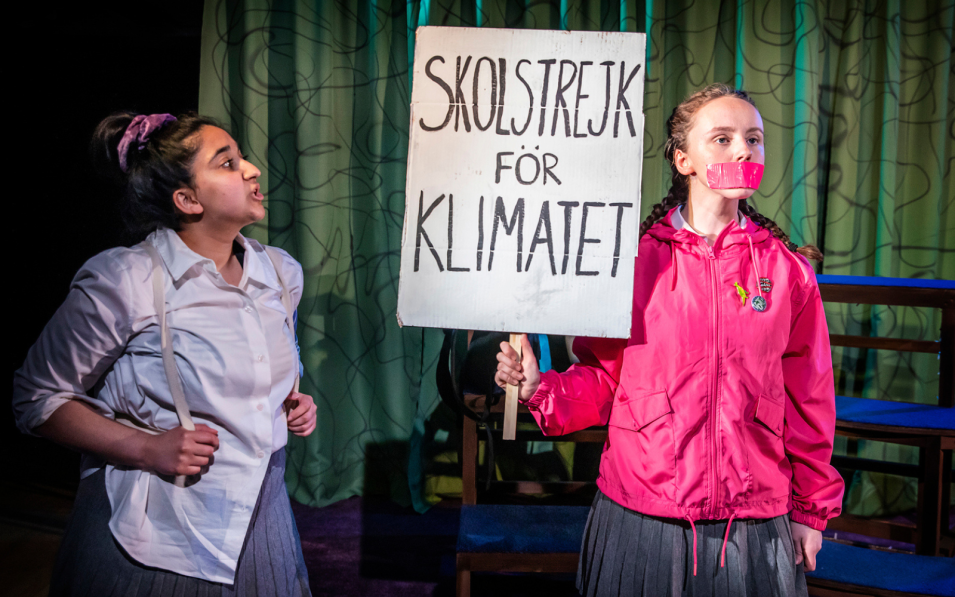
It’s a relatable, heartfelt but never cloying tale of friendship between two contrasting 14 year olds trying, initially in vastly different ways, to find their place in a world that is becoming ever more hostile, both in terms of the environment and the socio-economic infrastructure. Lou (Harriet Waters) idolises Greta Thunberg and looks set for a life of well-educated privilege, at least until she’s suspended from school for initiating a solo environmental protest. Meanwhile, irrepressible but vulnerable Priya (Gurjot Dhaliwal) uses social media as a means of validation as she tries to gain approval, or at least attention, from her absent dad and her newly affianced mother.
Middleton’s pithy, witty writing and the gutsy, caffeinated performances of these brilliant young actresses ensure that Shewolves never descends into cliché, even as it becomes possible to second guess where it’s heading and what’s going to come out of the mouths of its deeply lovable heroines. When Lou blithely refers to her new friend as “a lost cause”, it’s a funny, throwaway comment that has painful repercussions as Priya internalises the implicit dismissal and brings it up later in a moment of conflict. There’s a ring of authenticity to a scene where Lou (the kind of person whose early morning alarm is a posh voice repeating the words “Wake up! The world is still burning!”) delivers a lecture on imminent environmental disaster while Priya responds with an offer to take care of her monobrow.
Hannah Stone’s production has an exuberance and energy that befits its youthful characters but also gives full measure to their terrors and insecurities. The technical elements (Anna Reddyhoff – lighting, Eleanor Isherwood – sound and composition, Charlotte Henery – design) unobtrusively inform and support the text and performances while creating vivid visual and aural impressions. This is one of those allegedly simple productions that is actually way more complex than it looks.
Waters sometimes pushes a little too hard to convey Lou’s restless mixture of intense fervour and casual insensitivity, but she makes her inner conflicts vivid, moving and often very funny. Dhaliwal’s role is probably easier to negotiate – Priya goes from mouthy bravado to wearing her heart on her sleeve in an entirely credible journey – but she is an absolute knockout, expressing every beat and emotion with a devastating, open-faced honesty. They’re a fabulous team, impossible not to root for.
The title pertains to the name the young women give themselves when they go on the run from parental and scholastic authority, and their abandon and optimism is a joyous thing to witness. It’s also poignant because we guess that this verve and defiance is probably going to be short-lived, as adult responsibility inevitably overtake it.
Shewolves feels like the theatrical equivalent to really good Young Adult fiction, and that’s not a disrespect. It’s full of heart, fizz and truth. It’s sweet, spiky and smart. I loved it, even as I wished it went further and deeper. Still, very highly recommended.
Anybody coming to a show billed as “a lesbian rock opera” is probably expecting something along the lines of RENT but with the Joanne/Maureen storyline given more prominence. The rather brilliant Korean-American-Irish composer-writer Rena Brannan has other ideas however, and, although this show probably defies the Trades Description Act (it’s not a rock opera, but more on that shortly), she has come up with something truly original, pretty bonkers, and impossible to pigeonhole.
Shutters: A Lesbian Rock Opera is simultaneously a story within a story (several stories actually), a meta-theatrical look at queer people through the years between the Hollywood Golden Age and the first two decades of the 21st century, a dyke odyssey, and a charming musical that’s surprisingly conventional at times. It still feels very much like a work in progress – it’s messy, occasionally misjudged and rough round the edges – but it has a wit and spirit entirely its own.
While it undoubtedly needs work (also a bigger budget, and possibly a strict dramaturg), it’s a compelling piece of musical theatre. Whatever happens to it next – and it totally deserves a further life beyond this brief run during Pride season – it is imperative that it doesn’t become too smooth, too conventional, as the jagged defiance and disarming rawness are a huge part of it’s appeal.
Brannan is a major talent, with a bold imagination and assured command of language. Shutters: A Lesbian Rock Opera isn’t just the name of the show, it’s also the title of a film property David O Selznick – yes, he who produced Gone With The Wind, which is often referenced here – is anachronistically kicking around. This means that a lot of what we’re watching is part of this project, which sometimes means an uncertainty of tone, at least as seen in Tom Latter’s production, but also a unique get-out-of-jail-free card for the creatives when the material doesn’t land. For instance, there’s a touchy-feely post-911 number that is actually a good song but feels a bit toe-curling yet it’s unclear if the issue is with the show we are watching or the movie Selznick is working on. The multiple time periods is a useful way to interrogate the contrast between queer lives back in the early part of the twentieth century as opposed to the recent past.
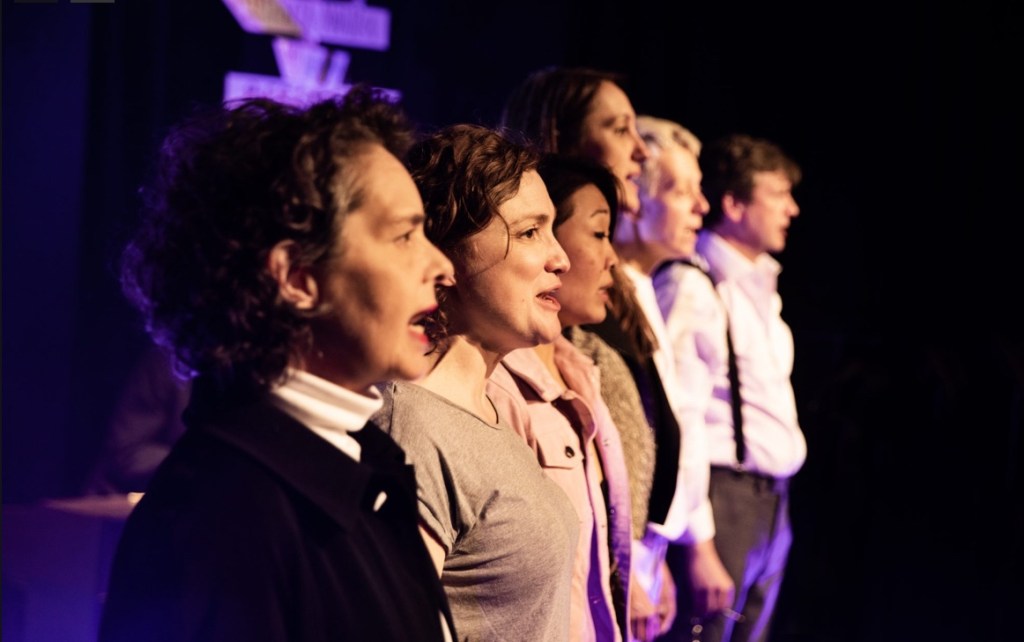
Although some of Brannan’s characters need more delineation, they express themselves in words erudite and honest. The score doesn’t really rock but that’s no disrespect to Faith Taylor’s virtuosic keyboard playing and backing vocals, and occasional knowing interjections. It just feels that it’s more about charm and eclecticism than thunder and bombast, and it needs more instrumentation. A larger band and orchestrations will surely reveal other colours. The vocal harmonies for the small company are already lovely, especially when heard acoustically.
The central characters are London-based musician Saving Liz (Morag Sims), Maggie the middle class, breadwinning career woman who adores her (Sarah Lawrie), and successful American singer-songwriter Billie Parker (Deanna Myers) who she truly loves. Liz and Billie have international meet-ups periodically while Maggie is the formers home base despite being a big noise in her own corporate field. If this sounds like classic RomCom territory with a sapphic twist, that’s not factoring in a rhyme-talking narrator (Bunny Cook) who feels like a third cousin to Cabaret’s Emcee without the make-up; and an audacious framing device involving Katharine Hepburn and Spencer Tracy (Jules Melvin and Thom Tuck respectively), two of Hollywood’s most high profile closet jobs.
You really haven’t lived until you’ve heard Hepburn and Tracy growling through a Glam Rock-lite non-sexual love song about friendship. Melvin and Tuck (who also plays a spiteful Selznick) are utterly sublime and the brief snatch of the same song that the former mouths after news of Tracy’s lonely death packs a real emotional punch. By contrast, the terminal illness that sees off one of the principal characters in the more contemporary tranche of the story needs more foreshadowing and exploration.
Brannan is a cracking songwriter. As it stands right now, this is an impressive collection of tunes with incisive, occasionally outrageous lyrics, that could benefit from cutting loose a little. But when’s the last time you heard a sexually frustrated woman belt out “you love fucking chocolate more than you love fucking me” as a refrain in a musical ballad? There’s probably more relatable stuff in about ten minutes of Shutters than there is in the entire three hour sprawl of the current West End Aspects Of Love, even for heterosexuals.
The script needs focussing and reining in but it’s verbally elegant and often heartfelt: it fundamentally works and is occasionally better than that of many bigger shows who weren’t half this interesting at much later stages in their development. There’s a potentially delicious scene near the end, where a trio of women about to take questions at a forum on lesbian ethics, suddenly realise they’ve been sexually cross-pollinating, that gets cut short and currently feels like a missed opportunity. It’s fun but it could be funnier.
It could also benefit from being a bit sexier. At the end of the first act an exasperated Selznick resolves to make the film-in-progress into something raunchier. The act two opener, which sees Myers and Sims writhing all over each other in Chicago-esque outfits while Taylor delivers something gorgeous at their keyboard, fulfils that promise briefly but then the tone reverts to normal. Having set up the premise that there will be a significant difference between the two parts, it seems odd that this doesn’t really happen. All that said, it’s bracing to encounter a show that’s cynical where other musicals would probably go sentimental.
The cast are excellent. Sims doubles convincingly as a flaky but passionate Saving Liz (with a superb singing voice) and a smart, knowing old school Hollywood secretary-cum-assistant. Myers’s Billie is a winning combination of self assurance and vulnerability, negotiating the slightly unlikely fall from grace the script gives her with commendable conviction. Cook is an endearing bridge between the audience and the numerous story strands. Lawrie invests Maggie with an intriguing combination of uptight middle class awkwardness and self-involved lunacy. Crucially, she’s very funny but also entirely real.
“Lesbian is everything that loves itself. Don’t resist, can’t resist” goes one of Brannan’s repeated lyrics. While Shutters: A Lesbian Rock Opera isn’t quite irresistible yet, it has an ambition, fire and bizarre kookiness, but also a humanity, that make it impossible to write off. Director Latter needs to up the pace of many of the scenes, and the presentation of the music generally needs more oomph, but there is a lot here to admire. Enjoyable, thought-provoking and well worth catching.
Sasha Regan’s inventive all-male versions of Gilbert and Sullivan are wildly popular and this 1950s schoolboys take on perhaps the most beloved but, to modern eyes, problematic of the G&S canon of operettas successfully continues the tradition. The Mikado presents a challenge these days because, although Gilbert’s script was a witty “topsy-turvy” comment on English Victorian politics, it was created at a time when faux japonaiserie was all the rage and it was perfectly acceptable to give characters made-up ‘comedy’ Japanese names like Pish-Tush, Ko-Ko and Pooh-Bah, have them don yellowface, and set them loose in a town with an fabricated oriental name (Titipu).
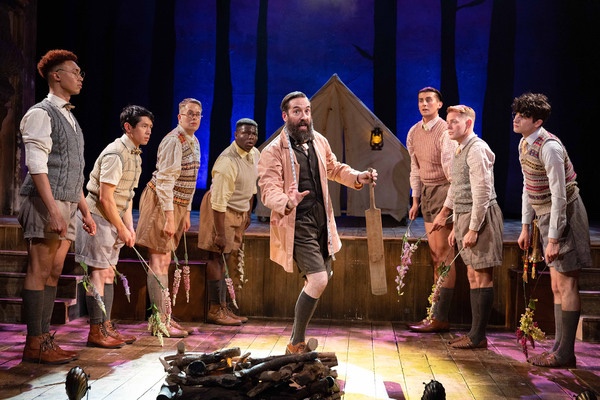
Jonathan Miller’s long-standing English National Opera production sidestepped the cultural pitfalls by setting the whole thing in the whitewashed lobby of a plush 1920s English hotel, and now Regan presents it as a storytelling diversion for a bunch of 1950s schoolboys on a forest camping trip. Ryan Dawson Laight’s set consists mainly of a spinning tent, a campfire and trees climbing into the flies; to avoid offence, all the characters names have been anglicised but into something similar sounding so as not to mess with Gilbert’s intricate rhymes. So “wand’ring minstrel” Nanki-Poo becomes Bertie Hugh, the “three little maids from school” Yum-Yum, Pitti-Sing and Peep-Bo are now, respectively, Violet Plumb, Bluebell Tring and Hebe Flo, the vengeful gorgon Katisha is now Kitty Shaw, and so on. There’s still a Mikado (another word for Japanese Emperor) which doesn’t make much sense, but then again, it’s pretty much impossible to think of an English equivalent.
Actually, the Mikado is one of the highlights of the whole show. In a performance that would make the late Eric Morecambe proud, a wonderfully deadpan Lewis Kennedy presents him as a clumsy, Geordie-accented nutter with milk bottle-bottom glasses, wildly eccentric head gear and the alarming habit of addressing everyone through a loudhailer even when they are but centimetres away. As Kitty Shaw, the starched but bloodthirsty bicycle-riding sidekick who loves his errant son Bertie Hugh, Christopher Hewitt is almost as funny, envisioning her as a sort of nightmarish amalgam of Margaret Rutherford and The Wizard of Oz’s Miss Gulch. Despite the laughs, Hewitt gives the whole evening what little emotional anchor it has.
Another highlight is David McKechnie’s Lord High Executioner, Mr Cocoa, urgently hell bent on finding a victim so as to avoid decapitation himself. McKechnie plays him with a sweaty desperation and mounting exasperation that gets funnier and funnier, not least because the actor never loses sight of the absolute serious truth at the core of successful comedy.
Elsewhere it’s a bit of a muggers paradise, with each of the performers busily pitching his bit of comedy business directly at the audience. Some of it is hilarious but I personally reached my threshold of tolerance for gurning adults pretending to be children and strapping young men trying to out-fey each other as archly simpering schoolgirls, about halfway through the first half. Many will, I’m sure, feel differently, but in non binary 2023, this performance style feels a little passé. That said, nobody is likely to go and see a Victorian operetta performed in a beautiful old music hall expecting cutting edge innovation, and the audience went wild for it.
There are some gloriously inventive touches in Regan’s witty direction, and in Adam Haigh’s choreography, which does wonders in a limited space. Alistair Lindsay’s lighting is gorgeously evocative. MD Anto Buckley does a heroic, accomplished job of playing Sullivan’s intricate, endlessly tuneful score. The choral singing frequently thrills the blood. Just occasionally the higher notes in the solos, particularly female roles, sound a little pinched, but that could be a combination of vocal fatigue and the fact we are in the midst of allergies season, although Sam Kipling’s amusingly disingenuous Miss Plumb really nails Yum-Yum’s tricky, but liltingly lovely, “The Sun Whose Rays…” aria, a number which can be a challenge to even a conventional soprano.
Overall, this isn’t really my cup of tea, and I felt it got better and better as it went along. The second act improves considerably on the first, largely, for me, because it featured the title character and the unlikely but rather glorious romance between Kitty Shaw and Mr Cocoa. The whole thing brought a packed house to its feet, and the infectious joy rolling from the stage into the audience proves pretty disarming. Over what could be a challenging summer, this is set to make a lot of people very happy, and it’s hard not to come away with a bit of a rosy glow.
42nd Street is the quintessential backstage musical, the motherload of showbiz fairytales. Based on a 1930s novel then movie about the eternally hopeful chorine who achieves instant stardom against all odds (“you’re going out there a nobody, but you’ve got to come back a star” bellows the bombastic director to neophyte Peggy Sawyer before pushing her into the spotlight), it was a major Broadway and West End success in the 1980s, and enjoyed a lavish revival at Drury Lane just before the venue closed for an extensive pre-pandemic refurbishment.
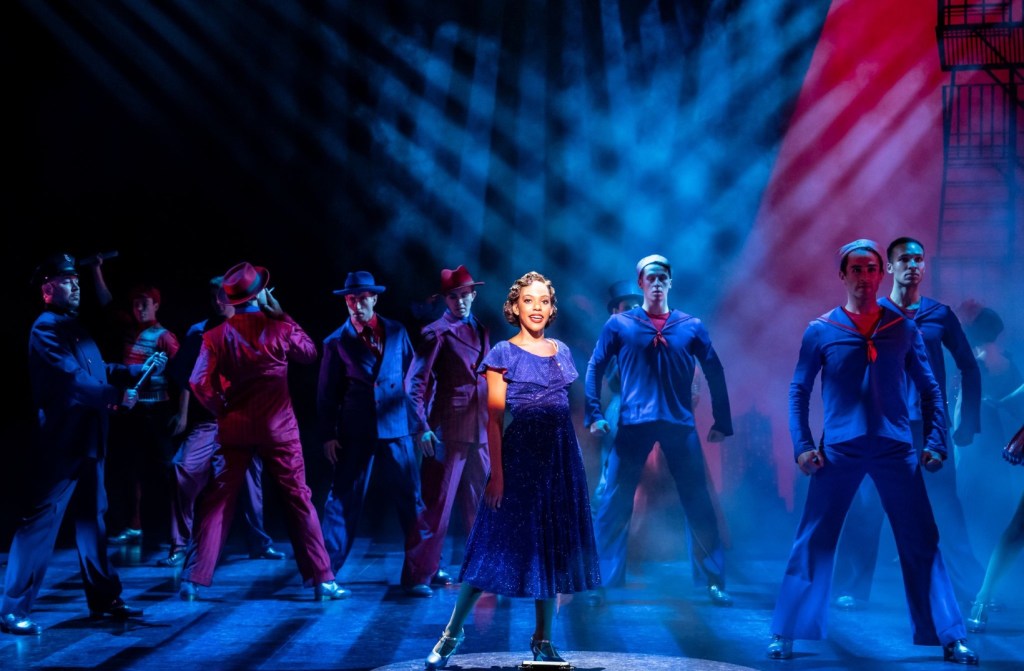
Now it’s back, in a brand new Curve Leicester production touching down at Sadlers Wells before embarking on a (substantially recast) national tour. The plot is fairly thin, but when the central performances and characterisations are as strong as they are in Jonathan Church’s new staging, which also makes a valid attempt at contextualising the show in the grim depression era rather than just presenting it as a glitzy stagey fable, Michael Stewart and Mark Bramble’s book feels like more than just a framework on which to peg a selection of Harry Warren and Al Dublin’s best known numbers.
And what beloved numbers they are: the title song, ‘We’re In The Money’, ‘Dames’, ‘Lullaby of Broadway’ and more all come up fresh as paint in Larry Blank’s suitably brassy orchestrations and sung by a uniformly strong company of voices. This production may not be as huge in scale as earlier iterations but neither does it look or feel cheap, or lacking the requisite flamboyance this show needs to really pop.
More than in any other version I’ve seen, there’s a sense that there’s a lot at stake, of artists attempting to create theatrical magic against the background of desperate financial privations, and that if the gamble of putting on this sumptuous new spectacle doesn’t pay off, then many of these people really will be on the breadline. To this end, the extended overture is punctuated by vintage film footage of a wan, destabilised 1930s America, interspersed with brief onstage glimpses, dimly lit, of auditions and gruelling dance classes. Far from sapping the fun out of this most entrancing of musicals, this extra intensity and context has the effect of throwing all the joyful stuff (of which there is plenty) into sharper, more concentrated relief.
If Adam Garcia seems a little young and down-to-earth to fully convince as hard boiled director Julian Marsh, he has an easy charm, and is pure magic in the brief moments when he gets to dance. His characterisation is further helped by the elimination of the bit of comedy business where Julian passionately kisses Peggy to elicit a specific romantic response in the script they’re working on. The recent Paris revival kept it in and, while it works, it looks borderline creepy through 2023 eyes.
Ruthie Henshall delivers far and away the most well rounded, hilarious yet oddly touching reading of diva-ish leading lady Dorothy Brock that I’ve ever seen. Magnificently venomous but with an undertow of unexpected vulnerability, she is part monster, part kitten, and entirely believable. Henshall is so magnetic that you sort-of love her even when she’s behaving appallingly, and, crucially, ignites the stage with authentic stardom when Dorothy is “performing”….difficult as this woman is, she is clearly the Real Deal. If it takes a star to play a star, then Henshall is it.
The Real Deal is a phrase that also applies to Nicole-Lily Baisden’s enchanting Peggy Sawyer. A glorious triple threat with enough energy and charisma to light up the Empire State Building, Baisden captures precisely Sawyer’s wide-eyed enthusiasm and sheer likability, but also gives her a steely edge of ambition. She’s utterly convincing too when she thinks she’s blown her showbiz dreams, and breaks your heart with her open-faced sadness. She’s fabulous.
Further down the cast list is some serious luxury casting. As Maggie Jones and Bert Barry, creators and co-stars of the musical-within-a-musical, Josefina Gabrielle and Les Dennis are a winning double act. Dennis’s Bert is a delightful loose cannon, kept (just about) on the straight and narrow by Gabrielle’s glamazon Maggie, a woman acutely aware of possible problems with her writing partner but also constantly mindful that they desperately need this gig. Gabrielle’s stage presence, ability to point a comic line, subtle playing of subtext, and sardonic way with a lyric is an object lesson in musical comedy performance, like watching an authentic Broadway diva in action, and she’s missed whenever she’s not on stage.
Sam Lips is utter perfection as the juvenile male lead, and Michael Praed lends Pat Denning, the man Dorothy loves and probably the only person capable of truly humanising her, a heart catching warmth and depth. Anthony Ofoegbu is very funny as the clueless sugar daddy that is funding Brock’s stage return while also standing in the way of her true happiness.
The tightly drilled ensemble deliver Bill Deamer’s elegant, tap-happy choreography with flair, commitment and apparently inexhaustible energy. Some of the bigger numbers threaten to raise the rafters of the theatre, and the cumulative effect is of a couple of dozen people defying you to wipe the smile off your face.
Robert Jones’s sets and costumes are attractive, employing a predominantly deep blue and gold colour pallet, periodically shot through with reds, greens and sparkle, all augmented by liberal use of projections, and gorgeously lit by Ben Cracknell. It may be a slightly more visually restrained 42nd Street than we’re used to, but it’s evocative (the titular ballet looks like a Vincente Minnelli movie musical burst into life) and opulent.
This is an intelligent but still exhilarating new slant on a much loved property. It feels fresh and vital, but has enough of the good old stuff to keep veteran theatregoers happy. Really great entertainment that sends you out into the night misty-eyed and satisfied. I defy anybody not to enjoy it.
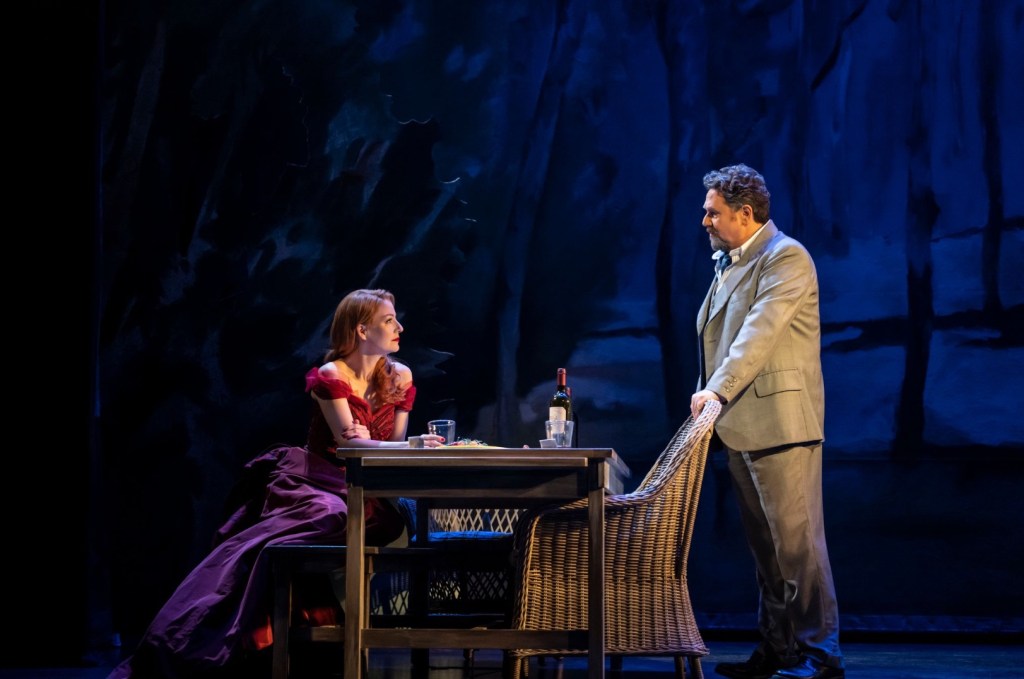
With controversy surrounding a youngster being potentially groomed by a much older man being all over the media at the moment, the timing could hardly be worse for this revival of Andrew Lloyd Webber’s 1989 musical (really a chamber opera given that almost everything is sung). Seeing Aspects Of Love in 2023 provokes the inescapable feeling that you’re watching one of the Lord’s loveliest scores unfortunately tethered to a story that seems to get more problematic with every passing year.
Based on David Garnett’s 1955 novella about bedhopping Bohemians disporting erotically and complicatedly all over Europe in the 1940s, it often felt like the poor relation in the early Lloyd Webber canon, coming as it did in the wake of Phantom, although the original London run clocked up a run of three years. Bad Cinderella and Stephen Ward would surely have been more than happy with that, and Aspects has enjoyed numerous tours, international productions and revivals since the original. It was last seen in London in 2019 at Southwark Playhouse in Jonathan O’Boyle’s exquisite bijou version from Manchester’s Hope Mill which intriguingly for a show that is sometimes tainted with accusations of misogyny put the women front and centre, with an astonishing lead performance from Kelly Price as histrionic but irresistible French actress Rose Vibert.
Jonathan Kent’s new production is less a revival than a full on revisal, switching the nationality of the central character Alex from English to American (presumably to accommodate new leading man Jamie Bogyo), changing a sizeable percentage of the lyrics, cutting, adding and repositioning scenes, altering the ages of a couple of principal characters, and reallocating Alex’s big number ‘Love Changes Everything’ to his bon viveur Uncle George.
That last alteration is one of the most successful and not just because it gives Michael Ball fans another chance to hear their idol perform his signature song (Ball was the first Alex in Trevor Nunn’s West End and Broadway premieres), which he does magnificently, albeit in a lower key. Originally a youthful declaration of the vicissitudes of love that sat slightly randomly in the score as a whole, here it is more contemplative and regretful coming from an older character. Ball still owns it though. Actually he lights up the stage whenever he is on, capturing all of George’s bonhomie, self-absorption and complicatedly conflicted emotions as the story twists and turns. It’s a charming, commanding performance, vocally winning and dramatically satisfying, that reaffirms Ball’s status as this country’s foremost musical theatre leading man.
Many of Don Black and Charles Hart’s original lyrics, always one of the weaker aspects of Aspects, have been tinkered with, mostly to positive effect, although the mind boggles that they still didn’t see fit to excise such wince-inducing horrors as “I think I know the reason you’re so keen for this to end / I saw what you were doing with your new Italian friend” or “Now tell me, do you still like omelettes?” The banality of the words contrast so jarringly with the full blown melodic lushness of Lloyd Webber’s tunes (Tom Kelly’s new orchestrations sound gorgeous as played by Cat Beveridge’s fine thirteen piece band) that I can’t help but wonder if this might be one of those rare shows best enjoyed by non-English speakers who can just experience the rapture of the music without having a clue what’s coming out of anybody’s mouth, a bit like watching an unfamiliar opera in it’s original language, without surtitles.
That said, I’m not sure the action in Kent’s pretty but ponderous staging would help anybody not listening to the words, to understand what was going on. In this rethinking, Alex is eighteen when he first meets and falls for older actress Rose (Laura Pitt-Pulford) and so is Jenny (Anna Unwin), George and Rose’s daughter (I told you it was complicated), when she in turn becomes besotted with her much older cousin. Despite the obvious talent of most of the leading players, there is zero sexual chemistry. During the idyllic first section where youthful Alex and Rose romp through the Pyrenees in the first flush of lust, you should get the overwhelming feeling that they can’t wait to rip each others clothes off, but instead this pair wander about like a couple of kids on a geography field trip. Far from adoring each other, most of the principal characters seem to barely even like each other, a problem exacerbated by some mind-bogglingly awkward blocking and misconceived musical staging.
In the original, Alex and Jenny were seventeen and fifteen respectively, so at least this new version removes paedophilia from the roll call of potentially troubling themes (incest and grooming being perhaps the two biggest no-no’s) that run through a story that seeks to be head-turningly romantic but in the wrong hands can come across as self-indulgent and not a little creepy. On paper, one would have expected a director with Jonathan Kent’s track record to be absolutely the right hands to steer this delicate but tricky ship.
Unfortunately though, in practise, he fails to make the disparate strands of melodrama, comedy and full blown romanticism coalesce, rendering an already elusive story pretty hard to follow. It all feels excessively restrained, precious and lacking in heat. Without a sense of palpable passion and the fire in their hearts and veins, the characters can come across as unlikeable, apart from Michael Ball’s George and Anna Unwin’s heartfelt, winsome Jenny.
Laura Pitt-Pulford is among this country’s finest musical theatre leading ladies, a consummate artist with heart, presence and formidable technique. Unfortunately though, her Rose feels too polite, too sensible, as though she has been directed to stay constantly at one remove from the other people on stage and from us. Pitt-Pulford sings the role terrifically but seldom finds the warmth, the earth, and the sexual magnetism to really make sense of this complex woman. I think it’s a directorial issue: for instance, during the impassioned tarantella ‘Hand Me The Wine And The Dice’ at George’s funeral, Trevor Nunn’s original Rose (the late, great Ann Crumb) danced wildly while sobbing pitifully having just scattered her husband’s ashes amongst his vineyards, it was cruel, powerful and rousing. Kent however has his Rose sit passively on a random cart on one side of the stage with her back to the audience as though waiting for the post-funeral vol au vents to be passed around. His star deserves better.
It also doesn’t help Pitt-Pulford that her leading man is so lacking in charisma that it makes nonsense of whole swathes of the story. It may be that Bogyo’s work reads brilliantly up close or in the audition and rehearsal room, but it fails to travel across the footlights; that was an issue in Moulin Rouge and it feels like an even bigger problem here where his singing is passable, but his acting is less than that. Opera star Danielle De Niese works hard and looks fabulous as George’s other great love, the Italian sculptress Giuletta, but her characterisation feels entirely too uncomplicated to convey a woman who was widowed young and suffers from waves of debilitating depression, plus the score doesn’t seem particularly well suited to her voice. There are richly enjoyable cameos from Michael Matus and Rosemary Ashe as a couple of innocent bystanders caught up in all the drama.
The staging aims for a cinematic feel but is hampered by the limited size of the Lyric’s stage (also not helped by having the musicians on a raised level at the back of the playing area, and coyly but pointlessly revealed during two orchestral sections, as though to reassure the audience that the music is in fact being played live). The use of panels with sometimes mystifying projections traversing the space during scene changes gets pretty tiresome, and a series of filmic close-ups and reveals later in act two, redolent of Michael Blakemore’s masterly original production of City of Angels or currently Sam Mendes’s vision for The Motive and the Cue over at the National, comes out of nowhere.
The uncertainty of tone and lack of palpable passion in the staging fatally blunts the emotional impact of the swooning swells and unexpected dissonances in Lloyd Webber’s score. Furthermore, this odd production makes a couple of the more eccentric scenes – a random act one visit to a fairground, and a circus sequence in the second half – feel even more surplus to requirements than in earlier versions. On the up side, John Macfarlane’s attractive, painterly scenery, ravishingly lit by Jon Clark, mean that even when boredom and/or bewilderment sets in, the whole thing is lovely to look at. It’s also often very beautiful to hear, but it’s a disappointingly pedestrian, inconsistent take on a sophisticated, conflicted musical.
So, apparently you can improve upon perfection. As Rose Rose might say, “who knew?!” When rising star director Scott Le Crass’s note-perfect production of Martin Sherman’s solo play that distils an entire generation of Jewish experience, from pogroms in a Ukrainian shtetl through the horrors of the Warsaw ghetto to the post-WW2 diaspora and a life of pragmatic plenty in America, transferred to London’s Park Theatre last year it was a total knockout. Who could imagine that a woman alone on a bench talking solidly for more than two hours could be so utterly spellbinding? Well, when that woman is Dame Maureen Lipman delivering career best work in a performance this extraordinary, it is required viewing.
She, and it, are back for a limited West End season that is on no account to be missed by anybody who couldn’t get tickets for the Park or Manchester runs (after an initial outing on screen during the pandemic, this Rose first bloomed on stage up at the Hope Mill in 2022). Anybody who went before and goes back may be struck by how much deeper and darker the production and performance now are. There’s more telling detail in the emotional highs and lows, more contrast between the dark and the light. Lipman’s Rose feels tougher somehow, even more of a pragmatic survivor. The cruelty she purports to have feels nearer to the surface, and it’s fascinating. If she’s now less ingratiating – you really feel you are encountering a woman who has looked into the yawning chasm of hell – she’s probably even more magnetic than she was before.
The late Olympia Dukakis premiered Rose at the National in 1999 before taking it to Broadway, and she was technically terrific but, not being Jewish, perhaps inevitably lacked the authenticity and intensity Lipman brings to the work. Sherman’s extended monologue is harrowing but rich, encompassing loss, hope, survival, the emotional and spiritual legacy handed down through generations, sexuality, mortality, making do….Lipman delves so deeply into the text, into this woman’s experience both personal and global, that it barely feels like acting at all.
When Rose Rose (her name is explained in the course of the play) first shuffles on in her comfy but elegant shabby-chic clothing with her immaculately coiffed hair, she seems pretty ordinary, like many other Miami Beach retirees, garrulous, warm, funny, maybe a little cranky. But Sherman’s script and Lipman’s charismatic performance go on to demonstrate that for the generation of Jews who escaped the anti-Semitic atrocities in twentieth century Europe, their lives were anything but “ordinary”, that their latter day security and contentment was hard won, their stories etched in blood, guilt and tragedy, and their survival bathed in humour ranging from ironic to gallows.
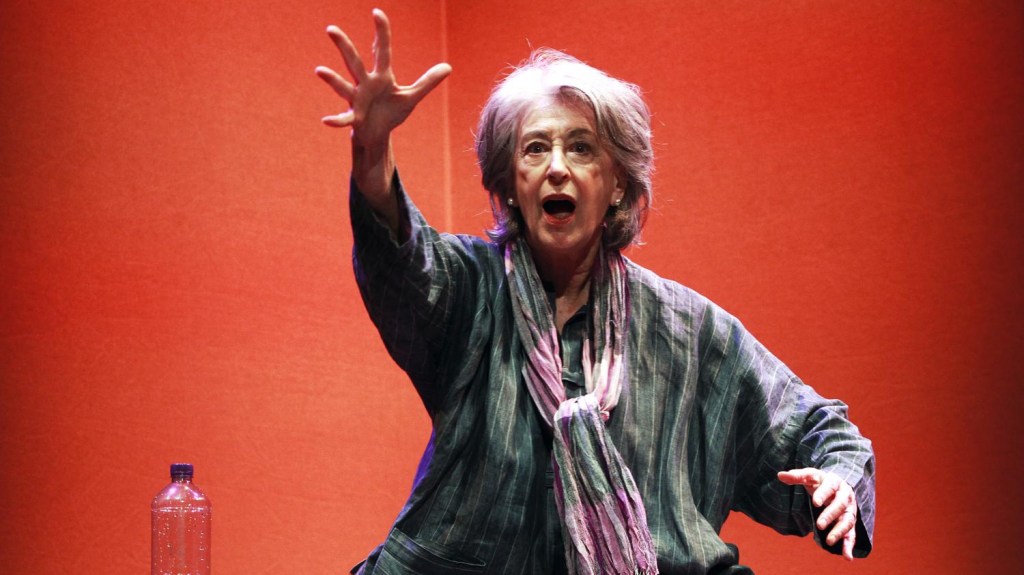
Maureen Lipman is astounding: her command of an audience, her ability to make the text sound as though she’s improvising on the spot, her lightning quick changes from cosy to cruel, chatty to profound, her timing, her authenticity, her technical precision… it all adds up to one of the greatest performances I’ve witnessed in a lifetime of theatregoing. There’s a dancer-like grace to the way her wide expressive hands whirr in front of her long, lovely face as she emphasises a point, and how her body sways as she recalls the motion of the boat that took her, all too briefly, to Palestine following the traumas of WW2 in Europe. Lipman’s face is unforgettable, mesmerising, equal parts granite and naked humanity as she vividly registers everything from memories of erotic awakening to unspeakable horror at the news of a child’s death, and blank shock at an unexpected reunion. Her accent is interesting, starting as American but becoming increasingly Mittel European as she delves back into her memories, some comforting, some hilarious, some rueful, many of them traumatic. It happens almost imperceptibly, but the detail takes the breath away.
Le Crass rightly places Lipman centre stage and matches her brilliance with a staging that is as stylish as it is unobtrusive. The pacing is exquisite and feels entirely organic, galvanising as Rose hits her stride in an especially impassioned flight of recall, sometimes slow and gentle as the text turns elegiac. Ultimately, everything Rose does, from mimicking Yiddish star Molly Picon in vintage movies to washing down her daily pills with ice cream (“I know, I know, I’m eating ice cream to take a pill for cholesterol. I’ll tell you something – who cares?”) to listening to her son berate her for sitting shiva for a child she never knew, becomes absolutely transfixing.
Jane Lalljee’s ever-changing lighting states complement the majesty of Sherman’s writing and Lipman’s acting without detracting from them, as does Julian Starr’s haunting sound score. Perhaps nothing is as powerful though as the silence in the room as the audience hangs on Rose’s every word.
This is a masterclass: Lipman is deeply moving; if she’s not as obviously funny this time around, that feels like a deliberate choice, and the opposing gain is more truth, an even more nuanced and unflinching appreciation for what this tricky, damaged, powerful woman has been through. Sherman takes us, and her, on a journey through twentieth century history that is at once a warning, a lesson and, almost miraculously, riveting entertainment. Lipman’s Rose is at once a mass of contradictions and a crucible of sheer humanity, and breathing the same air as her is an essential experience.
Operation Mincemeat has finally found its heart….and what a sentimental, thoroughly decent, and surprisingly transformative heart it is. I suspect the addition of a world class director (Sheffield Theatre AD Robert Hastie, who has already proved with Standing At The Skys Edge that he is peerless when it comes to calibrating breathtaking ingenuity with raw emotion) is a major component into turning this brilliant little show into an entirely satisfying, but still pleasingly oddball, West End triumph.
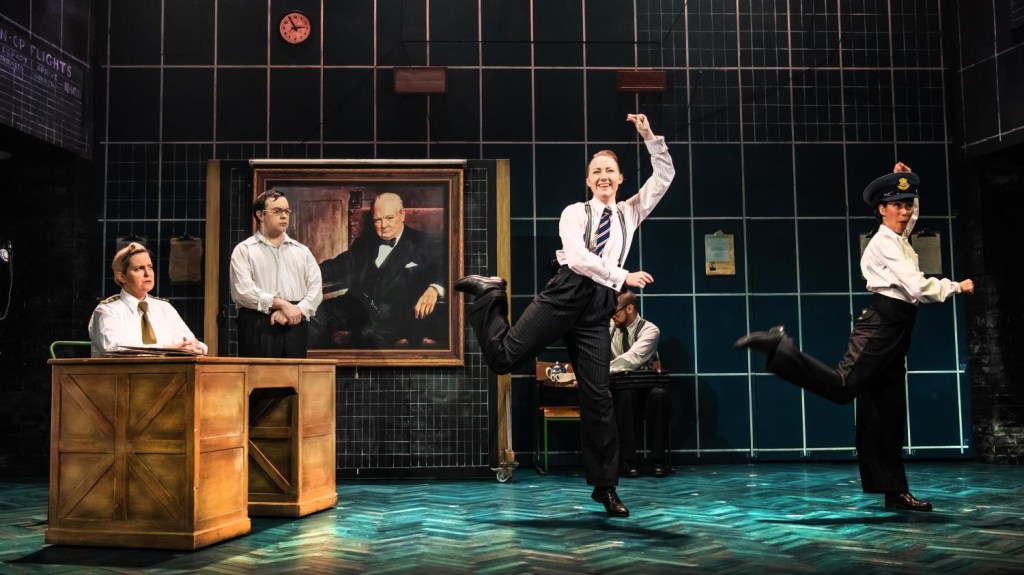
On it’s first outings at the New Diorama and Southwark Playhouse (I missed the Riverside Studios season as I felt I’d had enough by then) I found comedy troupe SpitLip’s sick (in both senses of the word) tranche of so-strange-it-could-only-be-true satirical insanity to be a ferociously clever, adrenalised mash-up of the Cambridge Footlights, Little Britain and The Rocky Horror Show. I also felt it needed to calm down, focus and breathe. It was fabulous, but a little relentless, as it told a frantic (with the emphasis on the “ick”) story centred on a real life WW2 incident whereby the British Secret Service wrong-footed the Nazis by casting an immaculately suited corpse adrift in the Mediterranean with a briefcase full of official-looking, but entirely bogus, government documents.
There was always much to admire in its energy, wit and masterly compounding of seemingly every musical theatre cliché in the book. The erudite, memorable, pastiche-heavy score references everything from Gilbert & Sullivan via Kander & Ebb and Billy Elliot to Hamilton, complete with rapping, and there’s still multiple role-playing from the same brilliant young cast (some of whom are founding SpitLip members), lots of jazz hands, and a fairly savage parody of elitist British bureaucracy. The audience continues to laugh with bitter familiarity at a group of privileged upper class men, strong on self confidence but fatally weak on everything else, bumbling insensitively and incompetently through an ever-worsening global situation.
There has been a major (non-musical) feature film since then, so the whole bizarre tale is better known to the general public, which perhaps helps this new iteration. But what is more telling and really lifts the whole glorious enterprise to a higher level is that Operation Mincemeat has unlocked a rich seam of emotional integrity that was missing earlier, except for a poignant ballad entitled ‘Dear Jack’ sung by a Home Office secretary pining for a lost pre-war lover. That number is still here, and still exquisitely put over by Jak Malone, but where previously it felt like a welcome oasis of calm amongst all the madness, within the new framework it has acquired much more power.
In another wonderful, heartbreaking development, the show focuses more on the identity of the lost soul whose cadaver is pivotal to the central plot. By acknowledging that here was a real human not just an abstract prop, the show goes into fresh, emotionally charged waters, that actually throw the playful comedy into sharp relief. Hastie weaves the different strands together seamlessly and anybody who, like me, caught the earlier versions and thought the only tears they’d shed at Operation Mincemeat would be of laughter, needs to rethink that assumption. It’s now ultimately deeply moving.
The new gravitas extends to, and informs, the performances. The same five-strong cast remain a versatile, gender-switching bunch, with fine voices, bags of energy and some serious comedy chops. But there’s real, nuanced acting now. Natasha Hodgson as the showboating, self congratulatory Montague seems to especially benefit from this. Previously her take on this fairly ghastly, but undeniably entertaining, individual was an inspired piece of clowning, but now he has a compelling undertow of melancholy, even neediness, that is so much more interesting. A brashly enjoyable comic turn has become a finely wrought portrayal that is arguably even funnier, and it’s pretty much impossible to take one’s eyes off Hodgson.
David Cumming is still essentially manic as eccentric mastermind Cholmondeley but binds all the tics and non sequiturs into a fully realised picture of a genius of a man who lives on his nerves: he is just delightful. Zoë Roberts is riotous as a clueless, “uncommonly sweaty” British attaché adrift in Spain and a gung-ho Ian Fleming forever touting his James Bond idea to his disinterested colleagues, but also finds the truth and compassion in the high powered head of department. Malone is a real find, delivering with broad yet precise brush strokes, roles as diverse as an improbably glitzy pathologist, a hearty American pilot, and a genteel, lonely, unexpectedly touching female civil servant, and he has an uncommonly good voice. Claire-Marie Hall sparkles as a new secretary determined not to be pigeonholed by her sex, and genuinely stops the show with ‘All The Ladies’, a Girl Power anthem of which Beyoncé or indeed the Schuyler Sisters would be proud.
The lyrics are sophisticated and sassy, but now, thanks to Mike Walker’s crisp sound design, they’re fully audible (they weren’t always in earlier versions) as are Steve Sidwell’s impressive harmonies. The myriad of running jokes land much better now. The storytelling is clearer than before, even if the pace and interest still flag slightly after the interval before regrouping for a lavish new finale that manages to be authentically British, utterly flamboyant and ecstatically bonkers.
It’s a total pleasure to see a piece that has grown and developed with each stage of its production history, hitting the West End with a slickness, swagger and bounce that preserves what initially made the piece so special but now renders it fit to take on the world. Everything that worked before (the hip hop dancing Nazi stormtroopers transforming in the blink of an eye to the quietly stoic inhabitants of a Naval submarine, the tangled telephone lines showstopper, Jenny Arnold’s expert choreography, to name a couple of highlights) is still here, but has been augmented and complemented by higher production values, a clearer vision, an inspired variegation of tone, and even more doses of irresistible theatrical chutzpah. Mark Henderson’s inventive lighting ups the ante further, the band led by Joe Bunker sounds terrific, and Ben Stones’s elegantly simple set undergoes a transformation that leaves most of the audience’s jaws on the floor.
Operation Mincemeat remains an ambitious, darkly humorous, highly original new musical that achieves lift off repeatedly and joyously, with some cracking songs and a shrewd brain in it’s dizzy head, but now it’s also a bit of a tearjerker with the quicksilver of real humanity coursing through the ventricles of it’s off-kilter showbiz heart, and I really did not see that coming. Pure exhilaration. Go, and if, like me, you saw it before and thought that was enough, go again.
A misandrist, according to the dictionary, is a person “who dislikes, despises or is strongly prejudiced against men”, so effectively the counterpart equivalent to a misogynist, although as a word it’s far less frequently used. Funny that.
Near the end of Lisa Carroll’s terrific new play, Elf Lyons, an incandescent presence and half of the cast of Bethany Pitts’s production, delivers a coruscating speech about the chokehold men have had over women’s lives for far too long that, in its erudition and magnificent rage, is reminiscent of Jodie Comer in the West End and now Broadway sensation Prima Facie. It’s the same sense of articulated weariness and propulsive fury that renders it almost impossible to just sit there and listen. It’s a stirring moment, an aria of indignation written and performed with such riveting precision and attack that it’s almost possible to overlook that it doesn’t feel fully integrated into what otherwise is a thoroughly engrossing, character-driven piece of comedy-drama.
If Lyons’s Rachel is truly a misandrist, she can pretty much justify it – a drunken, verbally abusive father, a cheating, blame-shifting ex – though it’s sad to reflect that a sizeable proportion of women watching this play may well have experienced at least one of these toxic male figures in their lived experience. If Rachel’s history is not particularly remarkable, her subsequent reaction to it is entirely understandable, at least at first, and Carroll’s writing and Lyons’s acting make acute psychological sense. She’s coolly defensive, extremely witty, and definitely off men, that is until she meets puppyish Nick.
Where Rachel is acid, Nick is honey: an open-faced, non-predatory charmer with a cracking sense of humour and a tinge of social anxiety that chimes well with Rachel’s own. Nicholas Armfield, in a tremendous, exquisitely well-rounded performance, invests him with a bouncy niceness that never cloys and an undertow of melancholy that suggests he’s all too aware that ‘nice guys’ often finish last. Armfield further impresses as Rachel’s salacious, functioning alcoholic female boss (hilarious) and her definitely non-functioning alcoholic father (chillingly real), but the chemistry between his Nick and Lyons’s Rachel feels wonderfully authentic, despite the obvious mismatches between the characters as they start a jokey, casual affair.
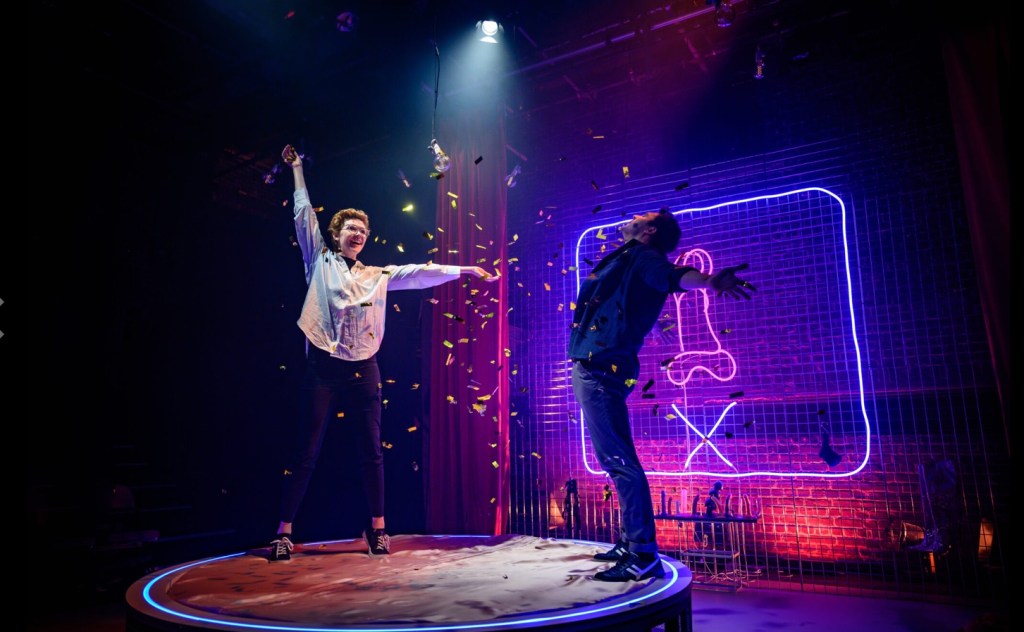
So far so raunchy RomCom, but when one of their sex sessions takes a turn for the unexpected, the play goes seriously off piste and turns into very much its own savagely funny, disturbing beast, as Rachel and Nick get into the unconventional sexual practise of pegging. For the uninitiated, pegging is where a woman straps on a fake phallus and anally penetrates a man, and there is an astonishing moment when the curtains at the back of Cara Evans’s set (which is equal parts combat arena, stand-up comedy stage and lurid sex club) open to reveal a giant neon penis and an eye-watering array of sex toys that remain in full view for the rest of the evening.
Carroll explores Nick’s reticence and Rachel’s enthusiasm with a clarity and sensitivity that deepens and darkens as a fun add-on to their sex life morphs into an obsession. You also realise while watching that the driving force, particularly for Rachel, is increasingly less about sex and more about power. Outrageously funny becomes awkward, even sinister, by stealth, and it’s all fleshed out with explosive, loaded dialogue and really magnificent acting.
Pitts’s staging, each scene amusingly having a summarising caption beamed up on the stage wall (“Meet-cute (gross)”, “Vibe killer”, “You pegged my soul”) has some gleefully meta moments and skilfully balances comic bliss with genuine unease. Watching the sunshine drain out of Armfield’s adorable Nick is hard to watch, largely because it is so brilliantly conveyed, just as his swaggering self-congratulation after first penetration is as joyful as it’s absurd, and Lyons makes vivid Rachel’s less admirable traits yet, almost miraculously, never forfeits sympathy for her. Carroll’s writing is crisp, contemporary and painfully honest, shot through with belly laughs and moments of raw shock. Structurally, the play meanders a little as it flirts with a number of dramatic genres and feels as though it could have benefitted from maybe one more draft to be something really special, but it’s never less than engaging. At its most dramatic and most impressive, it recalls Patrick Marber’s Closer in its unflinching frankness and urbane wit.
All in all, this is a very satisfying couple of hours of theatre. There’s nothing like a trip to Dalston to broaden your horizons.
Kane Verrall, Marcus J Foreman, Charlotte East, image courtesy of East Photography
NUL POINTS!
by Martin Blackburn
directed by William Spencer
Union Theatre, London – until 20 May 2023
It’s that time of year again….when Eurovision fever grips the nation (or at least for those who celebrate) and taste, restraint and anything remotely beige goes straight out of the window. It can also feel like an early start to Pride season, and William Spencer’s production ticks a number of the boxes that a predominantly gay crowd will look to get filled (behave!) when picking a theatrical night out around the longest running televised annual music competition in the world.
The overall experience is certainly camp: David Shields’s enjoyably garish London apartment design is an eyeful of musical theatre memorabilia (including a poster for cabaret trio Fascinating Aida, one of whose members – Adele Anderson – is in this cast), kitschy wallpaper and fairy lights, and past Eurovision performances run on a continuous loop upon a giant screen in the Union’s bar, which is serving a speciality cocktail of (what else?!) Bucks Fizz.
It looks like the perfect set-up for a night of rainbow-spattered, gay-centric joy, with a trio of drama students (two gay boys, one straight woman) settling down to watch the 2012 contest, buoyed up by Bucks Fizz and bants. Writer Martin Blackburn certainly has a realistic handle on the insecurity and low level jealousy inherent in fledgling acting careers. Josh (a nicely enthusiastic Kane Verrall) has the hots for cute but vacant Daz (Marcus J Foreman) much to the amusement of Kat (Charlotte East, very good) and the party is gatecrashed by stripagram cowboy Ryder (Sean Huddlestan, miscast but investing his character with a lot more charm than he has in the text) who has turned up at the wrong flat. It all feels a bit sub-Jonathan Harvey (who wrote his own, rather lovely, Eurovision tragicomedy Boom Bang-A-Bang seen at the Bush in the 1990s) but it’s perfectly watchable, littered with ESC trivia, musical theatre references and catty one liners (“Less gays have seen Wicked than your arse” is one of the better ones).
Unfortunately though, Blackburn has loftier pretensions. Having hit on the neat idea of making each scene a separate year and a separate ESC watch party to show the progressions and changes in the protagonist’s lives as the years pass (the first half runs through to 2015 while the second half shows 2022-3), Blackburn fudges it by trying to introduce serious themes that the sketchily drawn characters and rudimentary, flavourless dialogue -heavy on cheap jokes but light on illumination- are unable to support. The #metoo movement, suicide, child surrogacy, chronic guilt, celebrating the departed, the decline of the UK in the last twenty five years, all get trotted out and then discarded like so many Union Jack party hats after a festive night out.
Adele Anderson lends a worldweary elegance and wit as Josh’s unlikely mother. To be honest, on press night the usually divine Ms Anderson wasn’t quite on top of her lines, but being word perfect wouldn’t make sense of a character who we are seriously asked to accept is the lady of the manor in an Aberdeenshire estate while also a Eurovision and Strictly obsessive, a serial destroyer of any canapés she puts in the oven (a running joke that never gets past the start line) and the sort of woman who used to get puke-drunk on Malibu in cheap nightclubs, but then mysteriously becomes an online sensation. It may be that Blackburn intended to create an AbFab Patsy Stone type but the writing and performance just don’t deliver that and instead we are left with an accomplished artist struggling, and failing, to join some impossible dots.
There are moments when Spencer’s production veers towards farce but there isn’t the precision in the blocking or the playing to make that work. The plot borrows effectively from a certain long running West End ghost/thriller play (no spoilers here) and ends with an unexpected volte face that, while mawkish, is pretty impressive. Blackburn has a strong grasp of theatricality but doesn’t seem able to decide exactly what his script is supposed to be. It’s not really a comedy (it’s not that funny), it’s not a drama (the characters aren’t well developed enough), and it isn’t joyful enough to be a true Eurovision celebration. There’s a distinct whiff of misogyny about the female characters, which Ms East’s open-faced emotionalism goes some way to dispelling, and the trope of gay men who will shag anything, despite being in a relationship, feels well worn to the point of being totally exhausted.
The game cast work hard but the whole show feels under-rehearsed and uneven. It’s not exactly nul points, but it’s certainly no winner.
If you love theatre, you’re going to want to see this. It’s as simple as that. If you’re interested in the craft, the process of play-making, you’re going to need to see this. If, on top of all that, you’re fascinated by old school stardom of a bygone era – specifically Richard Burton and Elizabeth Taylor and, for those with more classical taste, Sir John Gielgud – then it’ll be like all your Christmasses have come at once. Jack Thorne’s engrossing new play is a love letter to the theatre and, in Sam Mendes’s beautifully calibrated, elegantly flamboyant production, looks likely to be the biggest smash hit the National has had with a piece of new writing on one of its main stages since Alan Bennett gave us The History Boys.
Thorne’s scintillating piece centres on the famous Burton Hamlet which Gielgud directed on Broadway in 1964. Burton and Taylor were newly weds at the time and the new bride had put her lucrative Hollywood career on hold temporarily to be in New York to support her husband. The play alternates between rehearsal room and various opulent NYC locations as the Burton-Taylors entertain, Richard struggles to find “his” Hamlet (as opposed to the one he feels Sir John is trying to impose upon him) and Gielgud overcomes his own demons as he struggles to stay relevant but true to his craft. There are glimpses of the alcoholism that will eventually cost Burton his reputation and then his life, and Broadway obsessives will love noting that the character list includes veteran actor Hume Cronyn and star Alfred Drake (the original Fred/Petruchio in Kiss Me Kate) both of whom were in the ‘64 Hamlet cast.
The play would have worked well enough as a gossipy, glamorous backstage drama but Thorne is interested in rather more than that. The Motive And The Cue (the title is a quote from one of Hamlet’s speeches, and refers to the intellectual reason for something and the passion to ignite it into being) examines why the theatre and storytelling are so important, and the legacy handed down through generations, both onstage and off. It also looks with great sensitivity at the isolation that a high profile artist who was also gay would have had to endure in those less enlightened times (there’s a particularly moving sequence when a lonely Gielgud picks up a male prostitute for company and the result is entirely unexpected.)
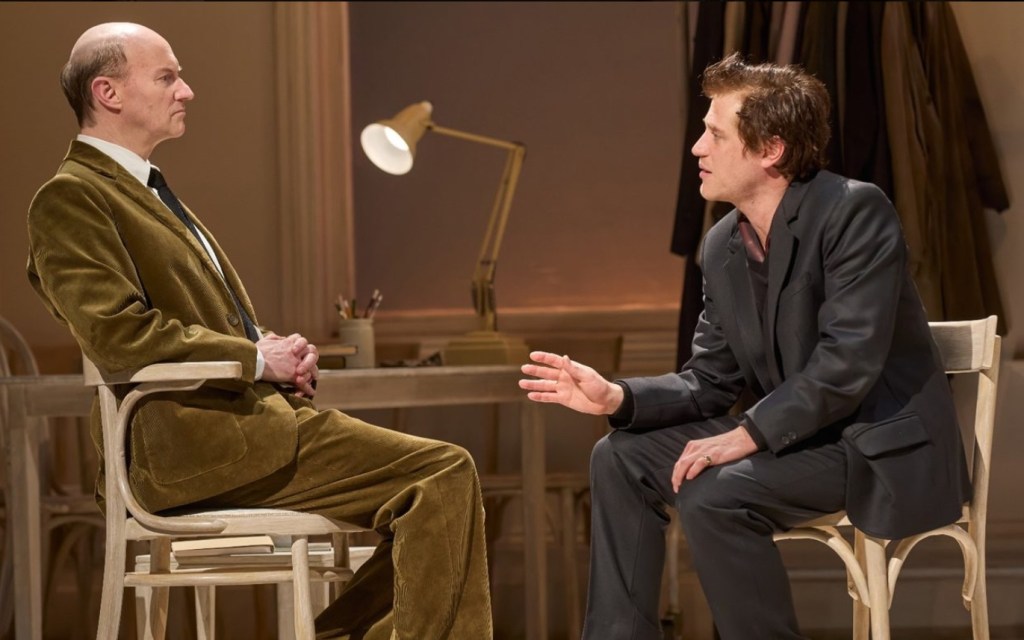
As Gielgud, Mark Gatiss delivers career-best, uncanny work. Not only does he look and sound just like him, but he captures his essence, his wit, his charm, his occasional tetchiness, and an underlying melancholy. At a time when so many things on stage and screen are hailed as “great”, this truly is a great performance. Johnny Flynn’s Richard Burton is almost as impressive, projecting the swagger, sexiness and bonhomie but also the sense of a lost soul. He’s likeable and maddening, irresistible yet on his way to being potentially a bit seedy. Flynn impersonates the compelling rasp of the Burton tone with real accuracy, even if the swoonworthy depth of timbre is sometimes missing.
Tuppence Middleton is a slightly one-note Elizabeth Taylor, and looks nothing like her, but is a suitably flashy presence in Katrina Lindsay’s period-gorgeous costume designs. Janie Dee is underused but still glorious as a veteran stage actress while Luke Norris and Allan Corduner do vivid, rich work as two main players, and Laurence Ubong Williams is quietly devastating as the young man from the New York streets who briefly connects Gielgud with his humanity.
Although it’s a play about theatre, Mendes, in tandem with Es Devlin’s striking set designs, gives it a cinematic sweep and motion, as walls expand and contract as though to focus or wide-shot scenes and moments. There is though a lot of theatrical magic here, from the act one closing sequence where Gatiss’s Gielgud quietly, and alone on stage, runs through a Hamlet speech with such understated brilliance, or the section where Gielgud and Burton find the common ground to make this particular Prince of Denmark resonate for the new actor playing him and Burton thrillingly delivers, or the spinetingling final section which is pure showbiz but also pure class. Thorne’s writing is erudite, punchy and heartfelt.
Ultimately, this terrific play and production is the closest this generation will probably get to seeing the particular greatness of Gielgud and Burton, but they will be seeing authentic greatness nonetheless, right here on this stage. With it’s famous characters, classical references and New York setting, I suspect The Motive And The Cue will turn out to have very long legs and wide ranging international appeal, but Flynn and especially Gatiss may prove very difficult to replace.

 ajhlovestheatre