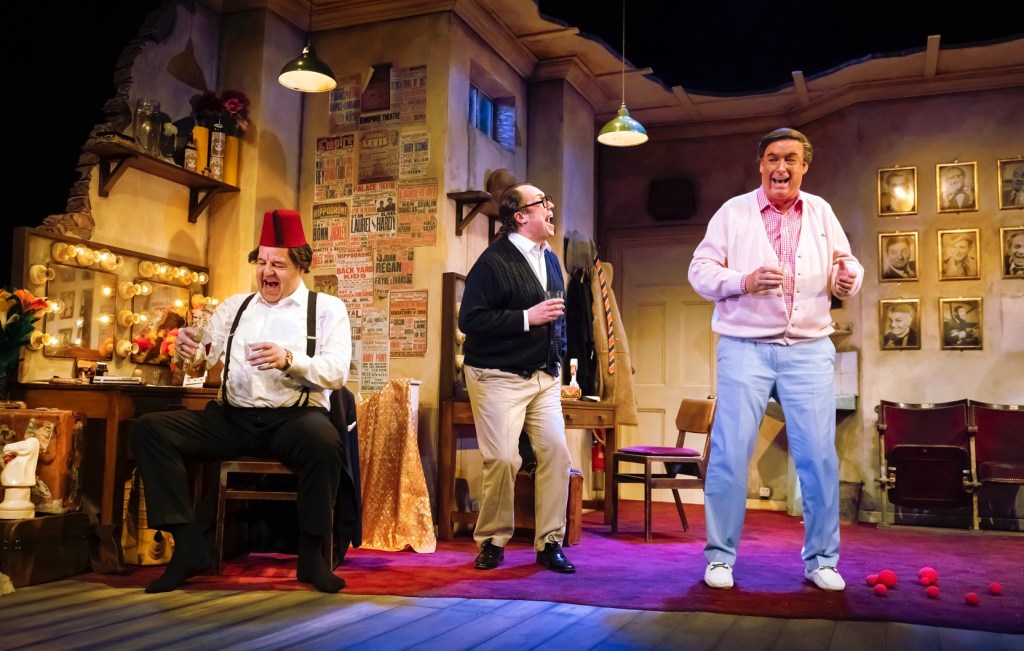
How would you react if you received a massive poo by post from an anonymous sender? That’s the starting point for Dave Florez’s snappy comedy, a merry three hander that begins in a state of amusing revulsion and ends up being an entertaining, if not particularly deep, look at sibling relationships in early middle age and what happens when a marriage loses its sheen.
The Gift is populated by the sort of sweary, affluent North Londoners (the loss of a table reservation in a Crouch End sushi restaurant is the source of almost as much consternation as the origin of the offending turd in the first scene) you might expect to find in the audience at the Park Theatre, although it also feels like the sort of script and production that would have played for years in the West End a couple of decades ago. With its bourgeois characters antagonising each other but fundamentally being full of mutual affection beneath the surface irritations, it reminded me a little of Yasmina Reza’s long running Art.
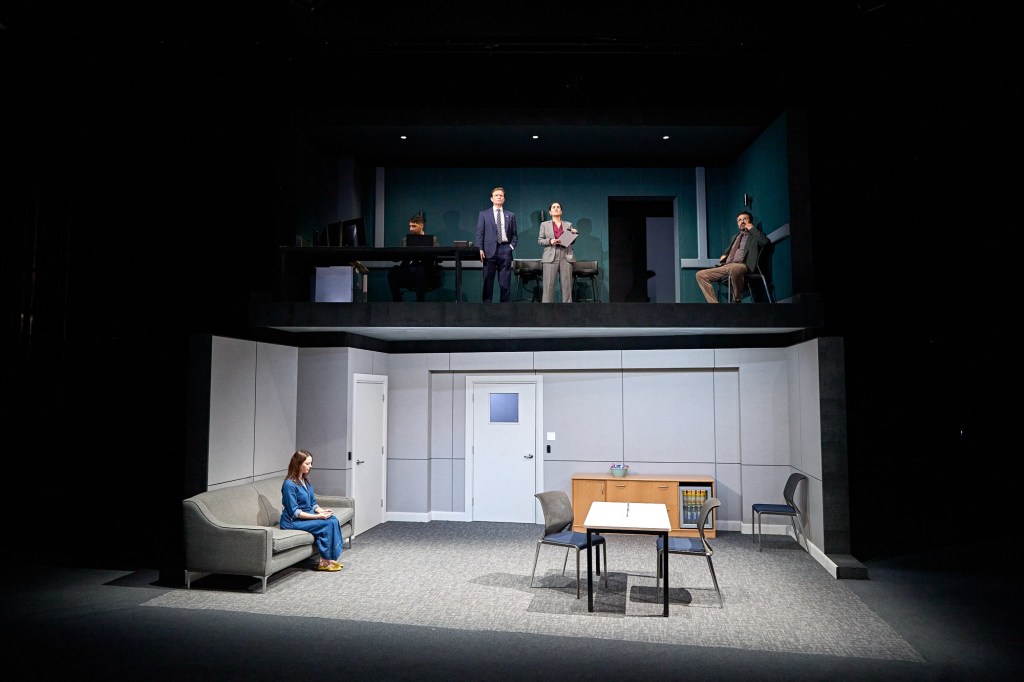
However, where the catalyst for that stroppy trio being at each other’s throats was an all white modern painting, here it’s an excremental MacGuffin in a patisserie box that spurs self-obsessed advertising exec Colin (Nicholas Burns) into paroxysms of navel-gazing while the tensions in the marriage of his sister (Laura Haddock) to his best friend (Alex Price) are exposed. It’s pretty slight but a lot of fun, and Adam Meggido’s crisp staging, played out on Sara Perks’s suitably soulless urban kitchen-cum-living room set, thrums along persuasively, though I’m not convinced it would be quite so satisfying, or plausible, without such a tremendous cast.
Florez’s creations aren’t bad people but nor are they entirely good, and it’s in those grey areas that the majority of the play’s dramatic meat is to be found, as well as some tangy psychological insights. Burns and Haddock make convincing siblings: he, boisterously unruly and emotionally incontinent while she is warm but incisive with an intriguing mean streak. Price makes something sharp, funny and relatable out of the blustering, opinionated sweetheart stuck in the middle of them, whose attempts to resolve a tricky situation don’t go according to plan.
Florez’s dialogue is smart and nicely turned, provoking chuckles rather than uproarious laughter perhaps, and I doubt I would have bought into the play’s premise (would somebody even as hysterical as Colin really devote so much time to hunting down past loves and foes to discover who might be his toilet-based tormentor?!) if the acting weren’t so good. It ends on a sweet, uplifting note that feels fitting for a comedy that is ultimately less outrageous than it thinks it is. The Gift is a sharp, cute, engaging piece of theatre that probably won’t linger long in the memory but makes for a thoroughly diverting night out that’s likely to be extremely popular.
Geraldine Sacdalan and Lara Denning, photograph by Matt Crockett
& JULIET
Music and lyrics by Max Martin
Book by David West Read
Directed by Luke Sheppard
on National UK tour – at New Wimbledon Theatre, London until 1 February 2025 then tour continues to Aberdeen, Leicester, Dublin, Woking, Bradford, Milton Keynes, Nottingham, Birmingham, Southend, Stoke, Sheffield, Newcastle, Truro and Cardiff
running time: 2 hours 40 minutes including interval
With a unique combination of Shakespearean quotes, wise-cracking humour, garishly beautiful spectacle and some of the most uplifting pop bangers of the ‘90s and the ‘00s, & Juliet is the classiest of jukebox musicals. This reimagining of what might’ve happened if Juliet chose NOT to drink the poison when she thinks Romeo has died, is populated with familiar pop numbers by Max Martin, whose name may not be familiar to the lay person but whose songs (Katy Perry’s ‘Roar’, Britney’s ‘…Baby One More Time’, Pink’s ‘Perfect’, Bon Jovi’s ‘It’s My Life’, Backstreet Boys’s ‘I Want It That Way’ and ‘Backstreet’s Back’…the list is endless and all featured here) most certainly are. Surely there are few modern musicals more tuneful or as rambunctiously life-affirming, and seeing it again in this energetic, exhilarating touring version reconfirms why it ran so long in the West End and has enjoyed international success (the Broadway iteration has already been playing for a couple of years and shows no signs of moving on).
Book writer David West Read is one of the scribes on TV’s beloved Schitt’s Creek and his script for this gorgeous tuner has some of the same off-the-wall wit tempered with moments of surprising emotional depth. He also borrows liberally from the Bard (and not just Romeo and Juliet) so that one moment a character is using modern parlance (there’s a bracingly contemporary, if simplistic, attitude to relationships and gender) and the next they’ve switched seamlessly to verse. The songs of course are utter earworms that would carry the evening even if almost everything else wasn’t so enjoyable.
Luke Sheppard’s production, dressed up with Jennifer Weber’s dynamic, pop video-inspired dances and the dazzling designs of Soutra Gilmour (set) and Paloma Young (costumes) which fuse Elizabethan ruffs with clubwear and pop art with Olde Worlde elegance, is a turbo-charged treat. It feels a little scaled down from the original and what you can currently see on Broadway (there’s no revolve or rising platform, Juliet only has one parent now, and the vehicle that conveys the leading players from Verona to Paris has been downgraded from an elaborately decorated caravan to a lightbulb-strewn rickshaw) but it doesn’t matter much.
If the physical production is a tad disappointing for anybody who’s seen the show in one of its sit-down versions, the fizzing energy of the cast makes up for it, and other elements (Howard Hudson’s entrancing lighting, Andrzej Goulding’s video designs and Bill Sherman’s consistently enthralling orchestrations and arrangements) remain transporting. This is about as much fun as you can have in a theatre, and Sheppard crucially never loses sight of the humanity amongst the roving spotlights, confetti cannons, camp humour and bravura belting.
The lynchpin to that humanity, and indeed to the overall success of this edition of & Juliet, is a sensational performance from Lara Denning as Shakespeare’s wife Anne Hathaway, whose efforts to rewrite her husband’s male-centric trajectory for our heroine exposes the fault lines in her own marriage. Denning has the inspired comic instincts of a true clown as Anne inserts herself into Juliet’s story as her hyper-supportive “yasss girl” best friend, but also conveys with piercing emotional clarity the hurt and rage of a wife sidelined by the ambitions and perceived indifference of the husband she adores. Vocally she is stunning, with a rich, rangy diva-esque belt of many colours, culminating in a shatteringly powerful second act version of the ballad ‘That’s The Way It Is’ that pretty much out-Dions Céline. This is a star turn, full of detail, craft and sheer charisma, that ought to catapult Ms Denning to the top of every casting directors list of multi-faceted musical leading ladies (producers of Death Becomes Her, which surely must be making West End plans, please take note).
As is appropriate for a show that trumpets female empowerment, the women really lead from the front here. Newcomer Geraldine Sacdalan’s Juliet is a hyperkinetic ball of charm, enthusiasm and love. Tiny but mighty, she reads as palpably younger than Miriam-Teak Lee originally, and feels like an actual teenager even more than Lorna Courtenay who premiered the role in North America. This Juliet is a beguiling fusion of can-do attitude, boundless but never obnoxious self-confidence and an irresistible generosity of spirit. She also has a tremendous voice, fearlessly and accurately attacking the role’s taxing demands. Sandra Marvin as the doting Nurse with a romantic past of her own is a weapons-grade delight: a hilarious, deeply lovable belter with a mega-watt smile as big as her heart, she’s just fabulous.
Jordan Broatch finds real melancholy but also great humour and a core of steel in Juliet’s non-binary friend May and Kyle Cox makes the young Parisian aristocrat they fall for into an utterly adorable goofball, permanently in the grip of mindless apprehension until he recognises his authentic self. TV star Ranj Singh plays his imperious father and, while he lacks the virile authority of his predecessors David Bedella (London) and Paolo Szot (Broadway), he proves a surprisingly adept song and dance man, and has a terrific rapport with the divine Ms Marvin. Jay McGuiness, formerly of boyband The Wanted, is Shakespeare and, surprisingly given his pop background, turns out to be a better actor than singer, offering tentative vocals but capturing the youthful swagger and arrogance of the feted writer. He doesn’t as yet fully convey William’s distress when he realises how close he has come to losing his beloved Anne, but his performance is likely to grow as the tour continues.
Seeing multiple casts take on these roles and bring their own strengths and hues is testament to the malleability of West Read’s writing and Sheppard’s vision: & Juliet feels a lot less ‘cookie cutter’ from company to company than many other long runners, and that’s a rare and beautiful thing. So too is the sheer joy and delight it elicits from paying customers. This remains a thunderous crowd pleaser, one that, for a couple of technicolored hours, makes the world seem like a brighter, kinder place, and right now that’s something we could all do with. The magic continues.
Anybody wondering if theatre can still be truly relevant needs to see Kyoto. It’s an epic full of fire and fascination, a cracking piece of entertainment with a deeply serious core. Of course, authors Joe Murphy and Joe Robertson, and their Good Chance Theatre company who are co-producing with the Royal Shakespeare Company, have form when it comes to creating theatre that breaks the normal rules of playmaking, while speaking urgently to the world we live in now.
Murphy and Robertson were the iconoclastic creatives behind 2018’s The Jungle, which was developed and set in the Calais refugee camp, and went on to win acclaim and prizes globally. That was a rich tapestry of humanity characterised by a searing intelligence while simultaneously wearing its heart on its sleeve, and this is similarly stirring and impressive.
Kyoto, centring on the historic 1997 international climate change conference which saw an unprecedented unanimity from global representatives to drastically cut carbon emissions, is a glossier affair, as thrillingly directed by Stephen Daldry and Justin Miller, but has the same grit, compassion and bravura theatricality. In a series of punchy vignettes, Murphy and Robertson dramatise the run-up to the Kyoto summit, all watched over by a Mephistophelean narrator, oil lobbyist Don Pearlman (a powerfully laconic Stephen Kunken). Facts and figures are hurled at us by actors and from video walls at rear of the playing area and all around the auditorium, yet the individuals doing the talking, while little more than sketches in some instances, resonate strongly as human beings. The command and delivery of information recalls James Graham at his most meticulous and energised, while the dynamism of the deluxe staging suggests a team of creatives at the very top of their game.
A terrific international cast, representing delegates from all over the world, ricochet around Miriam Buether’s imposing, all-encompassing conference room set (which features actual audience members seated at the central circular table), dextrously changing character and appearance in the blink of an eye, bringing to life a fascinating array of people, some familiar, others less so. Ferdy Roberts is a bluntly funny, sympathetic John Prescott representing the EU, and Kristin Atherton captures accurately Andrea Merckel’s unique blend of warmth and severity. Jorge Bosche is a ribald delight as Raúl Estrada-Oyuela, the Argentine diplomat who brokers the Kyoto Procotol with a mixture of bonhomie and bloody mindedness, and Nancy Crane makes a strong impression as the embattled American delegate.
Daldry and Miller employ a flamboyant raft of theatrical techniques to flesh out this compelling story, but the focus, despite all the sound and fury, never wavers. The stagecraft on display is dazzling… this is tremendously exciting total theatre, propulsive and vital, yet the clarity and gravitas are never sacrificed to mere entertainment.
But entertaining Kyoto most certainly is, playing out with the grip and menace of a thriller, as the ‘Big Oil’ controllers, who fund and influence Pearlman, appear out of the murk like the Seven Sisters of the Apocalypse, accompanied by Paul Englishby’s threatening sound score. If that sinister group represents the darker forces pulling at the morally ambiguous Pearlman then his questioning, good-hearted wife (lovely performance by Jenna Augen) personifies the light.
It’s also frequently very funny, sometimes bleakly so, such as the sequence where Pearlman introduces delegates one by one at the conference before stating the carbon emissions caused by each individual’s international journey. The laughter catches in our collective throats though when it is revealed that the fossil fuel conglomerates have been aware of the damage to the planet since 1959 but chose to suppress the information. Remarkably, the play never descends into preachiness, but the sense of time being of the essence for this compromised planet is palpable, and the raw excitement and catharsis to the final thrashing out of the agreement is pure drama, and becomes genuinely moving.
Whether observing from the sidelines, cynically haranguing the audience, or cracking open with rage, Kunken achieves a magnificent UK stage debut. Murphy and Robertson charge the real life figure of Pearlman with a similar jet black wit and energy as Tony Kushner found for the admittedly more openly malevolent Roy Cohn in Angels In America. The writing is caustic, muscular and literate, peppered with wit and expletives.
The production ends on a quizzical, visually arresting note – Pearlman’s widow alone on stage as the cherry blossom dances around her – that initially feels hopeful and poetic but cools to downright chilling when you recall the Japanese diplomat’s repeated point that the blossom falls earlier every year due to alterations in the climate. This utterly brilliant show, a smash hit in Stratford-Upon-Avon last year and surely on course for further success in London and probably beyond, is a clarion call for change, for mutual understanding and collaboration, and for holding our leaders to account. It should also be on every school’s curriculum. Essential, unforgettable, and, hopefully, life-changing theatre. You have to see this.
Based on Sergey Fetisov’s memoir and its acclaimed film adaptation, Richard Hough’s new play is a gay love story set against a background of modern history in Soviet Union-occupied Estonia in the late 1970s. Combat pilot Roman (Robert Eades) meets aspiring actor Sergey (Theo Walker) who is whiling away his Russian National Service on a Tallinn airbase, just as the Soviets join the war in the Middle East, heightening Cold War tensions. Owen Lewis’s production is peppered with recordings of Brezhnev’s speeches at the time, conveniently translated into excitable English.
Firebird as a script has a surprising amount of humour, given its setting and themes, and is gripping enough that you seldom notice how uncomfortable the seating in the Kings Head’s main house is. There’s also an unadorned brevity that doesn’t fully do justice to a story that should be more gut-wrenching than it appears here. It’s hard to know if it’s the acting or the writing, but the urgency of feeling between the two men doesn’t really come across, and they go from illicit kisses to full-on co-habiting in just a few pages of script, rather as though crucial scenes for the storytelling were somehow jettisoned or lost during the creative process, an impression further reinforced as the play continues. The tragedy that engulfs the principal characters doesn’t sear as one hopes it might.
Eades is all chiselled physical perfection as the man devoted to his flying career until love derails that (somewhat) but is a bit stilted in his delivery of the dialogue, while Walker brings a boyish self-possession to the more emotionally available Sergey. Apart from some snogging and teasing removal of shirts, the connection between the men seems unhelpfully tepid: there’s very little chemistry.
Intriguingly, the heterosexuals fare much better in this play. Nigel Hastings delivers a compelling, multi-layered account of Colonel Kuznetsov, a high ranking air force official who may just understand more than he lets on. Hastings convincingly conveys the humanity beneath the starched authoritarianism in a beautifully modulated performance. Even more fascinating is Sorcha Kennedy, marvellous as Luisa, the Estonian clerical worker who befriends Roman and Sergey before becoming unwittingly embroiled in their personal lives. Kennedy invests this good-hearted young woman with irrepressible warmth and sass, but also an endearing vulnerability. There’s a moment where the penny drops about the true nature of Luisa’s best friends‘s relationship and Kennedy plays it exquisitely. There’s a Rattigan-esque wistfulness and delicacy to a scene where Luisa meets with her former boss Kuznetsov over tea and confesses to her isolation and depression in the wake of an unwise marriage, and a rueful final scene between Luisa and Sergey is beautifully, heartbreakingly well done.
Lewis’s staging is strong on atmosphere thanks to Gregor Donnelly’s suitably grim period setting and a striking lighting design by Clancy Flynn. It’s also heavy on music and sound effects (nice work by Jac Cooper) although the lengthy scene transitions have a tendency to interrupt the storytelling flow.
Altogether this is an agreeable ninety minutes but it doesn’t hit as hard as it should. There doesn’t feel that there is as much at stake as there should be, but it’s a highly watchable insight into a recent period of modern history, lent an added piquancy by the fact that it’s true story.
Musical theatre doesn’t get much crazier than this. Titanique, the off-Broadway sleeper hit that marries the Céline Dion songbook to a jawdroppingly irreverent replay of the James Cameron blockbuster movie about the infamous passenger ship disaster, has docked in the West End amid much hilarity and mayhem. Tye Blue (who also directs), Marla Mindelle and Constantine Rousouli (who respectively played Céline and Jack originally but sadly don’t repeat their performing work for London) have created a caffeinated campfest loaded with pop culture references, anachronisms, visual jokes and banging tunes. It doesn’t take itself remotely seriously and anybody turning up thinking this is a revival of the classy Maury Yeston-Peter Stone tuner Titanic is in for one hell of a shock.
The show’s premise is that the divine Dion, interrupting a tour of the Titanic museum while dressed as a bag lady, was actually ON the ill-fated ocean liner and is keen to share her recollections, all while screlting in sequins of course. Blue, Mindelle and Rousouli adopt an attitude to the original story and their reinterpretation of it that might most accurately be described as scattershot. One of the ships mates is dressed as one of the Mario Brothers and named Luigi because, well, that’s what he looks like, a power-belting Molly Brown (Charlotte Wakefield, fabulous if a trifle youthful) is repeatedly referred to as Kathy Bates because that’s who played her in the film, and one of the movie’s other stars Victor Garber (gleeful Darren Bennett) is similarly commemorated. Meanwhile heroine Rose’s villainous fiancé Cal (Jordan Luke Gage, all hilarious snarls and pouts, with a roof-scraping vocal belt) has a face full of make up and a Grindr profile, and her scheming Mum is played by a man in an alice band with pigeons stuck to it (gorgeously scenery-chewing Stephen Guarino, imported from the American production) ….and wait til you see how they do the iceberg.
There’s audience interaction, lip synching à la Drag Race, a couple of improvisation sequences that don’t land as well here as they did in the New York original, a life size cardboard cutout of Patti LuPone gets bandied about for no very intelligible reason, and some ‘British-isms’ have been inserted (including references to The Traitors and Eastenders) for London. It’s tremendous fun, revelling simultaneously in its own ridiculousness and in the portentous seriousness of the film, even if Blue’s rumbustious staging still feels better suited to the basement comedy venue in Manhattan’s Chelsea district where it originated, than to a grand proscenium arch theatre. In that more modest setting, it was slightly less obvious that there are a couple of sections where the humour gets self-indulgent to the point of temporarily losing its audience or that the central romantic couple have one or two too many jokey duets.
These are comparatively small quibbles though in a piece of joyful theatrical frippery that knows exactly what it is and who it’s aimed at. Perhaps surprisingly for a show aimed so squarely at the funny bone, the musical aspect is stunning. Nicholas James Connell’s orchestrations and arrangements are fresh and vital, and played by a band that’s tighter than the sailors uniforms in those homoerotic Jean-Paul Gaultier perfume TV ads. The vocals are uniformly wonderful, and there are frequent moments where the company is singing en masse that take the breath away. Ellenore Scott’s choreography finds the sweet spot between slickness and the scrappy, off-the-wall quality that distinguishes Titanique from more conventional musicals.
A charismatic Lauren Drew sings up a storm and captures Céline’s unique combination of diva bravado and childlike enthusiasm but hasn’t, as yet, found the warmth, authority or sheer lunacy that made Mindelle’s original creation so memorable. The performance of the night comes from newcomer Kat Ronney as the much maligned Rose: a brilliant physical comedienne with a sensational, versatile voice, she unerringly locates the middle ground between sincerity and bonkers that drives this outlandish show, and she even looks a bit like Kate Winslet in the film. Opposite her, Rob Houchen isn’t perhaps a natural clown but has charming, athletic presence and terrific vocals. Layton Williams plays a couple of roles as, er, Layton Williams mostly but is great value.
Ultimately, this is an almost aggressively feel-good night out. Yes, it’s a little baggy and messy, and worked better in a less glossy iteration and an unconventional performance space, but it’s more exhilarating than exhausting (just), the affection for La Dion is unmistakable and the camp joy generated is enough to power a dozen cruise ships. “My heart will go on” proclaim the lyrics of Titanic’s signature tune, a major hit for Céline Dion and here given the inevitable audience singalong treatment, and so, I suspect, will Titanique.
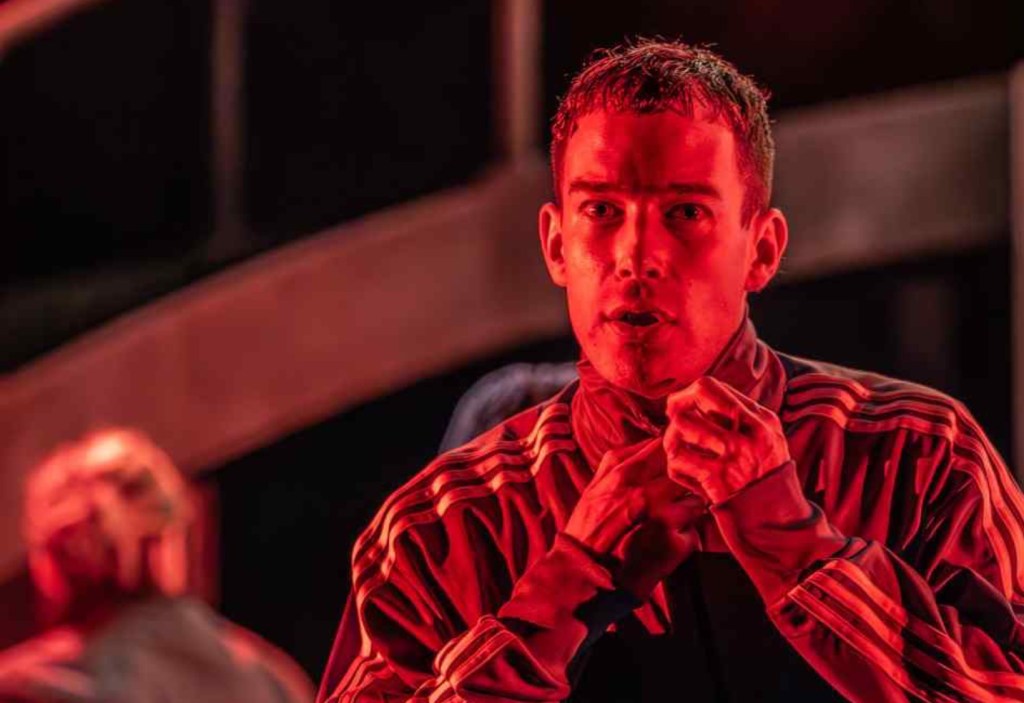
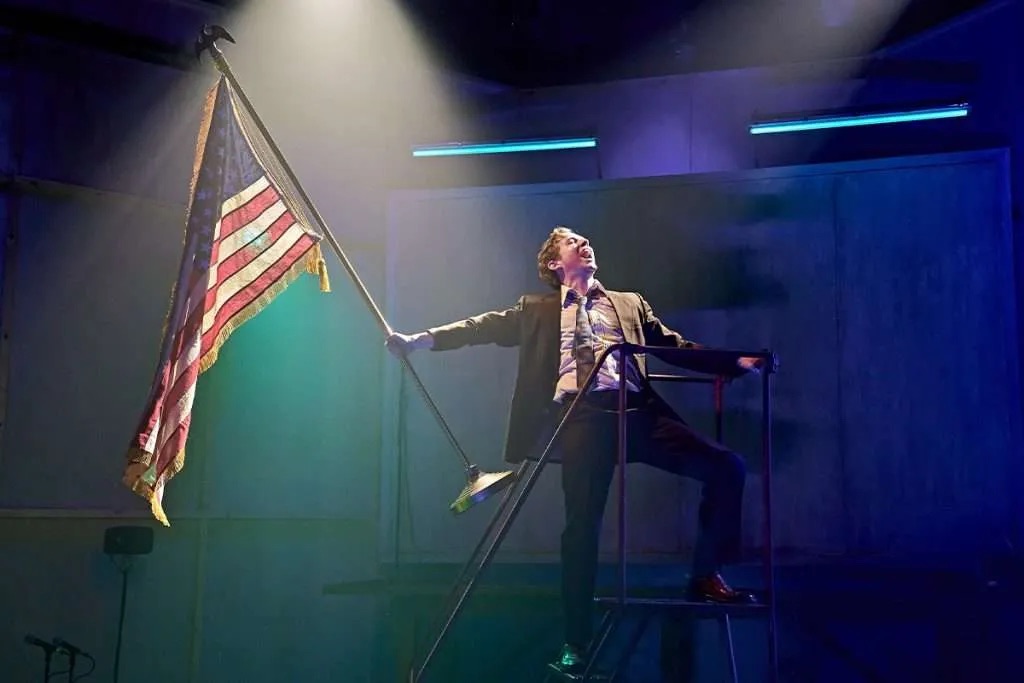
Boop!, Real Women Have Curves, La Cage Aux Folles, Scissorhandz, Alterations, Smash, Intimate Apparel, Cry-Baby, Unicorn, Here We Are, Punch, The Frogs (all images supplied by productions)
(In alphabetical but not necessarily preferential order)
*
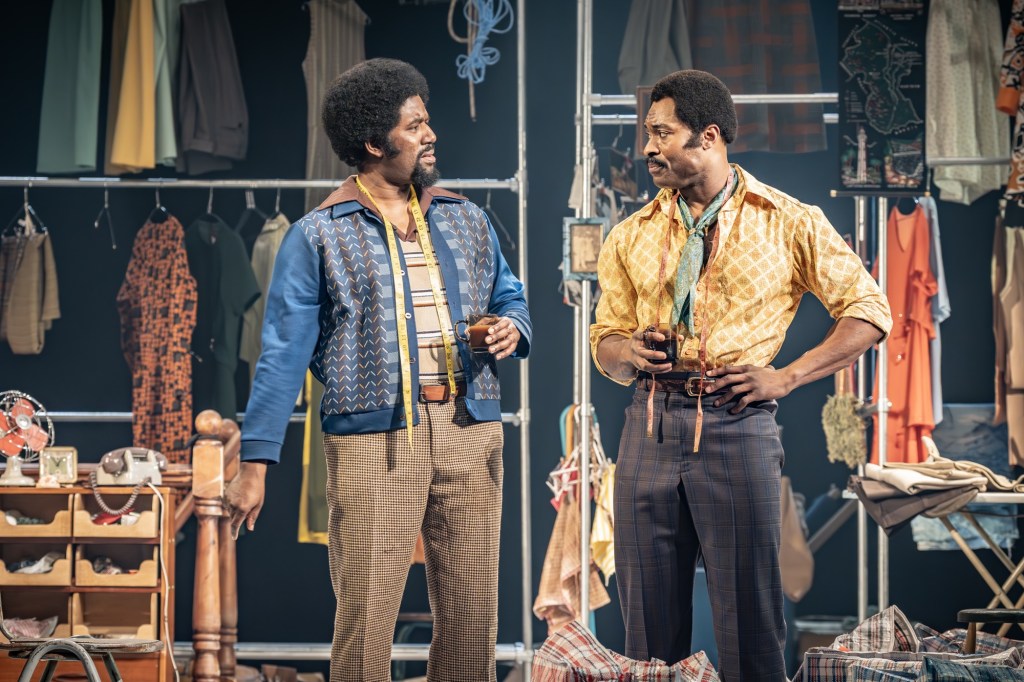
1. ALTERATIONS – National/Lyttelton Theatre, London – 20 February to 25 April
1970s London seen through the eyes of the Windrush generation in Michael Abbensett’s poignant comedy, directed by Lynette Linton whose characteristic attention to detail and ability to coalesce comic and tragic should perfectly match this kind of material. Cast includes Arinzé Kene.
*
2. BOOP! – Broadhurst Theatre, New York City – open-ended run from 11 March
This went down a storm during its Chicago premiere and now David Foster, Bob Martin and Susan Birkenhead’s big band, big budget, big hearted distillation of the beloved cartoon icon heads for New York, staged by Jerry Mitchell. Newcomer Jasmine Amy Rogers looks like a total star as Betty and Tony winner Faith Prince is in the cast.
*
3. CLUELESS – Trafalgar Theatre, London – open-ended run from 15 February
The delightful movie transplanted Jane Austen’s Emma to the gossipy, image-obsessed world of American High School, and comes to the stage in an eagerly awaited new tuner with a score by KT Tunstall. Move over Elle and Regina, here comes Cher. This should be a lot of fun.
*
4. CRY-BABY – Arcola Theatre, London – 3 March to 12 April
Hairspray proved that John Waters movies are an inspired basis for stage musicals, and although this one flopped on Broadway, the score is a jazzy, boppy gem. Plus any musical at the intimate Arcola is a special experience.
*
5. EVITA – London Palladium, London – 14 June to 6 September
Arguably Andrew Lloyd Webber’s greatest score, with Tim Rice’s dazzling lyrics, this thrilling rock opera returns. Jamie Lloyd’s earlier version for Regents Park was an astonishing deconstruction and it will be fascinating to see how his vision translates to the Palladium stage.
*
6. FOLLIES – Grand Opera House, Belfast – 13 to 20 September
Northern Ireland Opera and their AD Cameron Menzies gave us an intelligent, enjoyable Into The Woods a couple of years ago. Now they move on to this most epic of Sondheims, a masterpiece of yearning, nostalgia and exquisitely elegant bitterness, all filtered through the maestro’s take on the Great American Songbook.
*
7. HAMLET – Royal Shakespeare Theatre, Stratford-Upon-Avon – 8 February to 29 March
Rising star Luke Thallon is the latest Prince of Denmark in the Royal Shakespeare Company’s new production, helmed by the endlessly inventive Rupert Goold. Nancy Carroll, one of my favourite actresses, takes on Gertrude.
*
8. HERE WE ARE – National/Lyttelton Theatre, London – 23 April to 28 June
The final Sondheim: already seen in New York and inspired by two Buñuel films, this powerful, unsettling but playful piece is directed by Joe (Wicked) Mantello and has a magnificent cast including Tracie Bennett, Jane Krakowski, Martha Plimpton, Jesse Tyler Ferguson and Denis O’Hare.
*
9. INTIMATE APPAREL – Donmar Warehouse, London – 20 June to 9 August
Pulitzer Prize winning Lynn Nottage is one of the greatest living American playwrights so this lyrical 2003 piece, last seen here over a decade ago, will be a must-see, especially as Nottage’s inspired long term collaborator Lynette Linton directs. The production also marks the London stage return of acclaimed American actress Samira Wiley.
*
10. KYOTO – @sohoplace, London – 9 January to 3 May
Eagerly awaited West End transfer for Joe Murphy and Joe Robertson’s much lauded climate change drama. A triumphant popular and critical hit for the RSC, this is a major theatrical event.
*
11. LA CAGE AUX FOLLES – Theatre du Châtelet, Paris – 5 December to 10 January 2026
Acclaimed French screen and stage star Laurent Lafitte leads as Alvin/Zaza in a brand new production of Jerry Herman and Harvey Fierstein’s joyful, heartfelt Broadway extravaganza at this most opulent and atmospheric of Parisian venues.
*
12. MURIEL’S WEDDING – Curve Theatre, Leicester – 10 April to 10 May
Already a smash hit in Sydney, this stage musical version of the beloved cult movie arrives in the UK with Simon Phillips and Andrew Hallsworth (director and choreographer of Priscilla on stage) reprising their original work. The score is a mix of original songs and ABBA classics.
*
13. PUNCH – Young Vic, London – 1 March to 26 April
Any new James Graham play is an event, and this was hugely well received in its Nottingham premiere. Exploring the seismic consequences on a youngster’s life of an ill-considered one off punch, Adam Penford’s production features the glorious Julie Hesmondhalgh.
*
14. PURPOSE – Hayes Theatre, NYC – 25 February to 6 July
Phylicia Rashad directs the new play from one of America’s most exciting writers Branden (Appropriate, An Octoroon, The Comeuppance) Jacob-Jenkins. This family drama originated at Chicago’s Steppenwolf Theatre, and the Broadway company includes LaTanya Richardson Jackson and Tony winner Kara Young.
*
15. REAL WOMEN HAVE CURVES – James Earl Jones Theatre, NYC – open/ended run from 1 April
With its themes of strong fabulous women, immigration and pursuing your dreams, this musicalisation of the landmark indie film could hardly be more timely. The Boston ART premiere last year was raved about, and Joy Huerta and Benjamin Velez’s Latin-flavoured score is entrancing.
*
16. SCISSORHANDZ – Southwark Playhouse/Elephant, London – 23 January to 29 March
With a starry team of producers including Michelle Visage and Lance Bass, this celebration of the adored Tim Burton movie about the macabre but gentle misfit is packed with pop hits, and looks set to become a real fan favourite.
*
17. SING STREET – Lyric Hammersmith Theatre, London – 8 July to 23 August
This 1980s Dublin-set tale of the thrill of young love and the transformative power of music, based on the film and with a score full of bangers, had its planned Broadway debut scuppered by the pandemic, but here it is in London. This sounds like a real winner (and good luck with getting ‘Drive It Like You Stole It’ out of your head once you’ve heard it).
*
18. SMASH – Imperial Theatre, NYC – open-ended run from 11 March
The TV series was every Broadway lover’s dream and now here comes the ACTUAL Broadway musical about the show-within-a-show. The pedigree is fabulous: score by the Hairspray creators, staging by Tony winner Susan Stroman and a cast featuring some of the main stem’s finest including Robyn Hurder, Brooks Ashmanksas, Krysta Rodriguez and Kristen Nielsen.
*
19. THE FROGS – Southwark Playhouse/Borough – 23 May to 28 June
Another Sondheim and I make no apology for that! This seldom seen early gem, inspired by an Aristophanes comedy, is a musical satire cum fantasy cum road trip story that asks “can art save civilisation?” Glee’s Kevin McHale makes his UK stage debut.
*
20. UNICORN – Garrick Theatre, London – 4 February to 26 April
New plays premiering in the West End are an increasingly rare thing, but then Mike (Cock, King Charles III) Bartlett is a pretty uncommon playwright. James Macdonald directs a dream team of Nicola Walker, Erin Doherty and Stephen Mangan in this provocative look at polyamory.
Another year of seeing theatre, much of it fabulous, some of it so-so and a couple of absolute disasters (which I’m not going to go into here, but would be happy to talk about in person….)
A special mention to The Curious Case of Benjamin Button, which isn’t on this years list as its earlier incarnation at Southwark Playhouse was on last year’s, but it’s a joy and a thrill to now see it ensconced at the Ambassadors as a fully fledged West End hit. If you haven’t seen it yet, do go….it’s the best new British musical in decades.
Other British musicals I adored this year, but didn’t quite make it to my top ten, were the Old Vic’s surprisingly moving Live Aid nostalgia fest Just For One Day (transferring to the West End’s Shaftesbury next spring), and Babies, a pop-driven musical comedy about teens pretending to parent dolls for a school project, that punched well above its weight.
There was the grand Palladium revival of Hello, Dolly! with Imelda Staunton and an outstanding cast, which was on a scale we seldom see these days, and West End and Broadway smashes & Juliet and Come From Away headed out on UK tour with new casts every bit the equal of (and in a couple of instances, superior to) their predecessors. Billy Crudup made an accomplished London debut in the off-Broadway import, solo Harry Clarke which was a dazzling example of simple but essential storytelling.
As of Shakespeare, the Globe gave us a rapturous Much Ado About Nothing which felt almost radical thanks to its adherence to Elizabethan dress (seldom seen these days!) but truly fresh in its unusually complex but entirely delightful new take on Beatrice and Benedick (Amalia Vitale and Ekow Quartey, both irresistible). Then the National’s monumental, African-tinged Coriolanus was an autumn highlight.
The National also gave us a searing modern take on Antigone, with Alexander Zeldin’s The Other Place featuring an incandescent Emma D’Arcy, and the life-enhancing American play The Hot Wing King by Katori Hall. Another glorious piece of writing from a female African American writer was the Donmar’s Skeleton Crew, Dominique Morisseau’s engrossing, humane Rust Belt drama, featuring an astonishing cast.
In West London, the Finborough had another strong year with a triumphant rediscovery of Sidney Howard’s American family drama The Silver Cord in a flawless revival and Foam, Henry McDonald’s intense, fact-based examination of far right politics versus gay identity leading their list of must-sees, or rather, should-have-seens if you didn’t. Just a mile or so away, the Bush’s riveting, satisfying My Father’s Fable proved that rising star Faith Omole is as fine a writer as she is an actor. For me, the jewel in the Lyric Hammersmith’s 2024 crown was a world class revival of Brian Friel’s Faith Healer, dominated by a laser- sharp, unforgettable Justine Mitchell.
Further afield, the Rose in Kingston and Northampton Theatres collaborated on a fine, unsettling stage version of Kazuo Ishiguro’s Never Let Me Go, and while everyone’s talking about the National’s outrageous, technicolour Importance of Being Earnest, for me the wildest Wilde of the year was the Manchester Royal Exchange’s joyous but thoughtful update which saw Cecily as a TikTok-er, a Trustafarian Jack, and Lady Bracknell as a briskly brutal Home Counties matron in Barbour jacket and pearls.
I’ll never forget the enchanting new Broadway sleeper hit Maybe Happy Ending with Darren Criss and newcomer Helen J Shen breaking hearts as a couple of failing robots dealing with some very human problems. There was a great deal of robust fun, as well as lashings of blood plus legs crossed in discomfort, at off-Broadway’s Teeth, a rollicking rock musical based on a notorious gorefest (think vagina dentata meets Little Shop of Horrors) which should have run for years but ends its run next week. It would be a great fit for Southwark Playhouse, just saying… Then there were few things I laughed at as much as at the Chicago Shakespeare Theatre’s world premiere of Rob Ulin’s sit-comy but fabulous Judgement Day with Jason Alexander as an amoral lawyer trying to mend his ways to avoid eternal damnation and finding that doing good is a lot more powerful than he expected. It was an absolute treat and, like Alexander’s gleeful creation, thoroughly deserves a further life.
So that was a lot of what I loved this year, but here’s my top twenty of 2024, in alphabetical but not necessarily preferential order….
*
1 AN ENEMY OF THE PEOPLE – Duke of York’s, London – closed 13 April
Photograph by Manuel Harlan
Less a revival than a full scale reinvigoration, this thrilling European adaptation, starring Matt Smith for London, brought Ibsen’s climate crisis tragedy worryingly up-to-date.
*
2 BETWEEN RIVERSIDE AND CRAZY – Hampstead, London – ended 15 June
Photograph by Johan Persson
Stephen Adly Gurgis’s magnificently grimy yet magical Manhattan family tragicomedy received an overdue but rambunctiously enjoyable UK premiere.
*
3 BRACE BRACE – Royal Court Upstairs, London – ended 9 November
Photograph by Helen Murray
Oli Forsyth’s taut thriller, inspired by true events, examined how humans process trauma. Daniel Raggett’s hyper-focused staging featured terrific acting and a hair-raising approximation of a plane crash.
*
4 CABLE STREET – Southwark Playhouse, London – ended 10 October
Photograph by Jane Hobson
I doubt we’ve seen the last of this exciting British musical that played two sold out seasons. Retelling the story of the 1936 Battle of Cable Street where multicultural East Enders joined forces to defeat the fascists, it’s London’s own Les Mis.
*
5 CYRANO – Park, London – playing NOW until 11 January 2025
Photograph by Mihaela Bodlovic
Already a deserved smash in Australia and Edinburgh, this anachronistic queer riff on Rostand’s beloved text honours the original but repaints it with rainbow coloured joy for the 21st century. Writer and star Virginia Gay is the real deal.
6 DEATH BECOMES HER – Lunt-Fontanne, NYC – playing NOW in an open-ended run
Photograph by Matthew Murphy and Evan Zimmerman
High camp done right: caught this musical adaptation of the Meryl Streep-Goldie Hawn movie in its Chicago tryout and it was already fabulous but it’s been gloriously fine-tuned for Broadway. Megan Hilty and Jennifer Simard are gorgeous, glamorous…and deadly.
7 FIDDLER ON THE ROOF – Regents Park Open Air, London – ended 28 September
Photograph by Marc Brenner
Jordan Fein’s soul-stirring revival of the Broadway classic was that unique thing: a supremely intelligent and moving take on a familiar show that gave traditionalists everything they needed but still provided fresh insights.
*
8 GIANT – Royal Court, London – ended 16 November : reopens Apollo, London 26 April 2025
Photograph by Manuel Harlan
Mark Rosenblatt’s brilliant debut put the artistry and the antisemitism of literary titan Roald Dahl under the microscope. It feels like an instant modern classic elevated even higher by John Lithgow and a peerless cast.
9 HELLS KITCHEN – Shubert, NYC – playing NOW in an open-ended run
Photograph by Marc J Franklin
Simultaneously a thunderous Valentine to one of Manhattan’s most vibrant quarters and a jubilant celebration of Alicia Keys’s history and back catalogue, this is so exhilarating it’s practically an out-of-body experience.
10 JESUS CHRIST SUPERSTAR – Delamar, Amsterdam, Netherlands and touring – ended 17 November
Photograph by Jan Versweyveld
Ivo van Hove’s gritty, blood soaked Jesus Christ Superstar (with not a single camera or video screen in sight!) in the Netherlands (but performed in English), seemed less about religion than collective responsibility, and it was enthralling.
*
11 KING LEAR – Almeida, London – ended 30 March
Photograph by Marc Brenner
Danny Sapani was an astounding Lear in a Yael Farber production that was an object lesson in how to update and recontextualise Shakespeare without sacrificing urgency, clarity or poetry.
*
12 NATASHA, PIERRE & THE GREAT COMET OF 1812 – Donmar, London – playing NOW until 8 February 2025
Photograph by Manuel Harlan
It’s sold out but keep trying for returns for this intoxicating American musical culled from a section of War And Peace, given a marvellously chic and eccentric staging by the Donmar’s new AD Tim Sheader.
13 OH, MARY! – Lyceum, NYC – playing NOW until 28 June 2025
Photograph by Emilio Madrid
The off-Broadway show that could! Who knew that a stage life of deeply unhappy First Lady Mary Todd Lincoln could be this much fun. Oh, Mary! has rightly catapulted writer and star Cole Escola to mainstream stardom. An absolute riot.
14 SHIFTERS – Bush, London then Duke of York’s, London – ended 12 October
Photograph by Craig Fuller
Benedict Lombe’s heart meltingly beautiful love song cum memory play moved around in time but never confusingly. Heather Agyepong and Tosin Cole burned bright in Lynette Linton’s generous, supple staging.
*
15 STEREOPHONIC – John Golden, NYC – playing NOW until 12 January 2025
Photograph by Julieta Cervantes
Another instant classic, but this time on the other side of the Pond (though allegedly headed to London in 2025). David Adjmi’s remarkable dissection of a rock band recording an iconic album is like the most riveting fly-on-the-wall documentary.
16 THE CABINET MINISTER – Menier Chocolate Factory, London – ended 16 November
Photograph by Tristram Kenton
With her barnstorming central turn in this triumphant Pinero reclamation, Nancy Carroll reconfirmed her position as heiress apparent to the high comedy mantle of Dame Maggie Smith. She also did the naughty but nice adaptation and Paul Foster helmed a production that felt simultaneously timely and sparklingly escapist.
*
17 THE FEAR OF 13 – Donmar Warehouse, London – ended 30 November
Photograph by Manuel Harlan
Oscar winner Adrien Brody made a coruscating stage bow in Lindsey Ferrentino’s riveting true life tale of injustice and wrongful imprisonment, given a cracking staging by Justin Martin featuring another incandescent debut from Nana Mensah.
*
18 THE OUTSIDERS – Bernard B Jacobs, NYC – playing NOW in an open-ended run
Photograph by Matthew Murphy
Winner of this years Best Musical Tony award, this adaptation of S E Hinton’s beloved novel is a real beauty. A dark but uplifting coming-of- age tale set in late 1960s Oklahoma, the score is bluesily haunting and Dayna Taylor’s staging stuns.
19 THE PRODUCERS – Menier Chocolate Factory, London – playing NOW until 1 March 2025
Photograph by Manuel Harlan
Director Patrick Marber and choreographer Lorin Latarro may be delivering a scaled down version of Mel Brooks’s anarchic tuner but it’s every bit as wonderful as Susan Stroman’s original extravaganza.
20 TILL THE STARS COME DOWN – National Theatre/Dorfman, London – ended 16 March
Photograph by Manuel Harlan
Beth Steel’s engrossing, hilarious play combined warring sisters, the state of the nation and a wedding from hell to tumultuous, unforgettable effect. The writing, the performances, the staging…all exemplary. A gem.
Edmond Rostand’s big-nosed, poetry spouting swashbuckler gets a gay, feminist makeover in this delightful update, and it’s one of the most life-enhancing things on any current London stage. Author and star (although Cyrano is very much an ensemble piece), Australian multi-hyphenate Virginia Gay takes Rostand’s beloved, but increasingly problematic, tale and drags it, not so much kicking and screaming as giggling and winking, into the 21st century, with illuminating results.
Refocusing Cyrano, the scholar, bon viveur and wit, always “the most interesting person in the room”, as a high achieving, slightly intimidating, queer outsider makes perfect sense. This Cyrano is popular and charismatic, but she feels like an observer, a bystander, watching other people’s lives but not fully participating in her own by dint, she thinks, of her facial abnormality: as with the acclaimed Jamie Lloyd-James McAvoy modernisation a few years ago, there’s no prosthetic nose, just plenty of textual reminders.
Gay’s Cyrano is irresistibly funny and warm, but the vein of melancholy running through her is keenly felt, as is the sudden, shocking aggression that comes to the fore in moments of conflict or sheer frustration at the idiocy of her intellectual inferiors (Tanvir Virmani’s adorably kookie chorus member is a regular recipient of her ire). Gay’s is a complex, psychologically acute portrayal that honours Rostand’s original creation while making this Cyrano very much her own woman. Crucially, we care about her very much right from the beginning.
Equally her own woman is Jessica Whitehurst’s terrific Roxanne. Far from the cosseted princess of Rostand’s Cyrano de Bergerac, she is a sexy, self aware, feisty young woman who’s kind but doesn’t suffer fools gladly. It’s all too easy to see why Cyrano and Christian, the soldier whose flawless exterior doesn’t match the apparent command of poetic language that makes Roxanne weak at the knees, fall for her.
Yan – short for Christian – is played as a muscular, bluntly spoken Mancunian, more brawn than brains, but not without sensitivity. Joseph Evans renders his cluelessness surprisingly charming, and makes something really touching out of the realisation that Roxanne will never love his authentic self as much as he wants and needs her to.
The choric trio that sets the scene and comments on the action, and on the choices of the principal characters, is another source of joy. Virmani’s gauche youngster, rampantly hot for Yan and unable to remember her own name when challenged, Tessa Wong’s cute bossyboots and David Tarkenter’s world weary old stager, all have shining comic moments and make a wonderfully mismatched team.
To house this freewheeling, consistently enchanting riff on a classic, Gay and director Clare Watson have created a slightly unhinged, supremely theatrical world, one where the improbable just keeps happening. It’s a milieu where the austerity of a bare stage transforms into a hedonistic dancefloor in the blink of an eye, where the company gathered around a battered old piano unexpectedly breaks into exquisite multiple part harmony versions of pop songs, where an apparently buttoned-up cast member suddenly and hilariously starts expressing himself via interpretive dance, and where the entire audience find themselves as party guests, decked out with streamers and paper hats, while glitter falls from the flies. The sense of goodwill and lunatic magic makes the genuinely dramatic moments fall into sharp, potent relief. This is a play and production that satisfies on every level.
That’s especially true of the central plot development where Cyrano and Christian effectively gaslight Roxanne into falling for the latter. It may have felt romantic and noble in Rostand’s day but it doesn’t play so well in the age of #MeToo. Whitehurst’s fury and disappointment when she discovers the duplicity is authentically powerful. When one of the chorus asks what happens next, Gay’s Cyrano, with a combination of sullenness and shame, mutters “I die so she has to forgive me”. Mercifully that’s not the fate of this poetic dreamer and a tragedy is turned into a celebration of self realisation and forgiveness.
Gay’s script is a wondrous thing, riotously funny when it seeks to be but emotionally deft. It’s also tremendously erotic. With the highly amusing interjections from the chorus, this Cyrano is as much an examination of the nature of theatrical storytelling as it is a reinvention of the beloved romantic classic.
Watson’s intimate staging, a smash hit at the Edinburgh Festival this year and it’s easy to see why, is bold and inventive, slick enough for us to know we’re in the hands of real artists but rough-around-the-edges enough to ensure moments of real surprise, and it moves at a cracking pace. Andy Purves’s mood-shifting lighting, Toby Young’s sound, Amanda Stoodley’s unfussy designs and Paul Herbert’s glorious musical direction all combine with staging and performances to create the impression of that rare, exhilarating theatrical beast where everyone involved is singing from the same joyous hymn-sheet.
The ninety magical minutes fly by, you’ll laugh a lot, maybe cry a little, and emerge uplifted with a fresh perspective on a well known story and unequivocally fall in love with this cast. As much as a love story and a queer affirmation, it’s an exhortation to grab life by the balls. At the conclusion, I had tears in my eyes and couldn’t wipe the soppy grin off my face: I simply cannot recommend this highly enough.
When theatregoers refer to Stoppard as intimidatingly clever, it’s plays like this 1997 meditation on poetry, classicism and the regrets of a life not fully lived that helped cement that reputation. Really though, The Invention of Love is about, well, love; love in its purest form. It’s dressed up with Stoppard’s customary verbal dexterity and mind-bogglingly detailed background research and knowledge, but it’s hard to miss the beating, broken heart at its core.
Simon Russell Beale plays scholar and poet A E Housman, first seen after his death in 1936, being ferried across the River Styx into the afterlife (“I’m dead, then. Good. And this is the Stygian gloom one has heard so much about”) by a wry Charon (Alan Williams, very funny). Instead of eternity though, Housman is transported back to a vision of his younger self (a wonderfully gauche and earnest Matthew Tennyson) and his contemporaries at Oxford University in the mid nineteenth century. While the academics debate the High Victorianism in literature, art and morality versus the Aesthetic movement, prizing beauty over function and spearheaded by Dickie Beau’s flamboyant, whip-smart Oscar Wilde, youthful Housman is equally preoccupied with his covert, unrequited love for an athletic fellow student.
Stoppard’s cerebral script is peppered with aphorisms, literary quotes and Latin, and Blanche McIntyre’s chilly staging zips it along at as spritely a pace as possible but ultimately can’t, or possibly isn’t interested in, disguising the fact that this is a pretty static piece, characterised mostly by men talking. That’s not the only way in which it feels defiantly unfashionable: for starters, there’s the length (three hours including interval); then the fact that, for all the youth of many of the principal figures and the forbidden carnal urges represented, the play remains determinedly unsexy.
It is however a feast of fine acting. Tennyson breaks down most affectingly when confessing his love for Ben Lloyd-Hughes’s bewildered, likeable, sporty Jackson. A superb trio of actors – Jonnie Broadbent, Stephen Boxer and Dominic Rowan – brilliantly differentiate between a series of wittily pontificating literary and academic figures. Dickie Beau’s Oscar Wilde is a brittle, volatile creation (“better a fallen rocket than never a burst of light”), supremely stylish but with a hint of real anguish, and his scene with a rueful Housman, bringing the contrasts between their very different approaches to their (at the time) illegal sexuality, into sharp, unforgiving relief, is the most engrossing and moving in the play.
Few, if any, actors are as adept as Simon Russell Beale at conveying roiling feeling under a facade of unimpeachable urbanity and ferocious intelligence, tempered with irresistible sweetness and humour. He’s in his element here, as a sympathetic, all too human Housman. As with his triumphant, Tony-nominated turn in the same author’s Jumpers as the emotionally stunted philosopher whose marriage is imploding, he gives us a fully realised intellectual who we can see and feel thinking….and suffering. It’s a beautiful performance.
McIntyre’s production falls between the impressionistic and the overly literal: men play billiards in a rectangular slice of light, small set pieces fuse together to make boats drifting down the Cherwell (or is it the Thames…or the Styx?!), party streamers and a half populated tea table descend for the Oscar Wilde section, benches on green banks judder clumsily into view. I think the idea is that these are fragments of memory in the minds eye, but the lack of flow and enchantment in McIntyre’s staging and Morgan Large’s generally uninspired design (dimly lit by Peter Mumford) means that it sometimes feels frustratingly unfocused. Richard Eyre’s original National Theatre production had a painterly quality, and a degree of that aesthetic pleasure wouldn’t go amiss here.
This is very much a night ‘on’, and it clearly won’t be for everybody but watching actors of the calibre of Beale and his cast mates is always a pleasure. Stoppard’s writing has an elegant ferocity, butn the theatricality that adds an irresistible tang to much of the rest of his esteemed canon is mostly missing here. The emotional undertow is there though…you just have to work to get at it.
This surprising, affecting Cat On A Hot Tin Roof is the apotheosis of Rebecca Frecknall’s deconstructed Tennessee Williams trilogy for the Almeida. Where her 2018 Summer And Smoke elevated a B-grade play to something profound and moving, and the Paul Mezcal-Patsy Ferran Streetcar (returning briefly to the West End in 2025 before heading to NYC) found a humanity beneath the archetypes of Stanley and Blanche, this Cat refocuses the relationships in a play that, although written with Williams’s characteristic bruised poeticism, can sometimes feel excessively precious and long winded.
True to form, Frecknall goes for style and expressionism over the cooking heat that usually typifies this play. Some of it’s a bit heavy handed (having Daisy Edgar-Jones’s Maggie the cat crawling about like a real feline scores few points for subtlety) but this is an infinitely more satisfying version than the last London production in 2017 which saw Jack O’Connell and Sienna Miller as its photogenic Brick and Maggie wandering around naked on a bizarre, copper-coloured set that rendered more than half of the dialogue inaudible.
The first act is essentially a monologue for Maggie as she berates, cajoles and tries to get through to her increasingly catatonic husband, tortured former sports star Brick, while his plantation owner father’s birthday party is in full swing throughout the house outside their bedroom. I’ve seen it defeat more seasoned stage actresses than Edgar-Jones but she acquits herself magnificently here, even though she seems a little youthful. With her flashing dark eyes and auburn mane, red talons and sheer slip, she looks like a debauched version of Anne Hathaway (the film star), and she captures with graceful precision and piercing emotional acuity Maggie’s mix of sensuousness, anxiety and desperation. There’s a compelling vulnerability too: note the way she sucks her breath back in almost before it has left her body. She knows she has lost Brick already but is too self possessed to admit defeat.
Frecknall has the words delivered against the steady tick-tock of the metronome sitting atop the grand piano that dominates Chloe Lamford’s austere set. It’s a hypnotic effect that lulls us into a false sense of peace before the piano keyboard takes an absolute pounding at moments of high stress and conflict. Frecknall’s earlier Williams stagings employed music in a similar way.
She also reuses the convention of having a named but usually unseen character as a constant onstage presence. Personally, I thought having Skipper (a magnetic Seb Carrington), Brick’s best buddy (and something more) who drank himself to death, close to the centre of the action, playing piano, observing the marital tussles of the central couple, and getting progressively more soused, was the most potent example yet of this storytelling device. There’s a moment in the second half when Kingsley Ben-Adir’s Brick, drunk, in deep despair and cowering from yet another volley of recriminations, sinks down onto the piano stool and Skipper tenderly puts his arms around him. It’s a heart-piercing image that’s worth a thousand words, even when the words are as beautiful as Tennessee’s.
Good as Edgar-Jones is, this production decentralises Maggie to the extent that after the first act she effectively becomes just another bystander to Brick’s ongoing dance of death with the bottle and his beloved, lost Skipper. I have never seen a more moving or dangerous Brick than Ben-Adir. Out of his mind and on a clear course to self-destruction from the get-go, his torment and misery writ large across his features, he also conveys with devastating clarity the character’s detachment and his casual cruelty. He’s pitiful but you can’t take your eyes off him.
The centrepiece, arguably of the somewhat unwieldy script but undoubtedly of this production, is the electrifying showdown between Brick and his father. Usually a feast of grandstanding and recriminations, here it’s repurposed as a much more sensitive exchange, charged with implicit understanding (look out for the brief but astonishing moment when Big Daddy talks about tolerance). Lennie James is utterly brilliant as a man able to turn on a dime between kindness and cruelty. James makes obvious but never overplays the cancer eating him up from the inside and to which he is oblivious, and his irascible disrespect towards his long-suffering vulgarian wife (a strangely sympathetic Clare Burt, absolutely terrific) is superbly done.
This isn’t colour blind casting either: this wealthy black man has worked his way up from the lowliest positions in the plantation to being master of all he surveys, and it results in a more compassionate and multi-layered reading of the role than usual, and James is turning in a truly great performance. There’s magnificent support too from Ukweli Roach as the feckless, overlooked other son, Pearl Chanda as his envious, endlessly fertile wife (here given an intriguingly ambiguous attitude towards the more glamorous Maggie) and Guy Burgess as a hilariously fey local preacher.
Hugely watchable as this is, and at times it is completely riveting, I do think Frecknall has reached the end of the road with Williams and his ghosts. I also don’t think I’ll ever see a finer Brick and Big Daddy than Ben-Adir and James. Nor will I be able to forget the look on Burt’s face when she learns the truth about her husband’s health.
The three hours pretty much fly by and it all holds together: it’s just not necessarily the Cat On A Hot Tin Roof that we all thought that we knew.