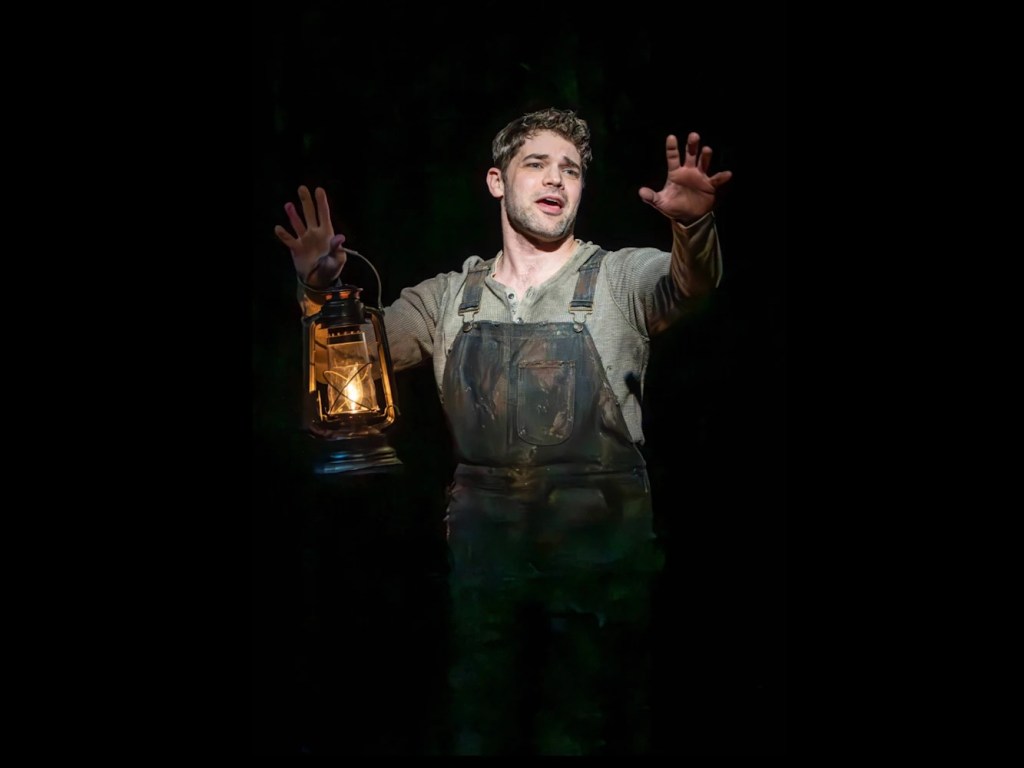
FLOYD COLLINS
Music and lyrics by Adam Guettel
Book, additional lyrics, and direction by Tina Landau
Lincoln Center Theater at the Vivian Beaumont, New York City – until 22 June 2025
running time: 2 hours 35 minutes including interval
https://www.lct.org/shows/floyd-collins/
Making its Broadway bow almost twenty years after premiering, Adam Guettel and Tina Landau’s meditative, anti-melodic folk opera, slightly revised, stakes a potent claim to be considered as the very pinnacle of modern American music theatre, right up there next to Ragtime (strongly rumoured to be next onto Lincoln Center’s Beaumont stage) and Parade. In Landau’s sublime, perfectly cast staging, Floyd Collins emerges as a true masterpiece. Musically dissonant and unpredictable, and dramatically sometimes inert, it steadfastly refuses to ingratiate but meet it half way (more than half way actually) and it will make your heart soar before shattering it.
Only Lincoln Center has the resources to mount this fascinating, frustrating beauty of a show on this scale, and my goodness it’s special. I’ve seen productions of Floyd Collins that better convey the sense of claustrophobia inherent in the true story of the intrepid Kentucky caver who perished underground aged only 37, but I’ve never appreciated the majesty, drama and sheer originality of this extraordinary musical until seeing and hearing this profoundly affecting rendering.
Landau, working harmoniously with set designing collective dots, lighting genius Scott Zielinski and projection artist Ruey Horng Sun utilise the Beaumont’s vast space with a combination of intelligence, economy and theatrical bravura that takes the breath away. The hard scrabble existence of rural Kentucky folk is keenly felt as is the contrast between Floyd’s physical entrapment and the carnival-esque goings-on above ground as his predicament is turned into a media circus. Then there’s the flights of fancy in Floyd’s own head, mostly involving his fragile, lovely younger sister Nellie (Lizzy McAlpine in a luminous, heart-catching Broadway debut), here reimagined as a beautiful and benign angel of death. The mixture of grit and the ethereal is totally compelling. Guettel’s music is seldom easy on the ear but its restless, surging, quicksilver insistence is authentically marvellous.
Floyd Collins is a defiantly uncommercial property as large scale musicals go, but its major selling point for this big Broadway reboot is the casting of Jeremy Jordan in the title role… and he is only fantastic. His rock star charisma and thrilling vocal range fit astoundingly well to a character who actually spends the majority of the performance trapped statically in one position. His pain and despair are devastatingly vivid, and the moments where Floyd sees himself in a former life, frolicking with his brother Homer (Jason Gotay, utterly wonderful) or examining his entire life and death philosophy (the concluding aria ‘How Glory Goes’, tear-jerking and magical) verge on the transcendent. Jordan has never been better than this, and the role will probably never again be performed this well. They may as well start engraving his name on the Tony award right now; even in a strong season for leading men (Jonathan Groff, Darren Criss, Tom Francis…) Jordan is a force to reckon with.
It’s not just the Jeremy Jordan show though (although, Gawd knows, that would be enough) – the casting from top to bottom is utterly flawless. As well as the aforementioned McAlpine and Gotay, Landau prises detailed, acute work from Sean Allan Krill (who really deserves to be a major star) as the embattled leader of Floyd’s rescue mission, Jessica Molaskey as his spiky but kind step mother and Kevin Bernard (brilliantly understudying Marc Kudisch at the performance I saw) as his gruff father. Then there’s Taylor Trensch delivering career-best work (so far) as the news reporter who gets more emotionally involved in Floyd’s plight than is convenient or advisable. Trensch’s Skeets Miller is the conduit between the audience and Collins’s horrible fate, and he is a marvel: so sympathetic and funny, and deeply moving. He’s a constant reminder of how much is at stake.
Directing her own work, Landau patches together the gear changes between melancholic contemplation and Kander and Ebb-esque acid (the witty trio of reporters Dwayne Cooper, Jeremy Davis, Charlie Franklin – all laser-sharp) better than any other interpreter I’ve encountered, of this tricky but ineffably worthwhile piece of musical theatre. This isn’t feel-good theatre, it’s feel-EVERYTHING theatre, and this is a production to treasure. Challenging but so so beautiful. If you’re a musical theatre aficionado visiting New York, this has to be at the top of your must-see list.
 ajhlovestheatre